AI Agent Development Services for Business Workflows
Explore AI agent development services for business workflows: learn about integrations, security, testing, and choosing the right automation approach.

A workflow that changes with the situation needs more than fixed automation. An AI agent can interpret a task, decide what to do next, and use tools or business systems within defined boundaries. AI agent development services turn that capability into software designed around a business workflow.
It’s reasonable to expect automation to follow clear rules. The difference is that traditional automation follows predefined steps, while an AI agent can assess context and select an action. That flexibility makes a clear scope, limited permissions, and human review essential parts of the design.
This article explains what agents do, where they differ from automation and chatbots, and which development services and specialties may fit different business needs. It also covers how teams connect agents to existing systems, set operating boundaries, test performance, and decide whether a focused agent is the right next step.
Key Takeaways
- Map the workflow, data, and systems an agent must use before deciding where it can act independently and where approval is needed.
- Choose rule-based automation for stable, predictable steps; consider an agent when a workflow needs context-sensitive decisions.
- Match the development approach to the work, from a focused single-agent task to a more complex system with several coordinated components.
- Use a focused business workflow to define the scope of custom software, internal tools, or an MVP, then plan for launch and support.
Table of Contents
- Agent capabilities, security, and integration
- What’s the difference between AI automation development and AI agent development?
- Custom AI agent development companies and their specializations
- AI agent development service offerings
- Sydeso: Custom software development
Agent capabilities, security, and integration
An agent can gather data, choose a next step, and act through connected tools. Its useful scope depends on system access, decision boundaries, and review controls.
Agent Capabilities and Efficiency
Agents can coordinate workflows, flag exceptions, track status, and draft structured reports. For example, an operations agent could check ERP records, detect a stock issue, and prepare a reorder for approval. Assess which handoffs it removes and which decisions should remain with staff. Integrations with CRMs, ticketing systems, and internal knowledge sources determine whether the agent can use current information.
Efficiency depends on more than the model. Define the task, data sources, tools, and success measures before testing. Validate performance across varied scenarios, including incomplete records and unusual requests. A sandbox or simulated environment can expose security issues and weak responses before deployment.
Permissions and Human Oversight
Set permissions for specific actions rather than granting broad system access. An agent that drafts a supplier order may need read access to inventory data, while approval controls govern submission. Authentication, encryption, and access controls help limit unauthorized interactions. Audit logs make actions traceable, and approval logic keeps consequential decisions open to review.
Risks include incorrect outputs, unintended actions, and exposure of sensitive data. Manage them with scoped permissions, human review of consequential actions, logging, and realistic testing. Assign someone to review exceptions and define when the agent must stop rather than proceed.
Compliance reviews should map the data, users, and decisions involved in each workflow. The European Commission identifies GDPR and HIPAA as regulations relevant to AI agent compliance. NIST’s 2024 Generative Artificial Intelligence Profile frames governance, mapping, measurement, and management as lifecycle responsibilities. Teams handling sensitive business or customer data can also examine ISO/IEC 27001 certification and a current SOC 2 report when evaluating controls.
Cost and timeline depend on workflow complexity, integration needs, data readiness, model selection, testing, and oversight. A narrow agent using accessible systems takes less design and validation than a multi-system workflow with approval gates.
Connect only the systems the agent needs, then monitor its behavior after deployment. Review logs, error patterns, and user feedback to guide updates. This allows measured expansion without automatically broadening the agent’s permissions.
What’s the difference between AI automation development and AI agent development?
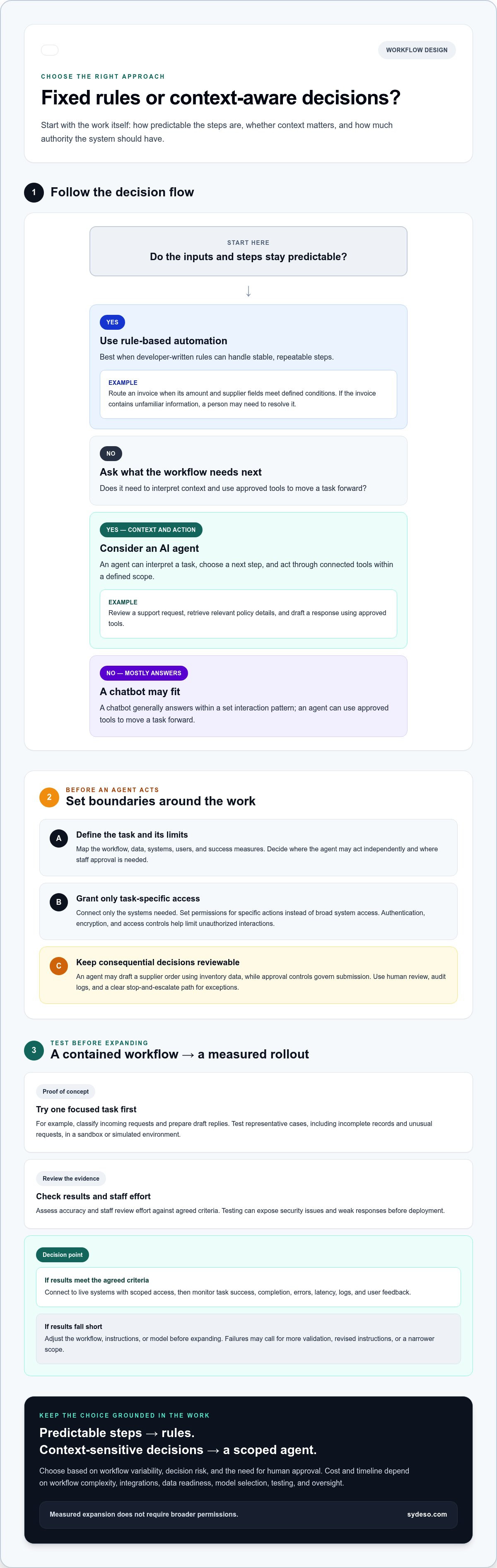
Traditional automation follows developer-written rules and works well when inputs and steps remain predictable. For example, an automation can route an invoice when its amount and supplier fields meet defined conditions. If the invoice contains unfamiliar information, a person may need to resolve it.
An AI agent uses models to interpret context and select actions within a defined scope. For example, it could review a support request, retrieve relevant policy details, and draft a response. A chatbot generally answers within a set interaction pattern; an agent can use approved tools to move a task forward. Choose based on the work’s variability, decision risk, and need for human approval.
Development starts by defining the task, boundaries, users, and success measures. The design maps the agent’s tools and data, including how work passes between steps. Implementation connects those components and sets controls on the agent’s actions. Evaluate a custom AI agent against representative cases, not just ideal inputs.
A proof of concept tests one contained workflow before wider deployment. For example, an organization could start by classifying incoming requests and preparing draft replies, then assess accuracy and staff review effort. If results meet agreed criteria, deployment can connect the agent to live systems with scoped access. If they fall short, adjust the workflow, instructions, or model before expanding.
After deployment, observability helps teams track task success, completion, errors, and latency. Review failures and user feedback to decide whether the agent needs revised instructions, more validation, or a narrower scope. Ongoing management also assigns owners for updates and defines when staff must take over. This ties improvements to measured results rather than assumptions about efficiency.
For workflows that mix fixed steps with context-based decisions, workflow engineering can help define where each approach fits.
Custom AI agent development companies and their specializations
Custom development fits workflows that need specific business rules, system connections, or approval steps. A platform may suit common tasks that require little tailoring.
Project Specializations
Customer service agents can help teams search knowledge bases, sort tickets, draft replies, and escalate cases. Contract-analysis agents can extract clauses, compare terms against defined criteria, and flag exceptions for legal review. For either project, map the source documents, expected output, and decisions that need human review. These details help determine whether the agent should act or prepare work for staff.
Architecture, Technologies, and Models
Agents can be developed with Python or JavaScript and frameworks such as LangChain, LangGraph, CrewAI, AutoGen, BeeAI, or Semantic Kernel. The architecture defines how a model receives context, selects tools, and returns results. Teams commonly start with a pretrained model and tailor it to the task rather than training one from scratch. The right choice depends on the workflow, data, and integration needs.
Data quality shapes an agent’s usefulness. For contract review, organize representative agreements, approved clause definitions, and examples of exceptions. Keep materials relevant to the task and define how the agent should handle missing or conflicting details. A validation set with varied real-world cases can reveal where the agent misreads context before its use expands.
Compare a platform and custom development against the work’s requirements. A standard customer-service task may fit a ready-made tool; an agent that must follow internal approval logic or connect with an ERP may need a tailored architecture. Consider governance, maintenance, and operating boundaries alongside features. Let the workflow, not the appeal of a particular model or framework, guide the decision.
AI agent development service offerings
A complete engagement can cover workflow selection, feasibility, architecture, integration, testing, deployment, and monitoring. Each step answers practical questions: which task needs an agent, which systems it must access, and how staff will review its actions. Define those boundaries before selecting models or building connections.
Discovery turns an operational need into a scoped use case. For example, an agent could gather information from internal sources, prepare a structured status report, and route exceptions to a staff member. Define the expected inputs, acceptable outputs, escalation conditions, and measures of task completion. These decisions establish the agent’s capabilities and limits.
Integration connects the agent to business software and approved data sources. API development can provide a controlled way for existing systems to exchange information. Mapping permissions, data formats, and failure responses helps prevent an unavailable source from blocking the entire workflow. The design should also specify which actions require human approval.
Testing should cover ordinary requests, missing information, conflicting records, and unexpected inputs. A validation set with varied cases helps show whether the agent can handle real operating conditions. Test in a sandbox before deployment, then compare task success, errors, and latency with agreed criteria. This makes changes traceable rather than speculative.
After deployment, monitoring tracks failures, user feedback, and changes in source data. Review these signals to determine whether instructions, integrations, or approval rules need adjustment. A focused release can show whether the agent fits the workflow before its capabilities expand. Expand based on validated results, not the assumption that a faster process is always better.
For a workflow with specific systems or operating rules, plan a tailored agent workflow as a defined software project, with scope, integration, and review needs set from the start.
Sydeso: Custom software development
Sydeso develops custom software for businesses with workflows that need tailored tools and system connections. When an AI agent must follow specific operating rules, custom software or an internal tool can provide structure for its tasks and review process.
For teams still validating a use case, MVP development can help define and test a focused version before wider deployment. When the software is ready, Sydeso’s launch and support service can help bring it into operation. The right next step depends on the workflow, the systems involved, and how staff will oversee the agent.
Contact Sydeso to discuss the workflow you want to improve and the software it may require.
Turn a workflow into a defined next step
Start with one workflow that has a clear owner and a practical measure of success. Document the current handoffs, the systems involved, and the decisions that require human judgment. This gives your team a basis for deciding whether to refine an existing process, test an agent, or build supporting software.
AI agent development services should fit the operating model, not create a separate process that staff must work around. Sydeso offers custom software development, internal tools, and MVP development to support different stages, from shaping a tailored tool to testing a focused product. The next step is to describe the workflow, its constraints, and what a useful outcome would look like.
Bring those details to a conversation with Sydeso. Contact Sydeso about AI agents to discuss a practical direction for your workflow and move forward with a clearly scoped next step.
Frequently Asked Questions
What is an AI Agent?
An AI agent is software that interprets a goal, selects from available actions, and performs work within assigned boundaries. For example, an internal agent could retrieve an expense policy, compare it with a submitted claim, and prepare the case for review. Its next step can depend on the information it receives, unlike a script that always follows the same sequence.
When should you hire a development service?
Bring in a development team when a useful workflow depends on business-specific rules, multiple systems, or controlled decisions. A team can translate the process into technical requirements, connect the necessary software, and validate the result with staff. If a simple rule and one system already handle the task reliably, conventional automation may be the more direct fit.
AI Agents Sound Great, But Where Do You Even Start?
Choose one recurring task and collect examples of completed work, including unusual cases and exceptions. Ask the staff who handle it to mark where they apply judgment or correct information. Then record how the current process is assessed, such as whether requests arrive complete and how often staff must revisit them. These examples give a pilot a grounded test set.
Are AI agents safe for regulated data?
Safety depends on data, permissions, safeguards, and review, so an agent should not receive broad access by default. Limit its access to necessary records and keep sensitive actions subject to human review. The European Commission identifies GDPR and HIPAA as regulations relevant to AI agent compliance. Map the data used and decisions affected before deployment.
Can you build AI agents without writing code?
Yes, no-code tools can support basic agents through visual steps and prebuilt connections, especially for narrow tasks with standard inputs. Their limits emerge when workflows need custom business rules, specialized system connections, or detailed controls. A prototype can test the process, but assess whether its access and review controls are suitable for production.
How Do You Choose a Provider and Plan Maintenance?
Choose a provider that documents the agent’s scope, expected outputs, system access, and handling of failed or unclear cases. Ask for test evidence using representative inputs, not just demonstrations of successful paths. Assign an internal owner to review behavior after release, track issues, and approve changes when business rules, connected systems, or source data change.
Questions
- What is an AI Agent?
- An AI agent is software that interprets a goal, selects from available actions, and performs work within assigned boundaries. For example, an internal agent could retrieve an expense policy, compare it with a submitted claim, and prepare the case for review. Its next step can depend on the information it receives, unlike a script that always follows the same sequence.
- When should you hire a development service?
- Bring in a development team when a useful workflow depends on business-specific rules, multiple systems, or controlled decisions. A team can translate the process into technical requirements, connect the necessary software, and validate the result with staff. If a simple rule and one system already handle the task reliably, conventional automation may be the more direct fit.
- AI Agents Sound Great, But Where Do You Even Start?
- Choose one recurring task and collect examples of completed work, including unusual cases and exceptions. Ask the staff who handle it to mark where they apply judgment or correct information. Then record how the current process is assessed, such as whether requests arrive complete and how often staff must revisit them. These examples give a pilot a grounded test set.
- Are AI agents safe for regulated data?
- Safety depends on data, permissions, safeguards, and review, so an agent should not receive broad access by default. Limit its access to necessary records and keep sensitive actions subject to human review. The European Commission identifies GDPR and HIPAA as regulations relevant to AI agent compliance. Map the data used and decisions affected before deployment.
- Can you build AI agents without writing code?
- Yes, no-code tools can support basic agents through visual steps and prebuilt connections, especially for narrow tasks with standard inputs. Their limits emerge when workflows need custom business rules, specialized system connections, or detailed controls. A prototype can test the process, but assess whether its access and review controls are suitable for production.
- How Do You Choose a Provider and Plan Maintenance?
- Choose a provider that documents the agent’s scope, expected outputs, system access, and handling of failed or unclear cases. Ask for test evidence using representative inputs, not just demonstrations of successful paths. Assign an internal owner to review behavior after release, track issues, and approve changes when business rules, connected systems, or source data change.