API Development Services for Product and Platform Teams
Explore API development services for custom integrations, compare REST, GraphQL, SOAP, gRPC, and WebSocket, and learn how to plan secure, reliable APIs.

A custom API should fit your product’s workflows, not make your team work around it. API development services design and build interfaces that let applications and systems share data and functionality. The scope depends on the systems involved, the access they need, and the work the API must support.
API development is a product and business decision as well as an engineering task. A well-designed API can connect existing tools, support new features, or give teams controlled access to legacy systems. The right approach depends on how those systems need to communicate and how the API will be maintained.
This article explains what custom API development includes, how REST, SOAP, GraphQL, gRPC, and WebSocket differ, and how planning, design, testing, and deployment fit together. It also covers how API decisions support business goals, what shapes delivery effort, and where a software development partner can help.
Key Takeaways
- Define the systems, users, and tasks an API must support before settling on its design.
- Match the API approach to how applications exchange data and how teams need to use it.
- Plan security, testing, and version changes as part of delivery, not as follow-up work.
- Connect API decisions to product priorities, team workflows, and the systems you need to keep in place.
Table of Contents
- What Is Custom API Development?
- REST, SOAP, GraphQL, gRPC, and WebSocket
- API planning, design, testing, and deployment
- API development services and business strategy
- Sydeso
What Is Custom API Development?
Custom API development defines how software systems exchange data and use one another’s functions. Set security, access rules, and monitoring requirements at the outset so they are built into the connection.
Authentication and Access Control
Authentication checks who or what is making an API request. OAuth 2.0 lets an app obtain limited, temporary access to a user’s account without handling the user’s password directly. Access control then limits which resources that identity can use. For example, a reporting tool may read sales records but not change them.
An HTTP 401 status code indicates invalid authentication. Rate limiting controls request volume over a set time period, helping prevent abuse and support fair usage. Agencies can bring coordinated engineering and security work; freelancers offer focused individual capacity, while in-house teams retain direct organizational context and ownership.
Security and Compliance Requirements
In the United States, security and compliance needs depend on the data, users, and business context involved. API design should identify sensitive resources, define permitted access, and document how authentication works. Teams handling healthcare data may need to account for FHIR or HL7 requirements. The applicable controls should be established during planning, not after deployment.
Cost and timeline depend on API scope, system compatibility, security requirements, and testing needs. A small set of stable interfaces typically takes less coordination than connecting legacy platforms with complex access rules. Common risks include incompatible data formats, errors, and downtime as integrations grow. A secure API layer can expose selected legacy data without replacing the whole application.
REST, SOAP, GraphQL, gRPC, and WebSocket
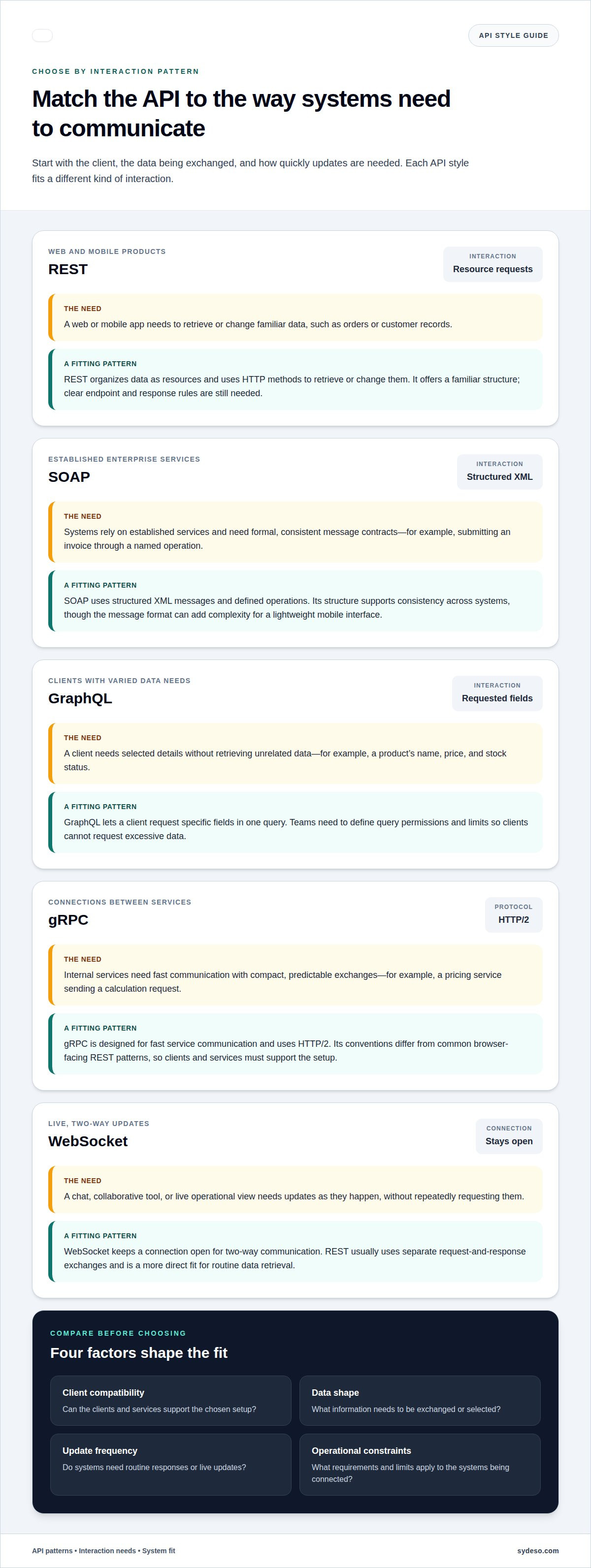
API style shapes how software systems connect, exchange information, and handle changing requirements. REST, SOAP, GraphQL, gRPC, and WebSocket support different interaction patterns. Choose based on the systems involved, the data exchanged, and how quickly each side needs updates.
REST suits many web and mobile products. It organizes data as resources, such as orders or customer records, and uses HTTP methods to retrieve or change them. A mobile app, for example, can request an order resource and receive its current details. REST provides a familiar structure, but teams still need clear endpoint and response rules.
SOAP uses structured XML messages and defined operations. It can suit enterprise environments that rely on established services and formal message contracts. For example, a billing platform might call a named operation to submit an invoice. SOAP’s structure supports consistency across systems, though its message format can add complexity for a lightweight mobile interface.
GraphQL lets a client request specific fields in a single query. A product screen could request an item’s name, price, and stock status without retrieving unrelated details. This flexibility can suit platforms with varied data needs. Teams still need to define query permissions and limits to prevent clients from requesting excessive data.
gRPC is designed for fast communication between services and uses HTTP/2. It can fit internal service connections where compact, predictable exchanges matter. A pricing service, for instance, can send a calculation request to another service. Its conventions differ from common browser-facing REST patterns, so the clients and services must support the chosen setup.
WebSocket keeps a connection open for two-way communication. A dashboard can receive live status changes without repeatedly requesting updates, making WebSocket useful for chat, collaborative tools, or live operational views. REST, by contrast, usually handles separate request-and-response exchanges, so it is a more direct fit for routine data retrieval.
Choose based on client compatibility, data shape, update frequency, and operational constraints. A browser-based catalog may suit REST; a multi-service workflow may benefit from gRPC. For a tailored API integration approach, align the interface with the systems that must connect and the work users need to complete.
API planning, design, testing, and deployment
API development services typically cover requirements, interface design, implementation, testing, deployment, and supporting documentation. This process turns product needs into working endpoints, then checks that they behave as intended.
Planning starts by defining users, systems, data, and required actions. For example, a team might map how an order moves from an online store to a fulfillment platform. That flow helps identify the necessary endpoints, what each request accepts, and what response the calling software should receive.
With contract-first development, teams agree on the API interface before building its implementation. The contract records endpoints, parameters, and expected responses. This shared specification can help reduce integration bugs and refactoring as teams grow, while giving separate teams a consistent basis for their work.
Design should account for future changes. URL path versions such as /v1/ and /v2/ make versions explicit, while a deprecation policy gives users a defined transition. Backward-compatible changes, contract testing, and documented migration guidance can help prevent updates from breaking existing applications.
Testing checks distinct failure points. Unit tests validate individual operations, integration tests check exchanges between connected systems, and performance tests examine behavior under expected workloads. Automated tests can run as code changes are made. For example, a test can confirm that an order endpoint returns the agreed fields and handles invalid input as designed.
Before deployment, validate functional requirements, access behavior, and operational monitoring. Teams can release changes in a controlled environment, review logs for errors, and address defects before wider use. Documentation should explain authentication, endpoints, parameters, request and response examples, error codes, usage limits, version rules, and integration steps.
Delivery time depends on scope and system complexity. A basic REST API with a few endpoints may take 3 to 6 weeks when requirements are clear. A complex API involving legacy integrations, enterprise-grade security, or high call volumes may take 3 to 6 months or longer.
API development services and business strategy
An API is a business boundary as well as a technical interface. It lets separate systems share data and functionality, such as sending an order from a storefront to fulfillment. Strategic planning starts by identifying the business process that needs a connection and the decision or task it should support.
Map the workflow before choosing an implementation. A team might trace how a customer update moves from a support platform to billing and account records. This can reveal duplicate entry, delays, and unclear ownership. The API should address a defined bottleneck or enable a specific product capability, not add another connection without a clear purpose.
Architecture becomes a strategic concern as product teams grow. If deploying one feature requires deploying the entire application, system boundaries may be limiting independent work. If one team’s changes regularly break another team’s work, review the API contracts and ownership. These are practical signals to assess how services should be separated and released.
APIs can extend existing systems without replacing them. A secure layer can expose selected legacy-system data and functionality, allowing a new customer portal to use account information while the core application remains in place. This supports staged modernization when access, data ownership, and maintenance responsibilities are designed into the connection.
Operational visibility connects strategy to actual use. Monitoring can show which integrations are active, where requests fail, and whether workflow automation handles routine tasks as intended. Repeated errors between inventory and order systems, for example, may point to mismatched data or an outdated process. Teams can use that evidence to prioritize fixes and updates.
The main takeaway is to fund APIs around business outcomes: faster handoffs, usable product capabilities, or controlled access to existing data. Define the workflow, system owners, success criteria, and maintenance plan before implementation. Plan an API implementation around business priorities when a product roadmap depends on reliable connections between systems.
Sydeso
Sydeso helps product and platform teams turn software requirements into systems that fit their workflows. When an API is part of a broader product change, custom software development can connect it to the surrounding application. Internal tools can support staff processes, while MVP development helps teams shape an early product scope.
The right starting point depends on what the API needs to enable, which systems it must work with, and how your team will maintain it. Sydeso supports projects through development, launch, and ongoing support. Clear ownership of requirements and decisions helps keep implementation aligned with business priorities.
Contact Sydeso to discuss the systems, workflow, and product goals involved.
Set a Clear Direction for Your API
Define the business process the API should support, the systems involved, and who will own decisions. That brief gives product and engineering teams a shared basis for scoping the work and keeps implementation tied to a real product need rather than adding complexity without purpose.
API development services can form part of a wider product effort. Sydeso offers custom software development, internal tools development, and MVP development for different stages of that work. The right fit depends on whether you’re extending an existing platform, improving an internal workflow, or shaping a new product.
Bring your product goals and current system constraints into the first discussion. Contact Sydeso to discuss your API and identify a practical path forward. A clear starting point helps your team make the next engineering decision with purpose.
Frequently Asked Questions
What makes robust API development services?
Robust API development services align the interface with user needs and establish clear operational ownership. A customer portal and an internal reporting tool, for example, may need different permissions for the same account data. Good delivery defines those boundaries, documents expected behavior, and gives teams a way to investigate failures. This makes the API easier to maintain as products and connected systems change.
How Do You Approach API Design To Ensure Scalability & Future-Proofing?
Design for change by keeping responsibilities clear and interface behavior predictable. For example, separate customer profile operations from billing operations when different teams manage them. Document which team owns each endpoint and how consumers will be notified of changes. Review usage patterns after release, then adjust capacity or boundaries as demand and product needs become clearer.
How Long Does It Take to Add an API?
Timing depends on the number of endpoints, system access, and how much existing software must be adapted. A basic REST API with a few endpoints may take 3 to 6 weeks to build when requirements are clear. Complex work involving legacy integrations, enterprise-grade security, or high call volumes may take 3 to 6 months or longer. Integration testing and deployment planning also affect the schedule.
How Much Does It Cost To Build An API?
The price depends on the project and is provided after a quote request. Cost factors include the number of systems involved, data complexity, access controls, testing scope, and deployment needs. Connecting two systems with stable data formats differs from adapting a legacy platform with inconsistent records. A defined scope clarifies what work is included and how changes are handled.
How Much Does It Cost to Develop an API?
The cost depends on project scope and is provided after a quote request. Key factors include custom endpoint behavior, existing system constraints, security controls, documentation, and ongoing monitoring needs. A read-only data connection has different requirements from an API that changes transactions across several platforms. Clear requirements help teams estimate the work and identify dependencies before development begins.
What Are APIs?
An API is an interface that lets software request data or functionality from another system under defined rules. For example, a scheduling application can use an API to retrieve available appointment times from a booking platform. The API defines what the application can request and how the response is structured, letting systems exchange information without users manually copying records between them.
Questions
- What makes robust API development services?
- Robust API development services align the interface with user needs and establish clear operational ownership. A customer portal and an internal reporting tool, for example, may need different permissions for the same account data. Good delivery defines those boundaries, documents expected behavior, and gives teams a way to investigate failures. This makes the API easier to maintain as products and connected systems change.
- How Do You Approach API Design To Ensure Scalability & Future-Proofing?
- Design for change by keeping responsibilities clear and interface behavior predictable. For example, separate customer profile operations from billing operations when different teams manage them. Document which team owns each endpoint and how consumers will be notified of changes. Review usage patterns after release, then adjust capacity or boundaries as demand and product needs become clearer.
- How Long Does It Take to Add an API?
- Timing depends on the number of endpoints, system access, and how much existing software must be adapted. A basic REST API with a few endpoints may take 3 to 6 weeks to build when requirements are clear. Complex work involving legacy integrations, enterprise-grade security, or high call volumes may take 3 to 6 months or longer. Integration testing and deployment planning also affect the schedule.
- How Much Does It Cost To Build An API?
- The price depends on the project and is provided after a quote request. Cost factors include the number of systems involved, data complexity, access controls, testing scope, and deployment needs. Connecting two systems with stable data formats differs from adapting a legacy platform with inconsistent records. A defined scope clarifies what work is included and how changes are handled.
- How Much Does It Cost to Develop an API?
- The cost depends on project scope and is provided after a quote request. Key factors include custom endpoint behavior, existing system constraints, security controls, documentation, and ongoing monitoring needs. A read-only data connection has different requirements from an API that changes transactions across several platforms. Clear requirements help teams estimate the work and identify dependencies before development begins.
- What Are APIs?
- An API is an interface that lets software request data or functionality from another system under defined rules. For example, a scheduling application can use an API to retrieve available appointment times from a booking platform. The API defines what the application can request and how the response is structured, letting systems exchange information without users manually copying records between them.