Business Case for Custom Software: Costs and Business Advantages
Explore the business case for custom software: compare costs with operational gains, identify workflows worth improving, and see when existing tools are enough.

The strongest business case for custom software isn’t about owning more technology. It’s about solving a business problem that existing tools don’t handle well. Custom software is built around one organization’s requirements and processes. The case is strongest when a better fit can reduce manual work, connect systems, or support a workflow that off-the-shelf tools handle poorly.
The upfront investment and time to a first release matter, as does the operational value the software can deliver over time. This article explains how to weigh costs against practical benefits, identify problems that may justify a custom build, and recognize when existing tools may be enough. It also covers examples, from internal tools and workflow automation to customer applications and system integrations, so you can assess the decision against the work your business needs to get done.
Key Takeaways
- Define the core workflow, user needs, and quality requirements before development to keep scope controlled and reduce delivery risk.
- Assess whether your proprietary processes create a real advantage that generic tools cannot support effectively.
- Explore how internal tools, customer applications, and integrations can address distinct operational needs.
- Look for recurring manual work, disconnected systems, and workarounds to identify problems that may justify a custom build.
Table of Contents
- What is custom software development?
- Competitive advantage and proprietary business logic
- Common custom business software examples
- What business problems justify building custom software?
- Sydeso: Custom software development
What is custom software development?
Custom software is designed around one organization’s requirements and processes. It may be a focused application, an internal tool, or an integration layer connecting existing systems. For example, an organization may need software that follows a specific intake and reporting workflow. The business case for custom software should explain how that fit improves operations.
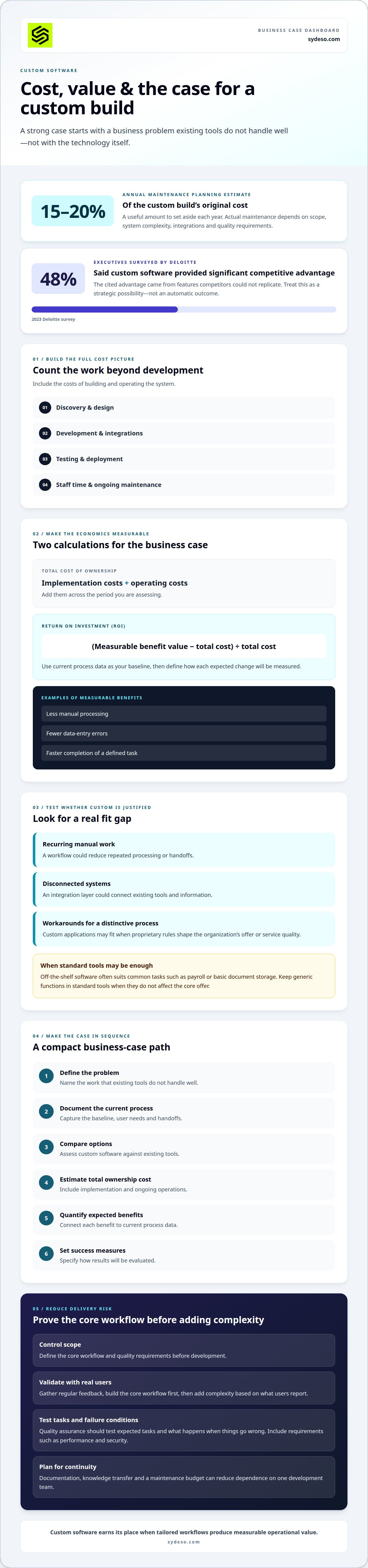
Include the full cost of building and operating the system, not just development work. Account for discovery, design, development, integrations, testing, deployment, staff time, and ongoing maintenance. A useful planning estimate sets aside 15 to 20% of a custom software build’s original cost annually for maintenance. The actual work depends on scope, system complexity, integrations, and quality requirements.
Calculate total cost of ownership by adding implementation and operating costs over the period you are assessing. Calculate ROI by subtracting total cost from the value of measurable benefits, then dividing by total cost. Benefits might include less manual processing, fewer data-entry errors, or faster completion of a defined task. Use current process data as your baseline, then specify how you will measure each expected change.
Control development risk with a defined scope, regular feedback from real users, thorough testing, and clear non-functional requirements, such as performance and security. Build and validate the core workflow first, then add complexity based on user feedback. Before release, quality assurance should test expected tasks and failure conditions. Documentation, knowledge transfer, and a maintenance budget can also reduce dependence on one development team.
A persuasive business case can follow a compact template: define the problem, document the current process, compare options, estimate total ownership cost, quantify expected benefits, and set success measures. An in-house team brings direct organizational knowledge; an external team can add development capacity. Either way, assign internal owners for decisions, user feedback, and acceptance testing.
Competitive advantage and proprietary business logic
Competitive advantage can come from how an organization makes decisions, serves customers, or handles exceptions. Custom applications can encode those processes directly. For example, a distributor may prioritize orders using specific rules for stock, delivery commitments, and customer needs. A generic tool may support standard order entry but miss the logic that makes the distributor’s service distinctive.
That difference matters when competitors can easily copy a visible feature but not the operating rules behind it. A 2023 Deloitte survey found that 48% of executives said custom software provided a significant competitive advantage through features competitors could not replicate. Treat that as a strategic possibility, not an automatic result. The business benefit depends on whether the software supports a valuable capability customers notice.
Off-the-shelf software often suits common tasks, such as payroll or basic document storage. Custom development may fit better when an organization’s processes shape its offer or service quality. For example, a subscription business might need an application that coordinates customer preferences, account changes, and service exceptions in one workflow. The advantage comes from consistent execution, not customization alone.
Test the case against specific outcomes. Identify the current bottleneck, the distinctive rule involved, and the effect of applying that rule consistently. A logistics team could measure whether dispatch decisions follow its established priority rules. A service team could track whether customer requests reach the right queue without repeated manual sorting. These measures connect software capabilities to business results.
Custom software can adapt as demand changes. If a new service requires different approval steps, a purpose-built workflow can reflect those rules without forcing staff into workarounds. But building every requested feature can be costly and dilute the initial advantage. Keep the scope tied to processes that differentiate the business. Leave generic functions to standard tools when they do not affect the core offer.
A sound decision distinguishes distinctive business logic from routine administration. Document which rules create customer value, who owns them, and how success will be measured. This helps decision-makers judge whether tailored applications protect a meaningful advantage or simply recreate features available in off-the-shelf software.
Common custom business software examples
Custom business software can be a focused application, an internal platform, or a layer connecting existing systems. The right form depends on the work it must support. To assess an example, identify the users, their task, the information they need, and the handoffs the software should manage.
A custom retail point-of-sale system can connect sales with inventory and customer databases. Staff can see stock changes as purchases are recorded, while the business can apply personalized discounts or loyalty rewards. The practical value lies in linking these tasks in one workflow, rather than entering sales and customer details into separate tools.
Customer service applications offer another clear example. A business can organize inquiries and complaints around its service process, route each request to the relevant team, and record its resolution. This structure can help staff respond consistently and resolve issues faster. Reporting can also reveal recurring complaint types, giving managers evidence to review service processes.
Internal operations offer further use cases. An inventory tool can connect stock records with purchasing tasks, while a workflow application can replace manual handoffs between teams. A reporting platform can draw information from operational systems and present the measures managers use to make decisions. Each example should solve a defined work problem, not simply add another screen.
Analytics and reporting applications can help when important information is spread across separate records. A tailored dashboard might bring selected operational data into one view, such as order status, stock levels, and open customer requests. The organization still needs clear definitions for each measure. Otherwise, one platform may display inconsistent data instead of improving decisions.
These examples point to a practical distinction: custom software is most relevant when workflows, data, or service rules need a specific fit. Generic tasks may not justify a custom build. To make the business case, connect the proposed application to a concrete result, such as less manual entry, clearer reporting, or smoother coordination between teams.
What business problems justify building custom software?
Custom software deserves consideration when existing tools fail to resolve a recurring operational problem. For example, if employees copy the same customer details between a spreadsheet and a billing system, duplicate entry adds work and can create inconsistent records. A tailored process can connect those steps and reduce repeated handling.
Workarounds are another concrete signal. A team that maintains several spreadsheets to track approvals, exceptions, and ownership may lack a reliable view of progress. When processes differ between departments, errors and delays can follow. The case is stronger when the work happens regularly and staff can describe its steps and consequences.
Growth can expose limits in existing systems. A tool may slow during busy periods, require costly upgrades, or fail to support a new department or business model. For instance, a distributor expanding into scheduled deliveries may need order handling that accounts for delivery windows and stock availability. The issue is not growth alone, but a system that blocks important work.
Disconnected applications create a separate problem. If sales, operations, and finance maintain separate records, teams may have to reconcile conflicting information by hand. An integration or shared application can help data move through the process, while clear ownership rules establish which system remains authoritative. Outdated technology also warrants review when it prevents staff from completing essential tasks or maintaining the system.
Custom software is not automatically the right response. If a standard tool already supports the process and its information needs, a custom build may add unnecessary operating work. Compare the recurring cost of the current problem with the effort required to build and maintain a tailored solution. Document who experiences the problem, how often it occurs, and which operational result should change.
If manual workarounds, system gaps, or growth constraints are disrupting core processes, discuss a custom software solution shaped around the business problem.
Sydeso: Custom software development
Sydeso helps businesses turn defined operational needs into custom software built around their processes. When off-the-shelf tools create persistent workarounds, internal tools can give teams a better fit for daily tasks. For a new product idea, MVP development can establish a focused first version for users to evaluate before further investment.
The work starts with the business problem, intended users, and desired outcomes. Sydeso can then shape the scope, develop the software, and support its launch and ongoing use. Clear priorities keep the solution tied to the business case rather than expanding it with unrelated features.
If you have a specific workflow or product idea to assess, contact Sydeso to discuss the next steps.
Turn the business case into a clear next step
A sound business case for custom software connects an operational need to measurable outcomes, ownership, and a plan for ongoing use. Turn assumptions into decisions by identifying who will approve the scope, who will use the system, and what evidence will guide the next stage.
The right starting point depends on the problem. Sydeso offers custom software development for tailored systems, internal tools for team workflows, and MVP development for focused product concepts. Define the operational challenge and intended outcome first. Then set a manageable scope and decide how your team will assess progress.
Bring the current process, its constraints, and the result you need into the discussion. Discuss your software plans with Sydeso and consider a practical next step. A clear problem gives your team a stronger basis for a well-judged decision.
Frequently Asked Questions
When does off-the-shelf software make sense?
Off-the-shelf software makes sense when a ready-made product handles an organization’s core tasks without extensive workarounds. A business with standard purchasing, invoicing, or document-storage needs may find that configuration covers its requirements. Compare the fit against everyday tasks, user roles, integrations, and data-export needs. If the process is common and the tool supports it reliably, a custom build may add unnecessary complexity.
What is a business case for custom software?
A business case for custom software is a decision document that explains the problem, evaluates possible approaches, and sets out expected costs and business value. It should identify the people affected, the process that needs to change, and how results will be assessed. For example, a proposal for a customer portal could define which service requests it will handle and what outcome would show it is useful.
What are typical costs and timelines for custom software development in the United States?
Costs and timelines depend on scope, integrations, data migration, testing, and rollout needs. Custom software development can take several months, while the first release of an existing subscription tool is usually quicker. A useful estimate separates build work from operating costs, such as maintenance and future changes. Avoid treating a broad market range as a project budget; define the required functions and constraints first.
How does custom software compare with off-the-shelf software and SaaS?
Off-the-shelf software is a ready-made product, while SaaS describes software delivered through a subscription service. A product can be both. Custom software is designed around an organization’s requirements, but the organization must plan for its development and continued operation. Compare options by workflow fit, integration needs, subscription terms, data export, and maintenance responsibilities. The best fit depends on the work and responsibilities involved.
What financial and operational benefits can custom software deliver?
Custom software can support financial value by reducing repeated work, limiting avoidable errors, or helping staff process requests more efficiently. Operational benefits may include clearer handoffs and faster access to decision-ready information. Estimate benefits using a baseline, such as staff time spent correcting orders or processing requests. Then track the same measure after launch, and avoid counting one improvement twice under different financial categories.
What risks can undermine a custom software project, and how can they be mitigated?
Projects can lose direction when stakeholders disagree about acceptance criteria or migrated records contain errors. Assign a decision owner and document what each release must do before work begins. Rehearse data migration on a sample, reconcile records, and stage the rollout so teams can identify problems before wider use. A named system owner should also manage access decisions and operational handover.
Questions
- When does off-the-shelf software make sense?
- Off-the-shelf software makes sense when a ready-made product handles an organization’s core tasks without extensive workarounds. A business with standard purchasing, invoicing, or document-storage needs may find that configuration covers its requirements. Compare the fit against everyday tasks, user roles, integrations, and data-export needs. If the process is common and the tool supports it reliably, a custom build may add unnecessary complexity.
- What is a business case for custom software?
- A business case for custom software is a decision document that explains the problem, evaluates possible approaches, and sets out expected costs and business value. It should identify the people affected, the process that needs to change, and how results will be assessed. For example, a proposal for a customer portal could define which service requests it will handle and what outcome would show it is useful.
- What are typical costs and timelines for custom software development in the United States?
- Costs and timelines depend on scope, integrations, data migration, testing, and rollout needs. Custom software development can take several months, while the first release of an existing subscription tool is usually quicker. A useful estimate separates build work from operating costs, such as maintenance and future changes. Avoid treating a broad market range as a project budget; define the required functions and constraints first.
- How does custom software compare with off-the-shelf software and SaaS?
- Off-the-shelf software is a ready-made product, while SaaS describes software delivered through a subscription service. A product can be both. Custom software is designed around an organization’s requirements, but the organization must plan for its development and continued operation. Compare options by workflow fit, integration needs, subscription terms, data export, and maintenance responsibilities. The best fit depends on the work and responsibilities involved.
- What financial and operational benefits can custom software deliver?
- Custom software can support financial value by reducing repeated work, limiting avoidable errors, or helping staff process requests more efficiently. Operational benefits may include clearer handoffs and faster access to decision-ready information. Estimate benefits using a baseline, such as staff time spent correcting orders or processing requests. Then track the same measure after launch, and avoid counting one improvement twice under different financial categories.
- What risks can undermine a custom software project, and how can they be mitigated?
- Projects can lose direction when stakeholders disagree about acceptance criteria or migrated records contain errors. Assign a decision owner and document what each release must do before work begins. Rehearse data migration on a sample, reconcile records, and stage the rollout so teams can identify problems before wider use. A named system owner should also manage access decisions and operational handover.