Choosing an MVP Development Agency for Your Product
Choosing an MVP development agency? Learn to assess industry fit, compare proposals, plan user testing, and secure support from launch through iterations.

A full product is not always the right first build. Skip an MVP only when you have enough evidence to support the product’s core assumptions; otherwise, a focused first version can test them before you commit to a broader scope. An experienced MVP development agency can turn those assumptions into a product users can try and assess.
Building the complete product may seem more efficient when the vision is clear. But a clear vision does not answer every question about user needs, essential features, or how the product will work in practice.
This guide explains how to assess an agency’s fit, pricing approach, team structure, testing practices, and post-launch support. You’ll learn what to look for in a partner, how to judge whether a proposed MVP is focused enough to test your idea, and what a sound working relationship should cover from planning through launch.
Key Takeaways
- Match an agency’s relevant project experience to your product’s users, workflows, and industry constraints.
- Compare proposals by scope, team responsibilities, and communication practices, not by headline rates alone.
- Make user testing, feedback review, and post-launch iteration part of the delivery plan.
- Choose a partner with clear ownership from product decisions through launch and ongoing support.
Table of Contents
- How can I assess whether an agency has the right industry fit?
- Company rates, team sizes, locations, and clients
- Testing, user feedback, and post-launch iteration
- Choosing an MVP development partner
- Sydeso: Custom software development
How can I assess whether an agency has the right industry fit?
An MVP development agency helps define, design, build, and test a focused first product. Its work should connect product decisions to evidence, not simply deliver a list of requested features. An MVP can be built to validate or invalidate a business idea in 8-16 weeks. The target is useful feedback, not a smaller copy of every planned feature.
Start with discovery. Ask the team to identify the user, the problem, and the assumption the product needs to test. Then review how it translates those into scope, functionality, and a roadmap. For example, a startup testing demand for appointments may need booking and confirmation flows, not a complete operations suite.
Industry fit means understanding the work behind the interface. A B2B SaaS product may need distinct permissions for administrators and staff. A logistics tool may need to represent handoffs, exceptions, and status changes. Ask the agency to explain how it would model those workflows and which assumptions need user feedback before launch.
AI and complex workflows also need clear boundaries. For an AI agent, define its task, the information it uses, and where a person reviews its output. For workflow automation, map the existing process before deciding what to automate. This helps prevent an MVP from hiding unresolved operational decisions behind new functionality.
A contract and statement of work should define scope, deliverables, acceptance criteria, responsibilities, change control, and the roadmap. They should also explain how the team reports progress, decisions, and risks. Tie each deliverable to a review point, such as approving the scope and design before any code is written.
Protect intellectual property by documenting ownership and permitted use in the agreement. Specify how project code, designs, documentation, and materials you provide will be handled. Record access to repositories and credentials, and define how those assets will be handed over. Clear written terms make ownership and access easier to manage.
Look for product-minded engineering in the team’s decisions. A transparent partner explains trade-offs, documents scope changes, and links each build step to a validation goal. Compare its proposed process with your users’ actual needs, whether you are building AI, B2B SaaS, or an industry-specific tool.
Company rates, team sizes, locations, and clients
Compare proposals by the work included, the people responsible, and evidence from relevant past projects. A clear breakdown makes differences in scope and delivery easier to evaluate.
Rates and Team Size
Project cost depends on scope. Sydeso provides a written estimate after a free, non-binding consultation. Cost factors include discovery, design, engineering, integrations, testing, and launch. Compare proposals by what each covers, not by a headline rate alone. A prototype with one core workflow calls for a different plan than a mobile application with several user roles.
Review the proposed team’s roles and responsibilities. Identify who handles product decisions, design, engineering, and testing, and how handoffs work. A compact team may keep decisions close; a larger team may divide specialist tasks. The key is whether each role supports the actual scope and has a clear owner.
Agency Locations and Clients
Location affects working hours, meeting overlap, and how quickly a team can resolve a blocked decision. Timezone alignment can enable real-time collaboration instead of 24-hour delays on critical decisions. Map the agency’s normal working hours against your team’s schedule, then agree on meeting times and written update practices.
Look at client examples that resemble your product’s users or operating model. A B2B application for staff workflows calls for different experience than a consumer mobile app. Review each case study for the client problem, delivered functionality, and the evidence used to assess the result.
Testimonials offer context, but case studies show the work. Check whether each account explains the agency’s role, project constraints, and how feedback shaped the product. A prototype case, for example, should distinguish assumptions that were tested from features that were simply delivered. This helps you judge relevance without treating another client’s outcome as a forecast for your project.
Ask for a walkthrough of one relevant case study. Note whether the team can explain trade-offs, changes to scope, and the reasoning behind launch decisions. A useful profile connects its client examples to the work proposed for you. For another perspective on defining software work, explore this software development approach.
Testing, user feedback, and post-launch iteration
An MVP development service should take a concept through discovery, development, testing, and launch. It should also explain how feedback will inform the next product decisions.
Testing and User Feedback
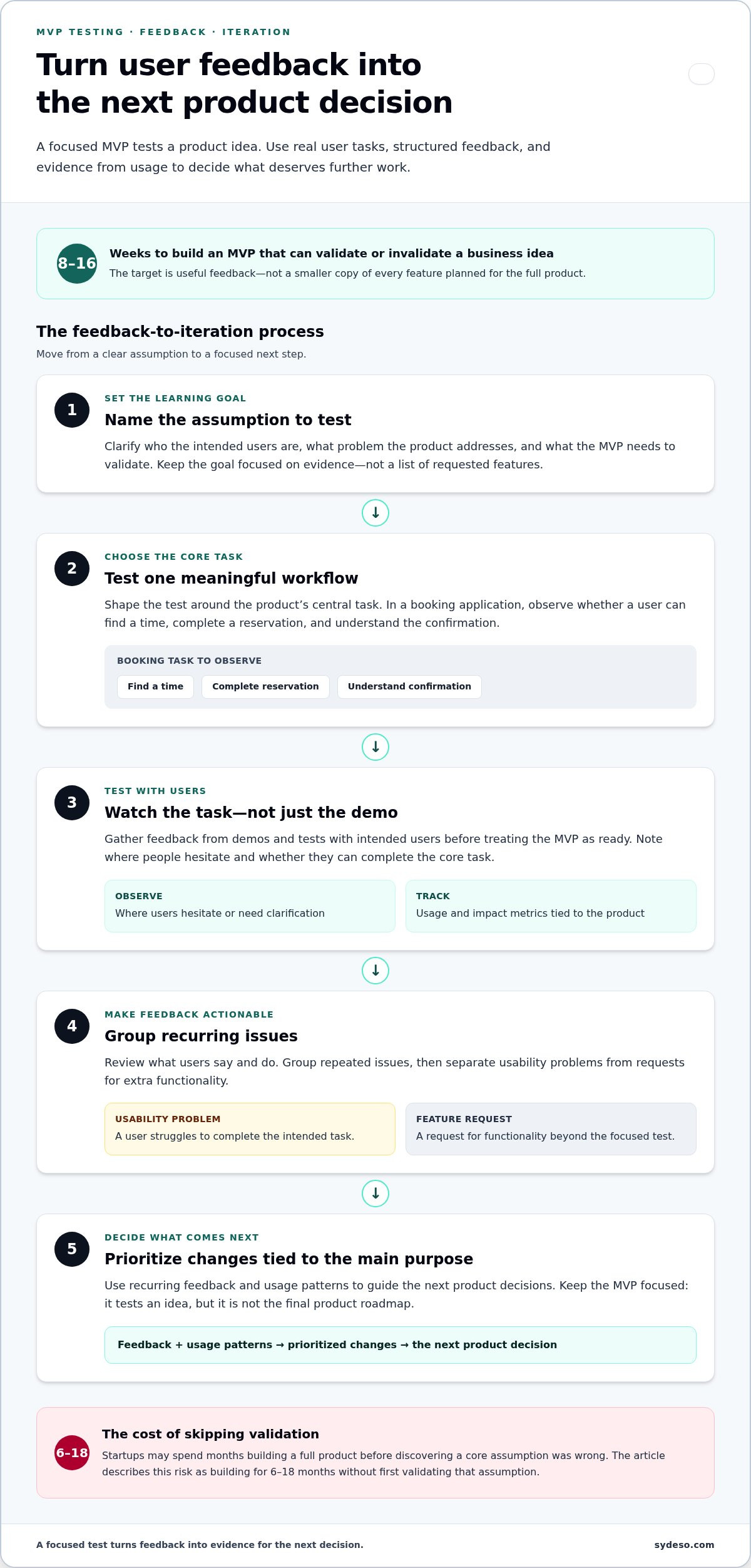
Test the core task with intended users before considering the MVP ready. For a booking application, observe whether users can find a time, complete a reservation, and understand the confirmation. The Opportunity Project recommends incorporating feedback from demos, testing with end users, and identifying metrics for usage and impact.
Use a structured review: note where users hesitate, group recurring issues, and prioritize changes tied to the product’s main purpose. Separate usability problems from requests for extra functionality. This makes feedback actionable and gives the team a clear basis for iteration.
An MVP tests a focused product idea; it is not the final product roadmap. After launch, usage patterns and user feedback help show which concepts deserve further work. Skipping validation can leave startups building a full product for 6-18 months before discovering a core assumption was wrong.
For an investor-facing launch, prepare a working demonstration around the product’s central workflow and the evidence gathered from users. A Web3 MVP also needs a clear explanation of what the software does and which user actions the prototype supports. Present tested functionality accurately, and distinguish it from planned features.
Post-Launch Iteration and Support
Launch marks the start of measurement, not the end of development. Agree on how the team will review usage, log defects, and decide which changes belong in the next release. For a marketplace MVP, this might mean checking whether buyers complete the intended transaction before expanding seller tools.
Define post-launch responsibilities in practical terms: who reviews issues, maintains the application, and turns validated feedback into roadmap changes. Ongoing support should connect each release to a reason, such as fixing a blocked task or improving a measured step. A clear review cycle helps teams improve without adding features by default.
Choosing an MVP development partner
An agency brings a coordinated team and delivery process; a freelancer offers direct access to one specialist; an in-house team builds product knowledge internally. Choose based on the skills, oversight, and continuity your software project requires. A mobile product involving design, backend development, and testing may need broader coverage than a tightly scoped prototype.
Start with your product vision. Write down the user, the problem, and the decision the first version must support. Then ask each prospective partner to explain how its proposed scope will test that decision. For a fintech concept, this could mean mapping the user journey and identifying which steps need careful review before selecting features.
Compare working methods, not presentation polish. Request a sample roadmap or project plan showing decision points, review steps, and how changes affect scope. Ask who makes product decisions, who approves completed work, and how the team records risks. A useful answer names the roles and explains how information moves between your staff and the delivery team.
Use the same scenario with every candidate. Describe a difficult workflow, such as a payment exception or a mobile sign-up problem. Ask each team to explain its first investigation step, proposed test, and expected output. Their reasoning shows whether they can turn an unclear problem into a practical next action.
Check that the working agreement supports the process. It should connect deliverables to acceptance criteria, clarify ownership, and explain how scope changes are handled. Agree on version control and handoff so your team can access the working product and its documentation as development progresses.
Choose the partner whose plan makes responsibilities visible and ties each build decision to a user need. If your team is defining product scope, discuss your MVP development needs with a software partner.
Sydeso: Custom software development
Sydeso helps teams turn a defined product need into custom software, an MVP, or an internal tool. Work with the team when you’re ready to move from a validated product scope to implementation, or when your workflows need software built around them.
For an early product, MVP development focuses the build on core functionality and user testing. For internal operations, internal tools can be tailored to your team’s processes. Sydeso’s launch and support services cover deployment, monitoring, post-launch fixes, and new features. Ongoing work is optional and billed hourly with a cap, by fixed-price phase, or through a monthly retainer. The right starting point depends on your goals, users, and development stage.
Bring your product goal, intended users, and known requirements to the conversation. Contact Sydeso to discuss your software project.
Make the next product decision concrete
Before choosing an MVP development agency, write a short decision brief. Name the user, the problem, the core assumption, and what evidence would change your next product decision. This gives your team a practical starting point and makes the first partner discussion more focused.
Keep the brief tied to a business need rather than a fixed feature list. Your understanding may change as users interact with the product. A partner should be able to work from that direction while keeping scope, ownership, and priorities clear.
Sydeso offers MVP development, custom software development, and internal tools development. If you’re ready to discuss a product or an internal workflow, contact Sydeso about your MVP. A clear first conversation can help turn your product goal into a workable next step.
Frequently Asked Questions
Can I skip the MVP and go straight to the full product?
Yes, if you already have strong evidence for the product’s core demand and requirements. For example, a business extending a proven service may have customer records and operating data to guide a full build. If key decisions still depend on user behavior, start with the smallest release that can resolve those uncertainties. The choice depends on the evidence, dependencies, and cost of changing direction later.
Do I need a business plan before building an MVP?
No, a complete business plan isn’t a prerequisite. You do need a clear problem statement, a defined user group, and a working view of how the product could create value. For example, note who pays, what task the product replaces, and what would make a user return. These assumptions give the team a basis for product decisions without requiring a lengthy formal plan.
How do I know when my MVP is ready to launch?
Launch when the intended user can complete the core task and the team can explain how the product handles common errors. For a budgeting tool, test account setup, entering a transaction, and correcting a mistaken entry. Also decide how to capture user issues and who will review them. A release is ready when its intended use is clear and its known limitations are documented.
How do you decide what goes into the MVP and what waits?
Include a feature when it directly supports the core user task or tests a key product assumption. Defer items that serve edge cases, add convenience, or depend on untested features. For a meal-planning app, creating a weekly plan may be essential while social sharing can wait. This keeps the first release focused and makes user responses easier to interpret.
How should I evaluate MVP development agencies?
Evaluate an MVP development agency by how it turns your requirements into clearly owned deliverables and decisions. Ask for a sample scope, an example of how changes are handled, and a clear explanation of who reviews each milestone. Check that the agreement covers code ownership and handoff. Then compare the proposed approach with your team’s capacity to make product decisions, review work, and prepare for launch.
What are the top agencies for building MVPs in the US?
There isn’t one top agency for every US product; the right choice depends on the work and your team’s needs. Compare relevant project experience, delivery responsibilities, communication practices, and how each partner handles changes. Sydeso develops MVPs for businesses moving from a defined product idea to a working release. Assess the proposed scope against your users, product goal, and internal capacity before deciding whether the fit is right.
Questions
- Can I skip the MVP and go straight to the full product?
- Yes, if you already have strong evidence for the product’s core demand and requirements. For example, a business extending a proven service may have customer records and operating data to guide a full build. If key decisions still depend on user behavior, start with the smallest release that can resolve those uncertainties. The choice depends on the evidence, dependencies, and cost of changing direction later.
- Do I need a business plan before building an MVP?
- No, a complete business plan isn’t a prerequisite. You do need a clear problem statement, a defined user group, and a working view of how the product could create value. For example, note who pays, what task the product replaces, and what would make a user return. These assumptions give the team a basis for product decisions without requiring a lengthy formal plan.
- How do I know when my MVP is ready to launch?
- Launch when the intended user can complete the core task and the team can explain how the product handles common errors. For a budgeting tool, test account setup, entering a transaction, and correcting a mistaken entry. Also decide how to capture user issues and who will review them. A release is ready when its intended use is clear and its known limitations are documented.
- How do you decide what goes into the MVP and what waits?
- Include a feature when it directly supports the core user task or tests a key product assumption. Defer items that serve edge cases, add convenience, or depend on untested features. For a meal-planning app, creating a weekly plan may be essential while social sharing can wait. This keeps the first release focused and makes user responses easier to interpret.
- How should I evaluate MVP development agencies?
- Evaluate an MVP development agency by how it turns your requirements into clearly owned deliverables and decisions. Ask for a sample scope, an example of how changes are handled, and a clear explanation of who reviews each milestone. Check that the agreement covers code ownership and handoff. Then compare the proposed approach with your team’s capacity to make product decisions, review work, and prepare for launch.
- What are the top agencies for building MVPs in the US?
- There isn’t one top agency for every US product; the right choice depends on the work and your team’s needs. Compare relevant project experience, delivery responsibilities, communication practices, and how each partner handles changes. Sydeso develops MVPs for businesses moving from a defined product idea to a working release. Assess the proposed scope against your users, product goal, and internal capacity before deciding whether the fit is right.