Custom Software for Small Business Cost: What to Expect
Explore custom software for small business cost, key pricing drivers, licensed alternatives, and ways to reduce project risks with a clear, realistic estimate.

The cost of custom software for a small business depends on what the system needs to do, not the size of the business. A focused internal tool has different requirements from a platform with multiple workflows, user roles, and integrations. Those requirements shape the scope, effort, and budget.
It’s reasonable to want a clear figure before committing. But a price without a defined scope can leave out important work, such as design, integrations, testing, deployment, and post-launch support. Licensed software may be a better fit if it already handles the work your business needs.
This article covers the main cost drivers, how custom software compares with licensed options, and how to weigh long-term value against project risks. You’ll also learn what a useful estimate should include, helping you assess the trade-offs before choosing a path.
Key Takeaways
- Define the business process the software must improve before assessing its scope and value.
- Account for design, integrations, data migration, testing, launch, and ongoing support when reviewing an estimate.
- Compare a tailored system with licensed software based on fit, operating effort, and long-term needs.
- Reduce project risk by setting clear requirements, agreeing on scope, and planning regular reviews.
Table of Contents
- Is custom software worth it for a small business?
- How Much Does Custom Software Development Cost in 2026?
- Custom software versus licensed software
- Software project budget and schedule overruns
- Sydeso: Custom software development
Is custom software worth it for a small business?
Custom software can be worth considering when a business process does not fit existing tools. Before requesting a quote, ask how the estimate covers integrations, testing, hosting, and support, and how changes affect scope.
Build and Ongoing Expenses
A software estimate should distinguish the initial build from the cost of running the application. It should itemize discovery and design, development, integrations, data migration, testing, deployment, and training. Ask how work outside the agreed scope is handled and what post-launch support includes. For example, replacing a spreadsheet-based process may require both data migration and new screens.
Custom Software and SaaS Costs
Custom software involves a project to build the system, while SaaS usually spreads costs across subscriptions. Compare those recurring fees with the value of software built around your workflows. Subscription pricing varies by product and plan.
Scope and Complexity Factors
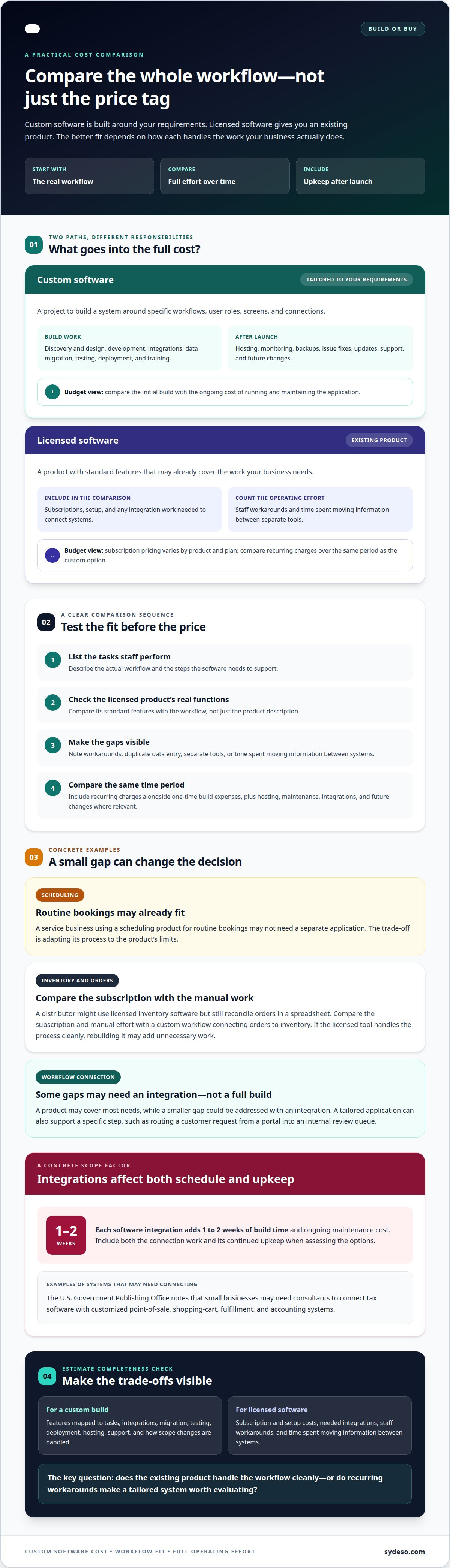
Scope means the workflows, user roles, screens, and connections the application must support. Each addition creates work for design, development, and testing, so a focused internal tool differs from a multi-team system. Each software integration adds 1 to 2 weeks of build time and ongoing maintenance cost. The U.S. Government Publishing Office notes that small businesses may need consultants to connect tax software with customized point-of-sale, shopping-cart, fulfillment, and accounting systems.
Hosting and Maintenance Expenses
Hosting and maintenance keep software available and usable after launch, so delivery is not the end of the operating cost. A plan can set out responsibilities for hosting, monitoring, backups, issue fixes, and updates. Ask what recurring work is included, how support requests are handled, and how changes are scoped when business needs shift. Clear boundaries make ongoing costs easier to budget and review.
How Much Does Custom Software Development Cost in 2026?
A useful estimate starts with the product’s scope, not a generic price range. The delivery plan also depends on the workflows, integrations, and reviews the application requires.
Development Price Ranges
A development estimate turns requirements into defined work, deliverables, and responsibilities. Sydeso provides a written estimate after a free scoping call. Scope, integrations, data migration, testing, and deployment all affect the proposed budget.
Compare estimates by checking what each includes, rather than treating the lowest upfront figure as the full cost. A platform with multiple user roles and connected systems requires different work from a focused product handling one workflow. The estimate should show how features map to development tasks and how changes to requirements affect delivery. This makes the trade-offs clearer before work begins.
Timelines need the same scope detail. According to Clutch, custom software projects reviewed on its platform take about 13 months of work on average. That figure is a broad reference, not a schedule for every small-business product. A defined MVP can limit initial work to its essential workflows, while a larger platform requires more development and testing.
AI-Assisted Cost Estimates and Savings
AI can support parts of software development, but it does not remove the need for product decisions, testing, or technical review. Its practical value depends on which tasks are suitable and how carefully people check the output.
For a small business, AI is most useful when it supports a clearly defined workflow or product feature. It does not make a complex platform simple to build or replace validation against real business needs. A sound estimate identifies where AI agents can draft repeatable work and where people review and decide, alongside the development, integration, testing, and maintenance the application still needs.
When planning an MVP or a larger platform, a clearly scoped software development project helps connect features, review, and delivery expectations.
Custom software versus licensed software
Licensed software gives a business an existing product; custom software is built around its requirements. Compare the options by asking how well each supports the actual workflow.
Custom and Off-the-Shelf Options
Off-the-shelf software can be a practical fit when its standard features cover the work. A service business using a scheduling product for routine bookings may not need a separate application. The trade-off is adapting business processes to the product’s limits. Custom software can support specific steps, such as routing a customer request from a portal into an internal review queue.
Fit matters more than the label. List the tasks staff perform, then compare them with the licensed product’s actual functions. Note workarounds, duplicate data entry, or separate tools needed to complete a process. A product may cover most needs, while a small gap could be addressed with an integration rather than a full custom build.
Build-or-Buy Criteria and Costs
The build-versus-buy decision compares the full effort of using a purchased tool with the development and upkeep of a tailored system. A subscription is only one part of the buying cost. Include setup, integrations, staff workarounds, and time spent moving information between systems.
For example, a distributor might use licensed inventory software but still reconcile orders in a spreadsheet. Compare the subscription and manual work with a custom workflow that connects orders to inventory. If the licensed tool handles the process cleanly, rebuilding it may add unnecessary work. If repeated workarounds slow staff or cause errors, a tailored application may address the underlying mismatch.
Use the same comparison period for both options, and include recurring charges alongside one-time build expenses. Account for hosting, maintenance, and future changes to a custom system, not just initial development. For licensed software, include subscriptions and any integration work needed to connect systems. The key question is whether a custom option reduces enough process friction to justify the responsibilities of owning and maintaining it.
A software estimate should clarify what is included, how scope changes are handled, and who maintains integrations after launch. These details make the alternatives easier to compare. Choose licensed software when its workflows fit; consider a custom system when essential operations depend on processes the product cannot support well.
Software project budget and schedule overruns
Scope changes, unclear requirements, and integration work can affect a project’s budget and schedule. Discovery and clear delivery boundaries help surface these risks before development begins.
Project costs can include discovery, design, integrations, data migration, testing, deployment, and staff training. Hosting, support, and technical maintenance continue after launch, so include them in the operating plan.
Overruns deserve attention: 46% of custom software builds run roughly twice over budget. Only 8% of software projects ship on time, and 11% stay on budget. These figures make scope control, regular reviews, and a clear change process important parts of a project plan.
Automation and internal-tool projects range from a focused task to a connected workflow used by multiple teams. A narrow tool needs fewer features and integrations, while a broader system requires more discovery, testing, and coordination. Define the primary process first, then separate essential functions from later additions. This creates a practical first release without treating every requested feature as essential.
Project timelines also vary by complexity. A quoting tool with customer-specific volume tiers, alloy surcharges, kit pricing, and historical part data takes 4 to 6 weeks to build. A typical project-based SMB workflow tool takes 4 to 6 months. The examples show why the technical detail behind a request matters more than its label.
Fixed-price phases suit stable, clearly defined scopes. When requirements may change, time-and-materials pricing can work with a written estimate and cap, regular progress reports, and client approval before any work goes beyond the cap. In either model, clarify deliverables, assumptions, and how approved changes affect the scope.
For a defined internal tool or automation, plan custom software development around clear scope and delivery reviews.
Sydeso: Custom software development
Sydeso builds custom software for businesses whose essential workflows need more than a standard tool can provide. Its services include internal tools, MVP development, and launch and support.
Turn to Sydeso when a manual process, disconnected systems, or a new product idea needs a defined software solution. Scoping establishes which workflows matter first, what the application must do, and how you’ll review progress. For an MVP, the focus is on core functions that let you test the product. For an internal tool, it’s the business process the application must support.
Bring the process, users, and main operational requirements into the discussion. Sydeso can use these details to shape the project scope and delivery plan. Contact Sydeso to discuss your software project.
Set a clear direction for your software project
To assess the cost of custom software for a small business, start with the operational result the system needs to support. Define what should change for staff or customers, then identify the highest-priority workflows. These decisions give you a practical basis for setting priorities and discussing scope.
Sydeso develops custom software, internal tools, and MVPs for businesses that need solutions shaped around their work. A focused project can start with one core process or product idea, then define what belongs in the first release. Clear priorities keep decisions tied to business needs rather than an ever-growing feature list.
Bring your goals and process requirements into a project discussion to explore a suitable direction. Discuss your project with Sydeso. A well-defined starting point makes the next decision easier to approach with confidence.
Frequently Asked Questions
How long does it take to build?
A timeline depends on scope, review cycles, and technical dependencies. Most Sydeso MVPs take 10 to 14 weeks from the first call to deployment, covering discovery, design, development, testing, and launch. Complex products can take longer, with the timeline set during discovery. A project schedule should identify key review points and dependencies, such as access to existing systems or timely decisions on product requirements.
How much does it cost to build software for a small business?
The cost of custom software for a small business depends on the product’s scope and technical requirements, so one general figure can’t describe every project. A booking tool with a small set of user roles differs from a product with customer accounts, payments, and several connected systems. For Sydeso projects, a written estimate follows a scoping call and sets the budget for the agreed work.
Hourly, fixed price or retainer: which pricing model is best?
The best model depends on how settled the scope is and how you want to manage changes. Time-and-materials suits evolving requirements when the work has a written estimate cap; additional work needs your written approval. Fixed-price agreements can suit projects with a well-defined scope that is unlikely to change. A monthly retainer reserves engineering capacity for ongoing work. Each model should define how progress and decisions are documented.
How do you get an accurate custom software estimate?
An accurate estimate starts with a clear discussion of the users, business outcome, and essential product behavior. Sydeso uses a free, non-binding 20-minute scoping video call before preparing a written estimate. The estimate sets the budget, and work beyond it requires your written approval. If requirements change, work stops while a change order defines the added scope and fixed cost for your decision.
How to choose the right development partner?
Choose a partner whose project controls make progress and ownership clear. Sydeso provides read-only access to the project board and staging environment from the start of development, so you can review work as it takes shape. Your company owns the code, repositories, data structures, and designs after accepting the work and paying the final milestone. Agreeing on these arrangements early helps set clear expectations.
Should a small business start with an MVP or build the full system?
Start with an MVP when the core product needs validation before its feature set expands. Focus the first release on the main user problem and the functions needed to test the solution. Sydeso develops MVPs for web apps, customer portals, internal tools, and APIs. A full system may be a better fit when requirements are well understood and the business needs connected workflows from the outset.
Questions
- How long does it take to build?
- A timeline depends on scope, review cycles, and technical dependencies. Most Sydeso MVPs take 10 to 14 weeks from the first call to deployment, covering discovery, design, development, testing, and launch. Complex products can take longer, with the timeline set during discovery. A project schedule should identify key review points and dependencies, such as access to existing systems or timely decisions on product requirements.
- How much does it cost to build software for a small business?
- The cost of custom software for a small business depends on the product’s scope and technical requirements, so one general figure can’t describe every project. A booking tool with a small set of user roles differs from a product with customer accounts, payments, and several connected systems. For Sydeso projects, a written estimate follows a scoping call and sets the budget for the agreed work.
- Hourly, fixed price or retainer: which pricing model is best?
- The best model depends on how settled the scope is and how you want to manage changes. Time-and-materials suits evolving requirements when the work has a written estimate cap; additional work needs your written approval. Fixed-price agreements can suit projects with a well-defined scope that is unlikely to change. A monthly retainer reserves engineering capacity for ongoing work. Each model should define how progress and decisions are documented.
- How do you get an accurate custom software estimate?
- An accurate estimate starts with a clear discussion of the users, business outcome, and essential product behavior. Sydeso uses a free, non-binding 20-minute scoping video call before preparing a written estimate. The estimate sets the budget, and work beyond it requires your written approval. If requirements change, work stops while a change order defines the added scope and fixed cost for your decision.
- How to choose the right development partner?
- Choose a partner whose project controls make progress and ownership clear. Sydeso provides read-only access to the project board and staging environment from the start of development, so you can review work as it takes shape. Your company owns the code, repositories, data structures, and designs after accepting the work and paying the final milestone. Agreeing on these arrangements early helps set clear expectations.
- Should a small business start with an MVP or build the full system?
- Start with an MVP when the core product needs validation before its feature set expands. Focus the first release on the main user problem and the functions needed to test the solution. Sydeso develops MVPs for web apps, customer portals, internal tools, and APIs. A full system may be a better fit when requirements are well understood and the business needs connected workflows from the outset.