Custom Software Project Scope: Understand Discovery Time and Delivery Pricing
Master your custom software project scope to stop scope creep, streamline discovery time, and align delivery pricing. Deliver your software build on budget.

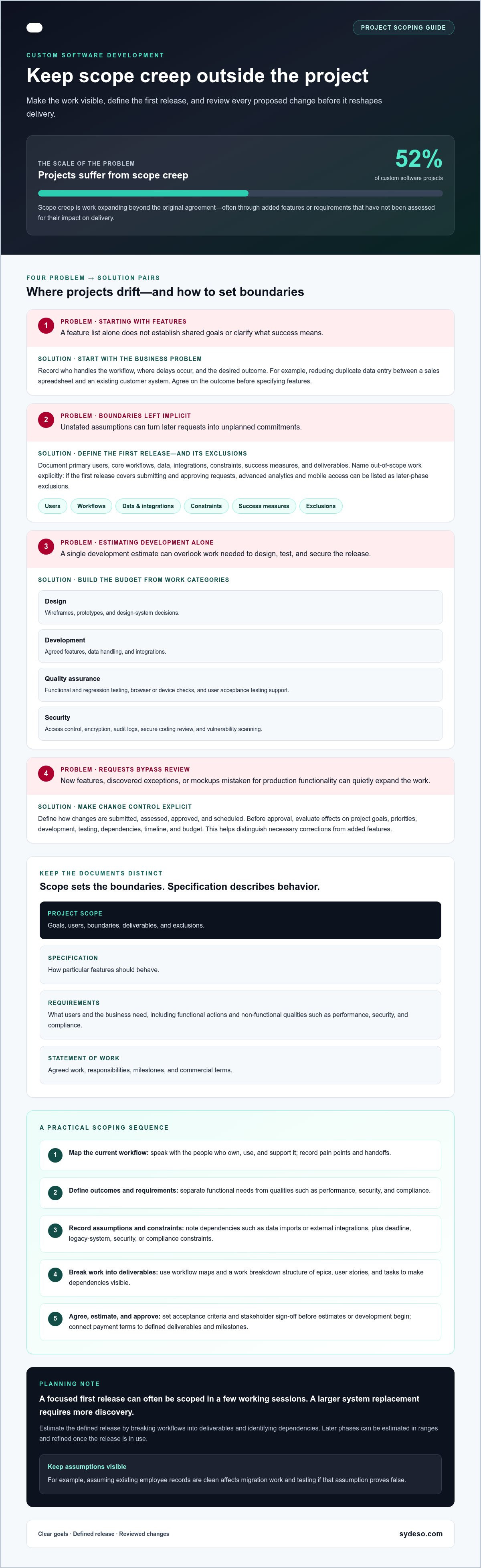
In custom software development, 52% of projects suffer from scope creep. It happens when work expands beyond the original agreement, often through added features or requirements that haven’t been assessed for their effect on delivery. A clear custom software project scope sets boundaries and gives the team a way to review changes before they alter priorities, timing, or budget.
It’s reasonable to expect a project plan to make delivery more predictable. But a feature list alone won’t do that: teams also need shared goals, clear acceptance criteria, and a process for handling new requests.
This article explains what belongs in a project scope, how it differs from a specification, and what discovery contributes before development begins. It also covers how scope clarity affects estimates and pricing models, and how to spot and manage scope creep as priorities change.
Key Takeaways
- Document the goals, users, first-release boundaries, and exclusions, then get stakeholder sign-off before development begins.
- Account for design, development, testing, and security work when shaping the project budget.
- Use the scope to set project boundaries and the specification to describe how features should behave.
- Match discovery effort and the pricing model to the project’s uncertainty, dependencies, and delivery needs.
- Require proposed changes to be assessed for their effects on priorities, timeline, and budget before approval.
Table of Contents
- 1. What Is Scope Creep in Custom Software Development?
- 2. What Exactly Is Software Development Project Scoping?
- 3. What is the difference between a project scope and a specification?
- 4. Discovery duration and delivery pricing models
- 5. Scope creep and its effects on software projects
- Sydeso: Custom software development
1. What Is Scope Creep in Custom Software Development?
Scope creep is the gradual expansion of work beyond the project’s original agreement. In an internal tool, a request to add approval routing might grow to include role-based permissions, notifications, and reporting. Each addition can affect design, development, testing, and delivery planning. A defined custom software project scope makes these changes visible before the team commits to them.
Start scoping with the business problem, not a feature list. For example, a team may need to reduce duplicate data entry between a sales spreadsheet and an existing customer system. Record who handles the workflow, where delays occur, and what success looks like, such as fewer manual handoffs. Stakeholders should agree on the outcome before specifying features.
The scope document then sets the project’s boundaries. It should identify primary users, core workflows, data, integrations, constraints, success measures, and the first release. It should also name out-of-scope work. If the first release covers submitting and approving requests, advanced analytics and mobile access can be listed as later-phase exclusions. Explicit exclusions keep assumptions from becoming unplanned commitments.
Common causes of scope creep include unclear requirements, missing acceptance criteria, and new requests that bypass review. Stakeholders may also discover exceptions during development or mistake a clickable mockup for production-ready functionality. Define how changes are submitted, assessed against goals, time, and budget, and approved. The team can then distinguish necessary corrections from added features.
A focused first release can often be scoped in a few working sessions, while a larger system replacement requires more discovery. Estimate the defined release by breaking workflows into deliverables and identifying dependencies, such as data imports or external integrations. A clear first release supports a more confident estimate. Later phases can be estimated in ranges and refined once the release is in use.
Useful tools include a scope-of-work template, a workflow map, and a work breakdown structure. The template captures objectives, deliverables, exclusions, assumptions, constraints, and change control. The workflow map shows each user action and handoff. A work breakdown structure divides features into epics, user stories, and tasks, making dependencies easier to identify. A shared backlog can track decisions and proposed changes. Stakeholders should review and approve the scope before estimates or development begin.
2. What Exactly Is Software Development Project Scoping?
Scoping turns business needs into an agreed plan for design, development, testing, and release. For an internal tool, that plan might cover request submission, manager approval, reporting, and access permissions. It also establishes the project’s foundation: deliverables, assumptions, constraints, timelines, budget, and decision points. Without these boundaries, teams may work to different expectations, leading to scope creep, budget overruns, or missed deadlines.
Gather requirements by speaking with the people who own, use, and support the workflow. Map the current process, record pain points, then define the business outcomes and requirements needed to achieve them. For example, a request form may need required fields, approval rules, and a record of each decision.
Separate functional requirements from non-functional requirements. Functional requirements describe actions, such as submitting a request or assigning an approver. Non-functional requirements cover qualities such as performance, security, and compliance. Document assumptions, too. For instance, assuming existing employee records are clean affects migration work and testing if that assumption proves false.
Build the budget from work categories rather than relying on a single development estimate. Design may include wireframes, prototypes, and design-system decisions. Development covers the agreed features, data handling, and integrations. Quality assurance should account for functional and regression testing, browser or device checks, and user acceptance testing support. Security work may include access control, encryption, audit logs, secure coding review, and vulnerability scanning.
Constraints shape both effort and sequence. A fixed deadline may require a narrower first release, while a legacy integration may introduce dependencies that affect the timeline. Security or compliance needs can add design, implementation, and validation work. Record each constraint alongside the assumption it affects, then show the impact on deliverables and schedule. This gives stakeholders a basis for trade-offs instead of late surprises.
The scope document should connect budget and payment terms to defined deliverables, milestones, and acceptance criteria. It should also explain how proposed changes are requested, assessed, approved, and scheduled. If a new reporting feature arrives mid-project, assess its effect on development, testing, dependencies, and the deadline before adding it. For teams setting these boundaries for a new internal system, custom software development can support planning through delivery.
3. What is the difference between a project scope and a specification?
A project scope sets the project’s structure: its goals, users, boundaries, deliverables, and exclusions. Requirements describe what users and the business need. A statement of work records the agreed work, responsibilities, milestones, and commercial terms, while a specification describes how particular features should behave.
For an internal request platform, the business goal might be to reduce delays in approving employee requests. A measurable outcome could track approval time or the share of requests completed through the platform. The objective should connect that outcome to a defined release, rather than treating every requested feature as equally important.
Translate the goal into requirements before detailing feature behavior. A requirement might state that managers need to review pending requests. The specification can then describe which request details appear, how an approval is recorded, and what happens if a manager rejects it. Acceptance criteria give testers and stakeholders a shared basis for deciding whether the behavior works.
Uncontrolled expansion creates business costs beyond additional development work. Extra features can increase testing, delay the release, and divert staff from their regular work. Scope creep can double custom software project budgets when additions accumulate without review. The impact depends on how changes interact with existing features, data, integrations, and delivery commitments.
Consider a team building a request platform. The agreed release supports submissions and manager approvals. During development, stakeholders ask for analytics, automated reminders, and a connection to a separate HR system. Each request may be valuable, but including all three changes the workload and can delay the release. Assess each request against the original business outcome first.
Keep objectives tied to business results, then rank requirements by how much they contribute to those results. A requested dashboard may help managers spot backlogs, while a new visual theme may not address approval delays. That doesn’t make the visual change irrelevant; it makes its priority and timing explicit. The project plan should show which requirements support the first release and which remain candidates for later work.
Review proposed changes for dependencies and consequences before approving them. A new HR connection, for example, may require data mapping, access rules, and additional testing. Record the decision, its effect on deliverables, and any revised acceptance criteria. This keeps a clear record of what the team agreed to build and gives stakeholders a practical way to measure results against the original goal.
4. Discovery duration and delivery pricing models
Discovery turns an operational problem into a plan the delivery team can estimate. For an internal tool, sessions might map how staff submit requests, who approves them, and where records are stored. The team can then identify technical dependencies, define deliverables, and record unresolved decisions. The goal is practical clarity, not documentation for its own sake.
Discovery effort depends on workflow complexity, stakeholder access, data quality, and integrations. Putting together a software project scope can require 40 or even 80 hours. A request form with one approval path needs less investigation than a system that replaces several connected tools. Delayed access to process owners or data also adds time because assumptions must be tested before estimates hold.
With a stable set of requirements, a fixed-price model ties payment to an agreed scope and defined deliverables. It can suit a contained release, such as an internal directory with specified search and access rules. The team must document exclusions and the process for assessing changes. Otherwise, new requirements can disrupt expectations or create disputes about what the original agreement covered.
A time-and-materials model charges for work performed under agreed rates and gives the team room to refine priorities as it learns. It can suit an evolving tool with uncertain integrations or workflows. Regular backlog reviews, progress reports, and approval checkpoints help stakeholders track work and spending. Milestone-based arrangements link payments to agreed outputs, such as an approved design, a working release, or completed testing.
Compare vendors by their discovery process and delivery practices, not just their proposal format. Ask for clear examples of deliverables: workflow maps, prioritized backlogs, technical assumptions, acceptance criteria, and release plans. A proposal should show who makes decisions, how progress is reviewed, and how changes are assessed. For an internal approval tool, confirm the plan covers user roles, exception handling, data access, and testing.
An Agile team may set a high-level objective, sketch a budget, and estimate what it can complete in 90 days. Treat that estimate as a planning horizon, then review completed work and remaining priorities at regular checkpoints. The first release should identify usable features, dependencies, and acceptance measures. Later work can be planned as usage and operational needs become clearer.
Price depends on the project and is provided after a quote request. Scope, integrations, design, testing, security, and delivery expectations all affect it.
5. Scope creep and its effects on software projects
Scope creep starts when new work enters a project without a clear decision about its impact. In an internal tool, a request for approval reminders may seem small. It can also require notification rules, user preferences, delivery tracking, and extra testing. The work grows, but the original timeline and release expectations remain unchanged.
The risk is measurable: 52% of projects in custom software development suffer from scope creep. A Harvard Business Review analysis found that one in six IT projects becomes a budget black swan. Of projects affected by scope creep, 27% fail when the expansion goes unchecked. These figures show why change control belongs in delivery planning, not only in contract language.
Uncontrolled changes affect more than the feature backlog. Added work can delay the release, increase testing needs, and pull people away from the original business goal. For example, an internal request system may start with submissions and approvals, then absorb analytics and connections to other tools. If teams implement each request without reprioritizing, the first usable release can drift further from the business goal.
Track scope drift by comparing planned work with unplanned work. Review the backlog size and the scope added during each sprint. When a new requirement appears, document its purpose, affected users, dependencies, and acceptance criteria. Then assess its impact on the timeline, budget, objectives, and compliance before approval. This record helps stakeholders see what changed and why.
A practical change-control process has three possible decisions: accept, defer, or reject the change. Accept it when it supports the agreed outcome and the team can adjust the delivery plan. Defer it when it belongs in a later release. Reject it when it adds effort without helping the project achieve its core purpose. Record the decision and update the scope documentation and backlog.
Set a baseline for the approved release, then compare proposed work against it at each review. A request for a new report, for instance, may depend on data fields the current release doesn’t collect. The team should surface that dependency before implementation. Stakeholders can then choose to change the release, move the report to a later phase, or preserve the original plan.
Clear change decisions help teams protect delivery focus while still responding to new information. If your internal tool needs disciplined planning and implementation, discuss custom software development.
Sydeso: Custom software development
Sydeso helps businesses turn defined workflows and requirements into custom software. Its internal tools development helps teams replace manual handoffs, disconnected spreadsheets, or repetitive processes with software shaped around their operations.
Bring Sydeso in when stakeholders have a clear business problem but need help turning it into deliverables, priorities, and a workable first release. If an idea needs validation before broader investment, MVP development can focus on a narrower set of core workflows. Launch and support can carry the work beyond initial delivery.
A useful starting point is a short outline of the users, current process, key constraints, and desired outcomes. This gives the project team concrete material for scoping and planning. Contact Sydeso to discuss your internal tool or custom software project.
Set the Next Release Up for Clear Decisions
Once planning is complete, keep the scope useful as the project moves forward. Treat a custom software project scope as a working decision record, not a document that sits untouched after approval. As teams learn from users and delivery, revisit priorities against the intended business outcome. This keeps the next release focused without turning every new idea into an immediate commitment.
Sydeso supports businesses with custom software development, internal tools development, and MVP development. If you’re preparing a new internal system, replacing a manual workflow, or narrowing an idea to its essential first release, bring the process and desired outcome into the discussion. A clear starting point helps shape practical next steps around the work your team needs.
Contact Sydeso about your project to discuss what you’re planning. A well-framed project gives your team a stronger basis for making decisions as delivery progresses.
Frequently Asked Questions
What Is Scope Creep in Custom Software Development?
Scope creep is work added beyond the agreed project boundaries without a considered decision about the change. In an internal tool, a simple expense submission feature might expand to include receipt review, exception handling, and policy checks. Before adding that work, identify who needs it, what problem it solves, and which existing work must move or change. This keeps decisions visible and prevents informal requests from silently changing the release.
What Exactly Is Software Development Project Scoping?
Software development scoping turns a business need into a plan the team can build and assess. For a staff scheduling tool, this might involve reviewing current schedules, identifying who assigns shifts, and documenting rules for availability and conflicts. The resulting plan helps the business and development team agree on priorities, dependencies, and decision owners before organizing implementation work.
What To Include In A Software Project Scope Document?
Include the project purpose, intended users, deliverables, exclusions, assumptions, constraints, and approval process. Add operational details that are easy to overlook, such as who owns imported data, how records will be validated, and who handles deployment decisions. For a reporting tool, specify which source records count, how errors are handled, and who approves the final report. These details help teams resolve edge cases without relying on informal interpretations.
What happens if the scope changes during development?
Assess a proposed change before adding it to active work. Record the request, identify affected features and dependencies, then decide whether to accept, defer, or decline it. For example, adding bulk editing may require new permissions and regression tests. If approved, update the backlog, delivery plan, and acceptance criteria. If the deadline must remain fixed, stakeholders may need to remove or postpone other work.
What is Scope of Work?
A statement of work, or scope of work, is the written agreement describing the project’s work and responsibilities. It commonly records deliverables, tasks, milestones, technical requirements, schedule, payment terms, and how changes are handled. For a customer portal, it can clarify which user roles and workflows are included. This gives both parties a shared reference for reviewing progress and resolving questions about the agreed work.
What is the difference between a project scope and a specification?
A project scope establishes the project’s boundaries and intended results; a specification describes how particular parts should function. For a staff directory, the scope might include employee search and exclude organizational chart editing. The specification could define which fields appear in search results and how filters behave. Keeping these documents distinct lets stakeholders adjust feature details without losing sight of the project’s agreed purpose.
What should a custom software project scope document include?
Include objectives, users, workflows, deliverables, exclusions, assumptions, dependencies, constraints, and success measures. Also document data sources, integrations, security needs, acceptance criteria, and the process for approving changes. For an inventory tool, clarify who can adjust stock records and how adjustments are recorded. Naming a decision owner for each area helps teams settle questions quickly and prevents unresolved choices from becoming hidden assumptions.
How do you estimate custom software project scope, timeline, and cost?
Break the defined release into features, tasks, dependencies, design, testing, and deployment work, then review assumptions with the delivery team. Integration complexity, data condition, security needs, and acceptance requirements shape effort and schedule. Price depends on the project and is provided after a quote request; scope, integrations, design, testing, security, and delivery expectations are cost factors. Refine estimates as discovery resolves unknowns and stakeholders confirm priorities.
Questions
- What Is Scope Creep in Custom Software Development?
- Scope creep is work added beyond the agreed project boundaries without a considered decision about the change. In an internal tool, a simple expense submission feature might expand to include receipt review, exception handling, and policy checks. Before adding that work, identify who needs it, what problem it solves, and which existing work must move or change. This keeps decisions visible and prevents informal requests from silently changing the release.
- What Exactly Is Software Development Project Scoping?
- Software development scoping turns a business need into a plan the team can build and assess. For a staff scheduling tool, this might involve reviewing current schedules, identifying who assigns shifts, and documenting rules for availability and conflicts. The resulting plan helps the business and development team agree on priorities, dependencies, and decision owners before organizing implementation work.
- What To Include In A Software Project Scope Document?
- Include the project purpose, intended users, deliverables, exclusions, assumptions, constraints, and approval process. Add operational details that are easy to overlook, such as who owns imported data, how records will be validated, and who handles deployment decisions. For a reporting tool, specify which source records count, how errors are handled, and who approves the final report. These details help teams resolve edge cases without relying on informal interpretations.
- What happens if the scope changes during development?
- Assess a proposed change before adding it to active work. Record the request, identify affected features and dependencies, then decide whether to accept, defer, or decline it. For example, adding bulk editing may require new permissions and regression tests. If approved, update the backlog, delivery plan, and acceptance criteria. If the deadline must remain fixed, stakeholders may need to remove or postpone other work.
- What is Scope of Work?
- A statement of work, or scope of work, is the written agreement describing the project’s work and responsibilities. It commonly records deliverables, tasks, milestones, technical requirements, schedule, payment terms, and how changes are handled. For a customer portal, it can clarify which user roles and workflows are included. This gives both parties a shared reference for reviewing progress and resolving questions about the agreed work.
- What is the difference between a project scope and a specification?
- A project scope establishes the project’s boundaries and intended results; a specification describes how particular parts should function. For a staff directory, the scope might include employee search and exclude organizational chart editing. The specification could define which fields appear in search results and how filters behave. Keeping these documents distinct lets stakeholders adjust feature details without losing sight of the project’s agreed purpose.
- What should a custom software project scope document include?
- Include objectives, users, workflows, deliverables, exclusions, assumptions, dependencies, constraints, and success measures. Also document data sources, integrations, security needs, acceptance criteria, and the process for approving changes. For an inventory tool, clarify who can adjust stock records and how adjustments are recorded. Naming a decision owner for each area helps teams settle questions quickly and prevents unresolved choices from becoming hidden assumptions.
- How do you estimate custom software project scope, timeline, and cost?
- Break the defined release into features, tasks, dependencies, design, testing, and deployment work, then review assumptions with the delivery team. Integration complexity, data condition, security needs, and acceptance requirements shape effort and schedule. Price depends on the project and is provided after a quote request; scope, integrations, design, testing, security, and delivery expectations are cost factors. Refine estimates as discovery resolves unknowns and stakeholders confirm priorities.