How Software Development Project Risks Affect Your Timeline
Learn how managing software development project risks helps teams identify schedule threats, reduce rework, and adjust plans to protect delivery timelines.

A project can slip for reasons beyond a task taking longer than planned. Managing software development project risks helps teams identify uncertain events, assess their likelihood and impact, and plan responses before delivery is disrupted. Risk analysis turns hidden assumptions into decisions the team can track.
Behind a delayed release, technical work may be difficult, but unclear requirements, shifting priorities, and weak coordination can also compound delays. A risk plan does not remove uncertainty. It gives the team a shared way to spot changes and respond while there is still room to adjust.
This article explains how software risk analysis supports delivery, how technical, operational, and project management risks affect timelines, and what teams can do to limit disruption. You’ll see why ongoing review matters, how estimates and scope shape schedules, and how focused planning can surface problems early. The goal is a clearer timeline based on understood risks, not untested assumptions.
Key Takeaways
- Compare product-owner and delivery-team assessments to surface different assumptions about impact, likelihood, and priorities.
- Trace how design, implementation, and testing uncertainties can create rework and push later tasks off schedule.
- Watch code quality, unfamiliar technology, and integration points for early signs that technical work may slow delivery.
- Break work into manageable steps and revisit scope, estimates, and resource plans as project conditions change.
Table of Contents
- Why is software risk analysis important?
- What impact do software development risks have on project timelines?
- Technical risks, including code quality and technology choices
- Operational and project management risks
- Sydeso: Custom software development
Why is software risk analysis important?
Risk analysis turns uncertain events into decisions the team can track and act on. Managing software development project risks makes assumptions visible before they disrupt planned work.
Risk Classification and Prioritization
Risk classification groups uncertainties by source and ranks them by likelihood and potential impact. This helps teams focus on the risks most likely to affect delivery.
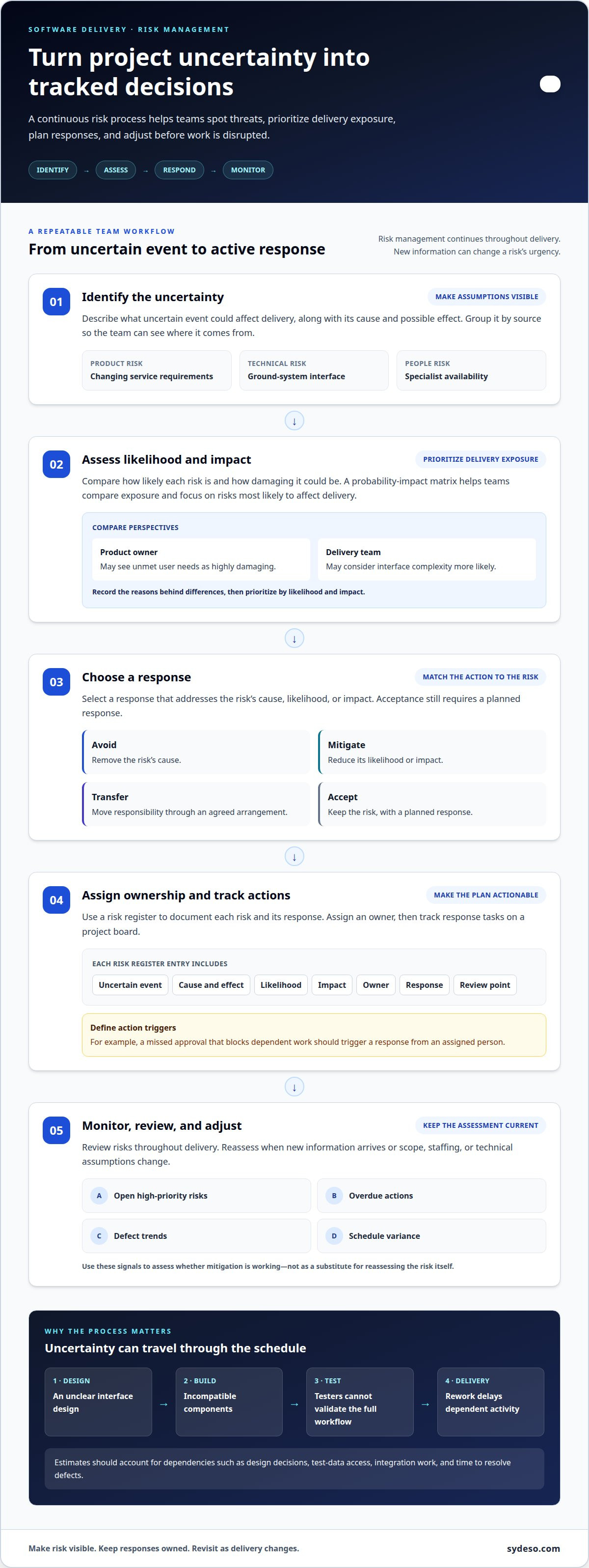
In a satellite communications project, classify changing service requirements as product risks, a ground-system interface as a technical risk, and specialist availability as a people risk. The product owner may see unmet user needs as highly damaging, while the delivery team may consider interface complexity more likely. Compare both assessments, record the reasons for differences, and prioritize risks by impact and likelihood.
Teams can use a probability-impact matrix to compare exposure, a risk register to document details and owners, and a project board to track response tasks. For each register entry, describe the uncertain event, its cause and effect, likelihood, impact, owner, response, and review point.
Risk Management Across the Project
Risk management includes identification, analysis, response planning, and monitoring throughout delivery. For teams managing software development project risks, ongoing review matters because new information can change a risk’s urgency.
Teams can avoid a risk by removing its cause, mitigate its likelihood or impact, transfer responsibility through an agreed arrangement, or accept it with a planned response. Track open high-priority risks, overdue actions, defect trends, and schedule variance to assess whether mitigation is working.
A common mistake is treating the first assessment as final. Reassess after scope, staffing, or technical assumptions change. Managing software development project risks also means defining action triggers, such as a missed approval that blocks dependent work, and assigning someone to respond.
What impact do software development risks have on project timelines?
A timeline slips when uncertainty interrupts work or sends completed tasks back for revision. Design assumptions, implementation defects, testing gaps, and operational dependencies can each delay the next planned activity.
Technical Risks Across Development
Technical risks involve uncertainty in design, implementation, or testing that can block dependent work. A flaw found late may require changes across several completed tasks. For example, an unclear interface design can lead developers to build incompatible components, leaving testers unable to validate the full workflow.
Project management and operational risks can compound technical problems. A decision awaiting stakeholder approval or an unavailable test environment can pause implementation, even when code is ready. Estimates should account for dependencies such as design decisions, access to test data, integration work, and time to resolve defects.
Architecture, Technical Debt, and Stack Relevance
Architecture determines how software components connect, technical debt creates future work through expedient choices, and technology-stack fit reflects whether the chosen tools suit the business case. These choices shape implementation effort, testing needs, and later changes.
For example, in a tightly connected application, a small feature change may affect multiple areas and increase regression testing. Microservices may suit cases where scalability and flexibility are critical; a monolithic architecture may better fit priorities around testing and maintenance. Software engineering analysis should match architecture to business requirements rather than assume one pattern fits every project.
A technology stack also affects delivery when the team must integrate unfamiliar tools or work around performance limits. Clear documentation of components, interfaces, and known trade-offs helps engineers estimate work and investigate faults. If technical risks need structured review, review software project risks as part of planning before design decisions become costly to change.
Technical risks, including code quality and technology choices
Technical threats can turn small defects or unsuitable tools into rework, delays, and cost overruns. Teams can strengthen estimates by reviewing code quality, bug counts, and delivery progress together.
Code Quality and Security
Code quality and security risks arise when defects, weak access controls, or unsafe coding practices leave software unreliable or exposed. They matter because late fixes can disrupt planned work and weaken stakeholder confidence.
Use version control and code reviews to catch problems before changes reach shared components. For example, a review can identify unchecked input before it creates a security weakness. Secure coding principles and frameworks such as NIST SSDF provide practices teams can apply during implementation. Frequent testing and prompt bug fixes support risk mitigation, while clear team standards make reviews more consistent.
Quality Assurance and Project Outcomes
Early quality assurance tests assumptions and working software before defects spread into later tasks. It matters because a test failure found during implementation usually involves less rework than one discovered near release.
Involve QA in design discussions to identify test cases and dependencies before coding begins. For example, testers can flag an error-handling requirement missing from a feature description. This gives developers a clearer target and helps project leads estimate testing effort more accurately.
Unresolved defects can trigger repeated fixes, expand testing, and delay dependent work. If a release slips or quality issues reach users, stakeholders may question the plan and delivery decisions. Track bug trends alongside milestone progress, and investigate an increase before it becomes a release blocker. Review technology choices against project requirements too: unfamiliar tools or integration limits can add testing and support work, affecting both schedules and confidence.
Operational and project management risks
Operational and project management risks affect delivery when decisions, resources, or dependencies are unavailable when needed. For example, a vendor delay can block integration even after the development team finishes its assigned code. Managing software development project risks means linking each dependency to an owner, a decision point, and the work that relies on it.
Unrealistic deadlines and scope changes can distort estimates. Define stakeholder requirements during business analysis, then record proposed changes against agreed project goals. If a stakeholder requests a reporting feature, assess its effects on design, development, testing, and release tasks before adding it. This makes trade-offs visible and prevents new requests from quietly displacing committed work.
Resource allocation creates another schedule risk. A specialist assigned to overlapping tasks can become a bottleneck, even when each task has a reasonable estimate. Break deliverables into smaller steps, map dependencies, and assign clear ownership. A work breakdown structure links tasks to deliverables, while a Gantt chart helps project managers see how a delay could affect later work.
Prioritize risks by likelihood and potential impact, then plan responses around the work they threaten. If a vendor delay puts a release at risk, identify dependent tasks and decide whether they can be resequenced. Revisit the plan when staffing, scope, or client needs change. Managing software development project risks also requires clear decision owners, so teams know who can approve a trade-off and keep work moving.
When unclear requirements or competing priorities affect a software project, plan custom software development around documented needs, dependencies, and delivery responsibilities.
Sydeso: Custom software development
Sydeso helps businesses address delivery risks with custom software developed around their requirements and constraints. Turn to the team when an internal process needs a tailored tool, an early product idea needs an MVP, or a planned launch needs development and support.
Clear scope and shared decisions give technical work a firmer foundation. Your team brings business priorities and stakeholder context; Sydeso builds software aligned with those needs. For internal tools, that means defining the workflow the software must support. For an MVP, it means focusing development on the product’s essential functions.
Software development support is most useful when uncertainty affects delivery decisions or internal capacity. If your team has a defined software need and wants a development partner, contact Sydeso to discuss the project.
Set the next project decision with care
Make uncertainty part of the project’s working plan, not a separate exercise. Choose a decision that could change scope, ownership, or delivery order, then document who will resolve it and what work depends on the answer. This gives stakeholders a clear basis for discussion as the project progresses.
Managing software development project risks also means matching the development approach to the work ahead. Sydeso offers custom software development for tailored business needs, internal tools for operational workflows, and MVP development for early product validation. Each suits a different starting point, depending on the problem your team needs to solve.
Bring your project goals and current delivery concerns into the conversation. Contact Sydeso about your project to discuss a practical next step. A clear starting point makes the work easier to shape.
Frequently Asked Questions
What are the potential consequences of not addressing risks in software development proactively?
Unaddressed risks can turn manageable issues into connected delivery problems. A delayed decision may leave developers waiting, compress review time, and force stakeholders to choose between changing scope and moving a release. For example, if an external dependency changes late, teams may need to revise connected features and their validation. The result can be avoidable rework and less confidence in delivery decisions.
What are the most common risks in software development projects?
Common risks include unclear requirements, changing priorities, unfamiliar technology, integration failures, security weaknesses, and limited access to people or systems. External dependencies add uncertainty when a vendor changes an interface or misses a delivery. People-related risks matter too: a team member may hold specialist knowledge others need to continue a task. Consider how each risk could interrupt a specific project activity.
How do you identify and assess software project risks?
Identify risks by reviewing assumptions, dependencies, requirements, and delivery constraints with the people responsible for the work. Ask each role to name events that could prevent an agreed outcome, then describe their causes and effects. Assess likelihood, impact, timing, and how much warning the team would receive. For example, link a pending interface decision to a feature that cannot proceed without it.
What risk assessment methods and scoring scales work best for software teams?
A probability-impact matrix helps teams compare risks visually, while a risk register records context, ownership, and responses. Labels such as low, medium, and high are easy to discuss; numeric scores can support consistent comparisons when teams define each rating clearly. Choose a method the team can apply repeatedly. For complex dependencies, note why a score changed instead of relying on the score alone.
How can teams prioritize software development project risks?
Prioritize risks by weighing potential harm against likelihood, urgency, and the number of dependent tasks. A lower-probability issue may still need early attention if it blocks a critical decision or offers little warning. Compare the product owner’s view of business impact with the delivery team’s view of technical exposure, and document the reasons for the ranking. Revisit priorities when scope or dependencies shift.
What are effective risk mitigation and contingency planning strategies for software projects?
Mitigation reduces a risk’s likelihood or impact; contingency planning defines the response if it occurs. For a fragile integration, a team might test the connection early and document a fallback workflow if the dependency fails. Assign an owner and a trigger for each response, such as a missed approval date. Review both plans as project conditions change, and accept only risks the team has deliberately assessed.
Questions
- What are the potential consequences of not addressing risks in software development proactively?
- Unaddressed risks can turn manageable issues into connected delivery problems. A delayed decision may leave developers waiting, compress review time, and force stakeholders to choose between changing scope and moving a release. For example, if an external dependency changes late, teams may need to revise connected features and their validation. The result can be avoidable rework and less confidence in delivery decisions.
- What are the most common risks in software development projects?
- Common risks include unclear requirements, changing priorities, unfamiliar technology, integration failures, security weaknesses, and limited access to people or systems. External dependencies add uncertainty when a vendor changes an interface or misses a delivery. People-related risks matter too: a team member may hold specialist knowledge others need to continue a task. Consider how each risk could interrupt a specific project activity.
- How do you identify and assess software project risks?
- Identify risks by reviewing assumptions, dependencies, requirements, and delivery constraints with the people responsible for the work. Ask each role to name events that could prevent an agreed outcome, then describe their causes and effects. Assess likelihood, impact, timing, and how much warning the team would receive. For example, link a pending interface decision to a feature that cannot proceed without it.
- What risk assessment methods and scoring scales work best for software teams?
- A probability-impact matrix helps teams compare risks visually, while a risk register records context, ownership, and responses. Labels such as low, medium, and high are easy to discuss; numeric scores can support consistent comparisons when teams define each rating clearly. Choose a method the team can apply repeatedly. For complex dependencies, note why a score changed instead of relying on the score alone.
- How can teams prioritize software development project risks?
- Prioritize risks by weighing potential harm against likelihood, urgency, and the number of dependent tasks. A lower-probability issue may still need early attention if it blocks a critical decision or offers little warning. Compare the product owner’s view of business impact with the delivery team’s view of technical exposure, and document the reasons for the ranking. Revisit priorities when scope or dependencies shift.
- What are effective risk mitigation and contingency planning strategies for software projects?
- Mitigation reduces a risk’s likelihood or impact; contingency planning defines the response if it occurs. For a fragile integration, a team might test the connection early and document a fallback workflow if the dependency fails. Assign an owner and a trigger for each response, such as a missed approval date. Review both plans as project conditions change, and accept only risks the team has deliberately assessed.