How to Calculate Software Development ROI from Time Saved
Start calculating ROI of software development 2026 using time saved. Learn how to convert freed hours into measurable economic value and track project gains.

Time saved is not a return until it creates measurable economic value. For teams calculating ROI of software development in 2026, the core formula is straightforward: subtract investment costs from realized value, divide by investment costs, then multiply by 100. A custom software project is generally considered a good investment when it pays back within 12-36 months and exceeds the company’s hurdle rate.
That benchmark is useful only when the calculation reflects how the software changes the work. Hours freed up may reduce labor costs, support more output, or create unused capacity. Adoption, training, maintenance, and workflow changes all affect the result.
This guide explains how to calculate software ROI, choose a measurement period, and turn saved time into an economic benefit you can track. You’ll also learn how to adapt the method for a small business or AI project, include the full cost of ownership, and compare projected gains with actual performance after launch. Use these steps when calculating ROI of software development in 2026, so the estimate reflects business outcomes rather than hours saved alone.
Key Takeaways
- Use the ROI formula to compare realized benefits with the full investment, including implementation, training, integration, and ongoing costs.
- Set project-specific measures for cost savings, revenue growth, and efficiency so the calculation reflects business results.
- For small businesses, start with a clear operational baseline and track whether saved time reduces costs or supports more valuable work.
- For AI projects, account for adoption, learning time, and the share of work the tool actually handles before projecting returns.
- Convert hours saved into economic value by assigning them to reduced labor expense, additional output, or other measurable business gains.
Table of Contents
- What is a Good ROI in Custom Software Projects?
- What is software ROI for small businesses?
- Customizing ROI metrics for specific projects, including AI
- Software ROI formula
- Converting time saved into realized economic benefits
- Sydeso: Custom software development
What is a Good ROI in Custom Software Projects?
Custom software and off-the-shelf software use the same return on investment formula, but custom projects include build and lifecycle costs; SaaS platforms typically aim for a 3x to 5x ROI. In the United States in 2026, development costs depend on scope, project management, QA, infrastructure, integrations, and stakeholder time; risks include rework, weak adoption, and communication delays, and project pricing depends on these factors.
-
Identify Project Cost Categories
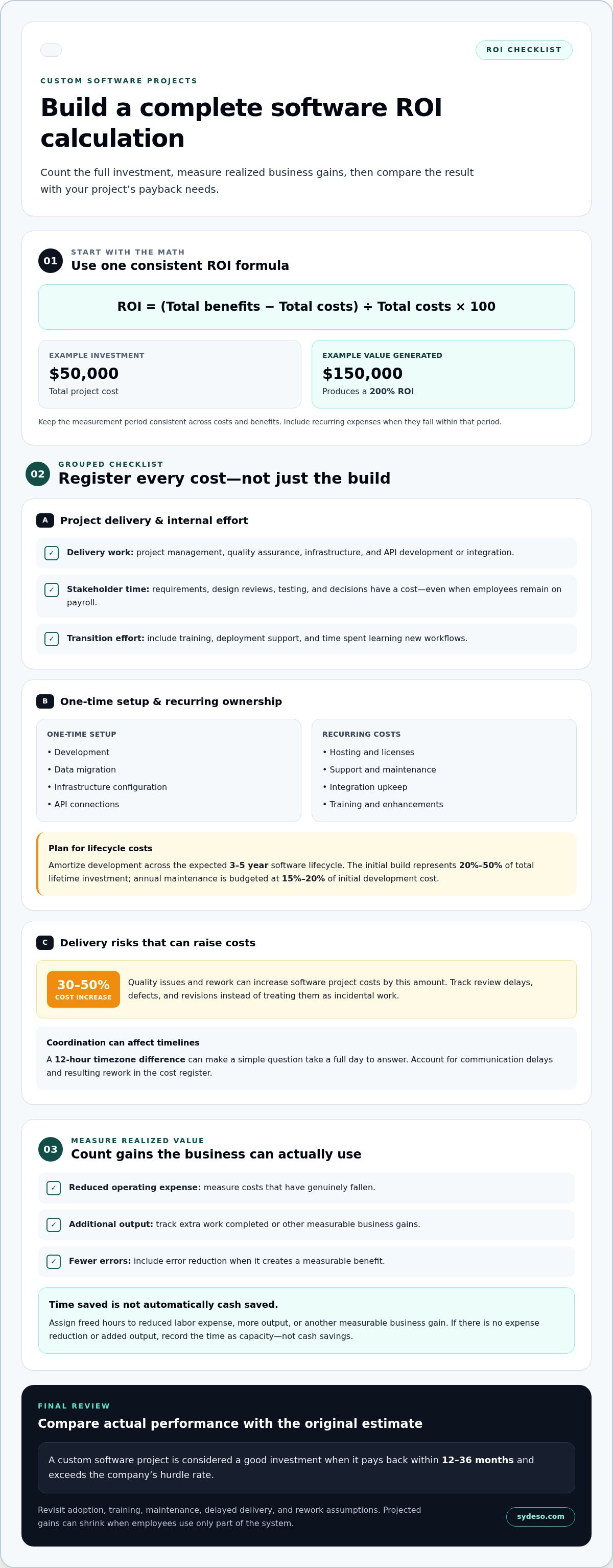
Build a cost register before comparing returns. Include project management, quality assurance, stakeholder time, infrastructure, and API development or integration. Add employees’ hours for requirements, design reviews, testing, and decisions. These hours carry a cost even when employees remain on payroll. Include training and deployment support, too, because teams spend time learning new workflows and managing the transition.
Check how delivery structure affects coordination. A 12-hour timezone difference can make a simple question take a full day to answer. Quality issues and rework can increase software project costs by 30-50%. Track review delays, defects, and revisions instead of treating them as incidental work.
-
Account for Lifecycle Costs
Separate one-time setup costs from recurring operating costs. Setup may include development, data migration, infrastructure configuration, and API connections. Operating costs can include hosting, licenses, and support. Include training, integration, maintenance, and support in your software investment estimate. Keep each category visible so recurring expenses don’t disappear inside the initial project figure.
Amortize development costs over the expected software lifecycle of three to five years. The initial build typically represents 20% to 50% of total lifetime investment. Budget annual maintenance at 15% to 20% of the initial development cost. Compare those planned costs with the actual effort needed to fix defects, adapt integrations, and maintain infrastructure. Avoid counting the initial build as the only investment.
-
Compare Total Benefits and Costs
Calculate return on investment by subtracting total costs from total benefits, dividing the result by total costs, then multiplying by 100. Include measurable gains such as reduced operating expense, additional output, or fewer errors. Keep the measurement period consistent across both sides. A software project costing $50,000 and generating $150,000 in value has a 200% ROI.
Compare the result with your company’s hurdle rate and payback needs. Custom software projects are considered good investments when they pay back within 12-36 months and exceed that hurdle rate. Revisit adoption, training, and maintenance assumptions; projected gains shrink when employees use only part of the system. Include delayed delivery and rework in the cost total, then compare actual results against the original estimate.
What is software ROI for small businesses?
For a small business, software ROI connects measurable gains with the full cost of ownership. Start with a defined metric, then track it against a consistent baseline.
-
Identify Costs and Benefits
List each software expense and benefit before calculating the return. Include licenses, hosting, hardware, labor, and internal time spent on training or implementation. For benefits, separate cost savings from added revenue and efficiency gains. A saved hour has financial value only when it reduces expense, supports more work, or improves another measured result.
Choose a baseline that reflects current operations. For example, record processing time, error rates, or sales completed before the new system goes live. Then compare the same measure after adoption. Record other outcomes, such as improved customer satisfaction, separately from cash benefits so the calculation doesn’t treat an unpriced result as realized revenue.
-
Calculate Total Cost of Ownership
Build a total cost of ownership estimate that includes setup and recurring expenses.
Add hosting, integration, maintenance, support, and employee training to the relevant periods. Businesses should plan for minor software enhancements to cost 10-15% of the initial build per year. Separate one-time implementation from recurring costs, then use the same period for costs and benefits. This prevents a monthly saving from being compared with only the setup expense.
- Choose a small set of measures tied to business priorities. Cost savings may include less manual processing or fewer duplicate tasks. Revenue growth may come from handling more orders or shortening sales follow-up. Efficiency gains can be measured through completed work, cycle time, or employee capacity. Keep each measure distinct to avoid counting one improvement twice.
Set a target for each metric before implementation. If the software reduces a process delay, record how that change affects completed work or customer response. If no expense falls and no additional output follows, record the time gain as capacity, not cash savings. This distinction gives a small business a more defensible view of return.
- Calculate ROI by subtracting investment costs from realized benefits, dividing by investment costs, then multiplying by 100. Software ROI can also be expressed as net profit divided by investment cost. Use one method consistently across projects and state whether the result includes recurring expenses.
Software returns of 100% or more describe investments that have paid for themselves. Review actual performance against the baseline and the original metric. If a tool reduces maintenance costs, for example, compare the expense before and after replacement. A consistent calculation helps owners decide whether to expand use, adjust the workflow, or reconsider the investment.
A clear cost-and-benefit model can also guide software investment planning before a project begins.
Customizing ROI metrics for specific projects, including AI
Match each measure to the project’s business goal, then update forecasts as evidence changes. Payback period is the time until cumulative benefits cover total costs. Net present value discounts future cash flows before subtracting the initial investment.
-
Tailor Metrics to Project Goals
Choose measures that reflect the work the system needs to improve. For an AI tool, track eligible work, adoption, time released, and the value of that time. Treat these as model inputs, not guaranteed results.
For a revenue tool, measure completed sales or reduced delays. AI and machine learning projects often target 5x to 7x ROI, but compare that target with your project’s measurable benefits and full costs.
-
Set Break-Even Timelines
Set a break-even point before work begins. Most custom software projects reach break-even within 12 to 24 months, while internal automation tools have a typical break-even timeline of 3-12 months. Use the project’s expected adoption, operating costs, and benefit ramp to estimate when cumulative net gains cover investment.
For startups, target break-even within six months because cash flow constraints matter. Enterprise software has a typical break-even timeline of 18-36 months. Don’t compare unlike projects using one deadline. Record the assumptions behind each estimate, including when users begin adopting the system and when measurable benefits start.
-
Evaluate Each Project Stage
Review the business case at each project stage, not just after launch. During discovery, confirm the target workflow and baseline. During development, track progress, scope changes, and costs. Before deployment, assess user readiness and training needs. These checkpoints show whether the project still supports its original business goal.
At each review, compare actual evidence with the forecast. If testing shows a feature cannot handle the intended work, revise the benefit estimate before expanding scope. A 90-day pilot can help assess AI ROI using real task completion, user adoption, and operating data before broader deployment.
-
Adjust Forecasts and Measurements
Update the estimate when adoption, delivery, or operating conditions change. A tool used by 60% of a team is estimated to deliver 60% of its projected benefit. Measure actual use and outcomes separately; login activity alone doesn’t show whether the work improved.
Reevaluate project expectations after deployment and adjust the plan when progress stalls or goals shift. BCG reports that 74% of organizations struggle to implement AI at scale and achieve ROI. Treat that as a reason to track deployment and realized value closely, not to assume projected gains will appear automatically.
Software ROI formula
Common measures include ROI, payback period, and net present value (NPV). Use a consistent time horizon, include all costs, and compare realized benefits with the investment.
-
Set Assumptions and Time Horizon
Choose a measurement period that matches the project’s expected useful life and financial strategy. Software development costs are commonly assessed across an expected lifecycle of three to five years. Keep the period consistent for benefits and costs, and record when benefits begin. Early training, adoption, and operating expenses can make first-year returns differ from later results.
State assumptions before calculating: expected adoption, benefit realization, recurring costs, and the discount rate used for NPV. Avoid assuming every employee adopts the system immediately. Use the same assumptions for each scenario, then change one input at a time to see what drives the result. Review performance 3, 6, and 12 months after launch.
Payback period is the time required for cumulative net benefits to recover the initial investment. NPV discounts future cash flows to present value, then subtracts the initial investment. Both measures add useful context to ROI by showing the timing and value of future returns.
-
Apply the Software ROI Formula
Calculate ROI by subtracting investment cost from value realized, dividing by investment cost, then multiplying by 100. In formula form: ROI = ((value realized − cost of investment) ÷ cost of investment) × 100. Include operating expenses and benefits from the same period. An ROI of 150% means gaining $1.50 for every dollar spent.
Track more than one financial measure. ROI summarizes returns against costs; payback shows how long recovery takes; NPV compares future cash flows in present-value terms. ClearPoint Strategy cites 20% as a target for software ROI. Treat benchmarks as comparison points, not substitutes for your organization’s hurdle rate or project assumptions.
Use a worked calculation to test the inputs before sharing a forecast. For example, separate direct savings from revenue growth, then check that both are measured over the same period. Don’t count a projected benefit as realized value until the business records it. Keep short-term results distinct from long-term effects, such as ongoing efficiency gains.
Apply the same formula and reporting period at each project review. If scope, adoption, or operating costs change, update the inputs and document why. Consistent calculations make results comparable across projects and help decision-makers distinguish performance changes from revised assumptions.
Converting time saved into realized economic benefits
Time savings become economic benefits only when they change costs, output, or service. Measure the change, then connect it to a business result.
-
Measure Time Saved
Record the current process before deployment, then compare it with actual use. Track task volume, completion time, and rework so the baseline reflects the full workflow. A new internal system that saves ten employees five hours weekly yields 2,600 hours of annual productivity. Use that estimate as released capacity, not automatic cash savings.
Next, identify where those hours go. If employees complete more customer work, measure added output. If the business reduces overtime or staffing expense, record the actual reduction. A chatbot example saved 13,300 customer service hours valued at $320,000. Connect saved hours to a verifiable result before including them in ROI.
-
Include Intangible Benefits
Record employee morale, company culture, and customer satisfaction as separate outcomes. For example, track customer feedback alongside response times after changing a support workflow. Keep these measures visible, but don’t assign them financial value without a defensible method. This prevents an ROI calculation from treating a positive experience as revenue or cost savings.
Use the same measurement approach before and after launch. A clear customer satisfaction measure can show whether faster service improves the experience. Staff feedback can reveal whether automation removes repetitive work or creates new review tasks. These indicators add context to financial results without replacing them.
- Convert released capacity into a documented benefit. Apply a loaded labor cost only when the time supports reduced expense or productive work. Keep the calculation tied to actual adoption and completed work, rather than assuming every employee uses the system fully.
Assign an owner to each benefit. Finance can validate expense changes, while operations can confirm workflow volume and completion time. A named owner and recorded measure make results easier to audit. Separate confirmed savings from projected productivity so decision-makers can see which gains have reached the business.
- Use ROI analysis to guide decisions, not just report a final percentage. Compare projected benefits with actual results, identify gaps, and adjust the workflow or rollout. A six-month post-launch audit can compare expected outcomes with performance data. Review adoption, quality, and realized savings together before extending the same system to more teams.
Keep records consistent across reviews. Note the baseline, measurement period, adoption level, and benefit owner. If productivity rises but spending remains unchanged, report the capacity gain separately. If an expense falls, record the amount and period in the financial calculation. This distinction keeps the ROI result accurate and useful.
- Use these measures to define the software workflow and the outcomes it must support. Plan a software ROI assessment around the tasks, users, and benefits you intend to measure.
Sydeso: Custom software development
Sydeso can help when the ROI case points to a workflow that existing tools don’t handle well. Its custom software and internal tools are built around the tasks, users, and outcomes identified in your analysis.
If the business case still needs validation, an MVP can test a focused set of assumptions before broader development. Once the solution is ready, Sydeso’s launch and support services help bring it into use. Your team defines the workflow and measures results; Sydeso turns those requirements into software.
Share the process you want to improve and the benefits you plan to measure. Contact Sydeso or visit sydeso.com to discuss the next step.
Turn your ROI case into a practical next step
A useful ROI model should guide a decision, not sit in a spreadsheet. For teams calculating ROI of software development 2026, the next step is to identify the workflow, users, and business outcome that need attention. That turns an estimate into a working basis for project planning.
If existing tools don’t fit the workflow, Sydeso can build custom software and internal tools to address the operational need. An MVP can test a focused set of assumptions before wider implementation. The right starting point depends on the problem, the users, and the outcome your team needs to measure.
Bring your workflow and goals into the next discussion. Discuss your software project with Sydeso and make calculating ROI of software development 2026 a practical step toward software that supports your operations.
Frequently Asked Questions
How to measure ROI in software?
Measure software ROI by comparing business outcomes against a clear before-and-after baseline. Choose a process measure, such as completed orders, error corrections, or customer response time, then compare equivalent periods and workloads. Separate verified cash changes from capacity gains. This helps show whether the software changed the business result or whether other factors, such as seasonal demand, influenced the comparison.
Can you calculate ROI for internal business tools?
Yes. Internal tools can be assessed through reduced processing effort, fewer errors, faster handoffs, or increased employee capacity. Define the workflow and the outcome before rollout, then collect the same operational data afterward. Year-one ROI for internal tools and process automation is typically 5-10%. Treat that as a reference point, not a substitute for measuring your tool’s actual use and results.
How long does it typically take to see a positive ROI on software?
Timing depends on implementation, adoption, and how quickly benefits affect business results. A software investment with payback under 12 months is considered very strong, while 12-18 months is a healthy benchmark for 2026. Track interim signals, such as completed work and operating expense, before the full investment pays back. A delayed benefit may reflect a gradual rollout rather than a failed business case.
What Actually Counts as "Returns"?
Returns include measurable gains caused by the software, such as lower operating expenses, additional sales, fewer errors, or more work completed with existing capacity. Count revenue only when it can be linked to the software’s effect, not merely to a period when the tool was available. Record employee morale or customer satisfaction separately unless your method assigns those outcomes a defensible financial value.
What are the ROI benchmarks and payback periods in 2026?
Benchmarks vary by project type and measurement method. iSixSigma considers software ROI of 5-10% a good return, while ClearPoint Strategy cites 20% as a target. Custom business software is often given a typical ROI range of 100%-300% and a payback period of 12-18 months. Compare these references with your organization’s hurdle rate, project scope, and measurement period.
How do you calculate ROI for software development projects?
Divide net benefit by total investment, then express the result as a percentage. Build the calculation around one defined period and use the same accounting boundaries for costs and benefits. For example, if a rollout serves several departments, allocate shared implementation expenses consistently. Report ROI alongside payback timing so decision-makers can see both the return level and when the project recovers its investment.
What costs should be included when calculating software development ROI?
Include costs beyond the developer’s work: internal planning, staff training, deployment effort, integration, licenses, hosting, hardware, maintenance, and support. Also record productivity disruption during implementation, such as time spent learning changed procedures. For a fair comparison, separate one-time expenses from recurring charges and allocate shared infrastructure or support costs to the software using a consistent method.
How do you estimate the financial benefits and time savings of custom software?
Start with observed task volume and completion time, then estimate how many hours the new process can release. Value those hours only when they reduce paid work, prevent added labor, or support measurable additional output. Validate the result with operational records and team leads. If saved capacity is redeployed rather than removed from payroll, report it as productivity capacity, not direct cash savings.
Questions
- How to measure ROI in software?
- Measure software ROI by comparing business outcomes against a clear before-and-after baseline. Choose a process measure, such as completed orders, error corrections, or customer response time, then compare equivalent periods and workloads. Separate verified cash changes from capacity gains. This helps show whether the software changed the business result or whether other factors, such as seasonal demand, influenced the comparison.
- Can you calculate ROI for internal business tools?
- Yes. Internal tools can be assessed through reduced processing effort, fewer errors, faster handoffs, or increased employee capacity. Define the workflow and the outcome before rollout, then collect the same operational data afterward. Year-one ROI for internal tools and process automation is typically 5–10%. Treat that as a reference point, not a substitute for measuring your tool’s actual use and results.
- How long does it typically take to see a positive ROI on software?
- Timing depends on implementation, adoption, and how quickly benefits affect business results. A software investment with payback under 12 months is considered very strong, while 12–18 months is a healthy benchmark for 2026. Track interim signals, such as completed work and operating expense, before the full investment pays back. A delayed benefit may reflect a gradual rollout rather than a failed business case.
- What Actually Counts as "Returns"?
- Returns include measurable gains caused by the software, such as lower operating expenses, additional sales, fewer errors, or more work completed with existing capacity. Count revenue only when it can be linked to the software’s effect, not merely to a period when the tool was available. Record employee morale or customer satisfaction separately unless your method assigns those outcomes a defensible financial value.
- What are the ROI benchmarks and payback periods in 2026?
- Benchmarks vary by project type and measurement method. iSixSigma considers software ROI of 5–10% a good return, while ClearPoint Strategy cites 20% as a target. Custom business software is often given a typical ROI range of 100%–300% and a payback period of 12–18 months. Compare these references with your organization’s hurdle rate, project scope, and measurement period.
- How do you calculate ROI for software development projects?
- Divide net benefit by total investment, then express the result as a percentage. Build the calculation around one defined period and use the same accounting boundaries for costs and benefits. For example, if a rollout serves several departments, allocate shared implementation expenses consistently. Report ROI alongside payback timing so decision-makers can see both the return level and when the project recovers its investment.
- What costs should be included when calculating software development ROI?
- Include costs beyond the developer’s work: internal planning, staff training, deployment effort, integration, licenses, hosting, hardware, maintenance, and support. Also record productivity disruption during implementation, such as time spent learning changed procedures. For a fair comparison, separate one-time expenses from recurring charges and allocate shared infrastructure or support costs to the software using a consistent method.
- How do you estimate the financial benefits and time savings of custom software?
- Start with observed task volume and completion time, then estimate how many hours the new process can release. Value those hours only when they reduce paid work, prevent added labor, or support measurable additional output. Validate the result with operational records and team leads. If saved capacity is redeployed rather than removed from payroll, report it as productivity capacity, not direct cash savings.