How to Choose a Software Development Partner: A Practical Checklist for 2026
Learn how to choose a software development partner in 2026. Use this practical checklist to assess delivery fit, technical skills, and post-launch support.

The best-looking proposal may tell you the least about who will own delivery. Knowing how to choose a software development partner means looking past polished presentations and checking how the work will be scoped, managed, tested, and supported.
It’s reasonable to compare technical skills, cost, and past projects. But credentials matter only when they connect to your business needs, and a low-friction sales process doesn’t guarantee clear responsibilities once development begins. Scope changes, communication gaps, and unclear post-launch ownership can create avoidable risk.
This practical checklist helps you build an evidence-based shortlist and assess each partner’s fit, delivery practices, accountability, and support. You’ll learn what to examine in project examples, how to clarify decision-making and responsibilities, and how to match an engagement model to the work. The goal is a partner suited to your project’s full lifecycle and your team’s capacity, from initial requirements through launch and ongoing support.
Key Takeaways
- Start with the business problem, intended users, operating constraints, and your team’s capabilities before comparing proposals.
- Use the same project scenario to assess each candidate, recording evidence, open risks, and who owns each decision.
- When considering how to choose a software development partner, weigh delivery evidence and accountability more heavily than presentation quality.
- Before signing, document the outcomes, scope, assumptions, dependencies, responsibilities, governance, and acceptance criteria.
- Match the partner’s capabilities to the work and lifecycle, from custom software or internal tools to launch and ongoing support.
Table of Contents
- How to Choose a Software Development Partner: Start With the Work
- Software Development Partner Checklist: Assess Delivery Evidence
- Compare Software Development Partners With Evidence, Not Sales Claims
- Before You Sign: Validate Scope, Ownership, and Working Rules
- How Sydeso Fits a Software Development Partnership
How to Choose a Software Development Partner: Start With the Work
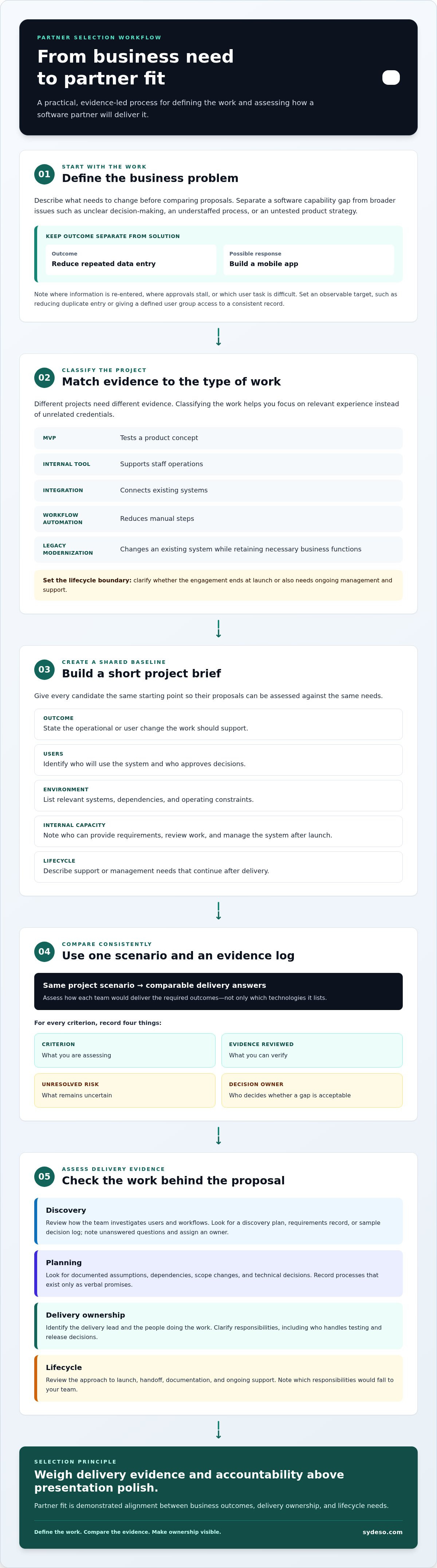
Choose for the business problem, delivery needs, and lifecycle, not the polish of a pitch. The first step in how to choose a software development partner is to define what needs to change and what your team can contribute. Without that baseline, proposals can make different assumptions about users, scope, or ownership and still appear comparable.
Start by separating a software capability gap from a broader business problem. A new tool won’t resolve unclear decision-making, an understaffed process, or a product strategy that hasn’t been tested. In some cases, the right next step is to adjust the workflow or clarify ownership before development begins. This distinction keeps the brief focused on work software can reasonably support.
Define the business outcome before evaluating partners
Describe the current process in operational terms. For example, identify where staff re-enter information, where approvals stall, or which user task is difficult to complete. Set a target that can be observed, such as reducing duplicate entry or giving a defined group of users access to a consistent record.
Record who makes decisions, who uses the system, and which tools or processes it must work with. Note constraints such as data access, internal technical capacity, and dependencies on other teams. Separate these requirements from solution assumptions. “Reduce repeated data entry” is an outcome; “build a mobile app” is one possible response.
Match the partner search to the type of work
Different projects need different evidence. An MVP tests a product concept. An internal tool supports staff operations. An integration connects existing systems, while workflow automation reduces manual steps. Legacy modernization addresses an existing system that needs to change without losing necessary business functions. Classifying the work helps you assess relevant experience rather than collect unrelated credentials.
Also define where the engagement ends. Does the work stop at launch, or will it need ongoing management and support? A tailored application has decisions beyond its initial feature set, including how it fits into current operations. The custom application development overview can help clarify the components involved.
Before requesting proposals, capture a short project brief:
- Outcome: State the operational or user change the work should support.
- Users: Identify who will use the system and who approves decisions.
- Environment: List relevant systems, dependencies, and operating constraints.
- Internal capacity: Note who can provide requirements, review work, and manage the system after launch.
- Lifecycle: Describe the support or management needs that continue after delivery.
This brief gives each candidate the same starting point. It also reveals whether you need product development, integration, automation, modernization, or a combination. Define the work first; then assess which partner’s capabilities and working approach fit it.
Software Development Partner Checklist: Assess Delivery Evidence
Use the same project scenario and required outcomes to assess every candidate. A practical answer to how to choose a software development partner is to compare how each team would deliver the work, not just which technologies it lists. Familiar tools may be relevant, but they don’t prove the team understands your constraints or can take responsibility for the delivery process.
Partner fit is demonstrated alignment between business outcomes, delivery ownership, and lifecycle needs. Record what you can verify, what remains uncertain, and who will decide whether each gap is acceptable.
Keep a working checklist with four fields: criterion, evidence reviewed, unresolved risk, and decision owner. For example:
- Discovery: Review a sample plan or discussion of how the team investigates users and workflows. Record unanswered questions and assign an owner to resolve them.
- Planning: Look for examples of documented assumptions, dependencies, scope changes, and technical decisions. Note any process that exists only as a verbal promise.
- Delivery ownership: Identify the proposed delivery lead and the people doing the work. Record unclear responsibilities, including who handles testing and release decisions.
- Lifecycle: Review the proposed approach to launch, handoff, documentation, and ongoing support. Note which responsibilities would fall to your team.
Check discovery, planning, and technical judgment
Look for a repeatable way to understand users, workflows, requirements, and constraints before committing to a design. Useful evidence can include a discovery plan, a requirements record, or a sample decision log. Ask how the team identifies assumptions and revisits them when new information changes the scope. Architecture choices should be tied to actual needs, such as integration requirements or expected operating conditions, not presented as defaults.
For product work, Lean Startup principles in software development partnerships reinforce the value of testing assumptions through iterative development and customer feedback.
Verify team ownership, quality, and communication
Get a clear account of who performs the work, who leads delivery, and how decisions move between your team and theirs. Review how testing, code review, security, and release readiness fit into the process. Ask to see practical examples, such as a test plan or release checklist. Agree on how stakeholders will see progress, blockers, risks, and decisions, and how unresolved issues get escalated.
Include launch and post-launch responsibilities
Define what completion means beyond code delivery. Clarify who manages deployment, prepares documentation, transfers knowledge, and handles operational handoff. Then map ongoing support and lifecycle work to your internal capacity. A retained engagement or a project-based arrangement may suit different needs; the key is to make ownership explicit. Businesses assessing tailored engineering and lifecycle support can review Sydeso’s software development work as one point of comparison.
Compare Software Development Partners With Evidence, Not Sales Claims
Use one comparison framework for every candidate. A polished portfolio, familiar technology stack, or confident presentation can help start a discussion, but none shows by itself how a team will handle your project. To compare software development partners fairly, score the quality of the evidence separately from the quality of the pitch. Mark a claim as missing or untested when you can’t verify it.
Keep the rows consistent across candidates. Record evidence beside each assessment, then note unresolved concerns and who will follow up.
| Criterion | Evidence to review | What to record |
|---|---|---|
| Fit | Relevant work and the team’s role in it | How closely the example matches your needs |
| Delivery evidence | Planning, testing, and change-handling practices | Artifacts reviewed and gaps |
| Ownership | Named responsibilities for delivery and decisions | Unclear boundaries or dependencies |
| Communication | Approach to progress, blockers, and risks | How stakeholders stay informed |
| Lifecycle support | Launch, handoff, and ongoing responsibilities | Work retained by your team |
Use the same evaluation questions for every candidate
Ask each team for a relevant example and a clear account of its role in delivery. Use the same scenario to discuss changing requirements, dependencies, and delivery risks. Ask how the proposed team will coordinate with your internal stakeholders. Consistent questions make differences easier to see and help prevent a strong presentation from receiving more weight than demonstrated working practices.
Separate deal-breakers from trade-offs
Set non-negotiable requirements before scoring, such as source code ownership, security expectations, or operational fit. Treat unclear responsibilities, unsupported promises, and evasive discussion of risks as issues to resolve, not minor score deductions. Then record acceptable trade-offs and their likely effect on delivery or internal workload. If the solution approach is still open, compare custom software versus off-the-shelf software against the project’s requirements.
Build a decision matrix the team can defend
Agree on criteria and weights before scoring candidates. This reduces hindsight bias and makes priorities visible. Keep deal-breakers separate from weighted criteria; a strong score should not erase a non-negotiable gap. For every score, cite the evidence and record open questions with an owner and decision deadline. That gives stakeholders a clear basis for reviewing the recommendation.
Don’t reduce the decision to one price, stack, or portfolio. Compare how each candidate’s evidence supports the work, who owns delivery, and what your team must contribute. For a reference point on tailored engineering and software lifecycle work, review Sydeso’s software development services.
Before You Sign: Validate Scope, Ownership, and Working Rules
The final check is whether the proposal can become a workable agreement. A clear process is central to how to choose a software development partner, because even a sound plan can falter when scope, decisions, and responsibilities remain implicit. Put the working rules in writing before development starts.
Use this five-step review:
- Confirm outcomes. State the business result the work must support.
- Validate scope. Document deliverables, assumptions, dependencies, and exclusions.
- Assign ownership. Name who makes decisions, provides access, reviews work, and approves changes.
- Agree governance. Set communication channels, review points, and escalation paths.
- Define acceptance. Specify how stakeholders will assess completion and release readiness.
Confirm scope and change control
Translate the proposal into plain language. Describe each included deliverable and state what sits outside the agreement. Record dependencies such as access to existing systems, timely feedback, or decisions from internal teams. A dependency should name the responsible party and explain how a delay affects planned work.
Define how new requests will be assessed, approved, and reflected in scope and plans. Set review points around milestones so stakeholders can provide feedback and make decisions before work moves forward. This keeps a feature request from becoming an assumed commitment without an agreed impact on delivery.
Agree on accountability, access, and ownership
Document the responsibilities of both teams. Specify who supplies data and system access, who provides business input, who reviews deliverables, and who can approve changes. Clarify ownership of source code, data, documentation, and intellectual property in the agreement. Use language the people responsible for the work can understand, not only broad statements that leave practical handoffs open.
Set the working rhythm as well. Record the channels used for updates, how blockers are escalated, and which stakeholders attend governance meetings. The partner should own agreed delivery work; your team should own timely decisions and inputs assigned to it.
Validate release and support expectations
Acceptance criteria define how stakeholders determine whether agreed work is complete. Make them observable. For example, identify the workflows that must pass testing, the review required before deployment, and the materials needed for handoff. Assign testing responsibilities and name who decides whether release conditions have been met.
Also document who will maintain or use the software after handoff, how post-launch support is arranged, and how later lifecycle changes are handled. If cost is under review, compare categories such as development work, integrations, testing, launch, and ongoing support against the documented scope. Avoid relying on a single total without understanding what it covers.
Reviewing a software project’s scope, ownership, and support needs? Discuss your software development project with Sydeso.
How Sydeso Fits a Software Development Partnership
Once you’ve defined the work and set your selection criteria, compare each candidate’s capabilities against the actual need. Sydeso builds and manages tailored software across product development, operations, integrations, automation, modernization, launch, and support. The right fit depends on the problem to solve, the responsibilities your team can own, and how much support the work needs after delivery.
Match the engagement to the work
Different needs call for different forms of development. Sydeso’s custom software development supports tailored applications and portals shaped around specific business requirements. Internal tools development fits operational workflows and collaboration needs. For a new product idea, MVP development provides a way to build and deploy an initial product for validation before deciding what to develop next. Start with the intended outcome, then identify which type of work aligns with it.
- Custom software: For product or business requirements that call for a tailored application.
- Internal tools: For team processes that need software aligned with day-to-day operations.
- MVP development: For an initial product that can be put into use to test assumptions and gather feedback.
Consider the full software lifecycle
The initial build may be one part of the need. If systems must exchange information, API development and integration can address data flow between them. Workflow automation and AI agent development can support defined process requirements, while legacy modernization addresses updates to existing software and architecture. Sydeso also provides launch assistance and ongoing support, so the engagement can account for work beyond development and release.
Include these lifecycle needs in your comparison. A partner’s fit depends not only on the build, but also on how the work connects with existing systems and who will manage the software after launch. Project-based and retained engagements can support different engagement needs. Match the arrangement to the work and your team’s capacity.
Take the next step with a defined brief
A focused discussion starts with a clear account of the work. Bring the business outcome, intended users, operating constraints, required capabilities, and known risks. Add your selection checklist and decision matrix, including evidence already reviewed and questions that remain open. This gives both sides a practical basis for discussing responsibilities, scope, and lifecycle needs.
If Sydeso’s capabilities align with your requirements, discuss your software development needs with Sydeso. Use the conversation to connect the project brief to a suitable approach, from custom software or internal tools to integrations, automation, modernization, launch, and support. This evidence-led approach to how to choose a software development partner keeps the decision grounded in fit rather than presentation.
Make the Next Decision With a Clear Brief
The strongest next step is to turn your evaluation into a brief your team can use to make decisions. Keep the business outcome, key constraints, unresolved risks, and required ownership visible. That record gives stakeholders a shared basis for deciding what matters, what can change, and what must be settled before work begins. It also keeps the question of how to choose a software development partner tied to your organization’s actual needs, not a generic score or sales presentation.
Sydeso builds custom software around business requirements and operations, with work spanning MVPs, internal tools, automation, APIs, modernization, launch, and support. If those capabilities align with the brief you’ve developed, take the next step and discuss your software development needs with Sydeso.
A well-defined conversation doesn’t require every detail to be settled. It gives both sides a practical place to start, surface assumptions, and decide on a responsible path forward. Your project can move ahead with greater clarity and shared ownership.
Frequently Asked Questions
How do you choose a software development partner?
Choose a partner by matching its delivery approach to the work your organization needs done. Start with the outcome, then examine how the team handles decisions, technical trade-offs, and changing information. The best way to judge how to choose a software development partner is to look for evidence that its proposed roles and working methods fit your project. A short, consistent evaluation process helps stakeholders explain the choice and identify unresolved concerns.
What should I look for in a software development partner?
Look for clear ownership, relevant experience, and a working style your team can sustain. Check whether the people who explain the proposal will be involved in delivery, and whether responsibilities are clear across product decisions, engineering, and review. Also consider how the partner handles disagreement or changing priorities. A team that can explain trade-offs plainly and make decisions visible is easier to work with than one that relies on broad claims.
How can I assess a software development company’s technical expertise?
Assess technical expertise by asking the team to explain a relevant design decision and its effect on users or operations. For example, ask how it would connect an existing system to a new application, then listen for the assumptions, risks, and alternatives it identifies. Review sample technical documentation or a code walkthrough where appropriate. The goal is to see how the team reasons and validates its work, not to test obscure terminology.
How much does it cost to hire a software development partner?
The cost depends on the agreed scope, team responsibilities, technical complexity, integrations, testing, and support needs. Ask for an estimate that separates the work into understandable categories and identifies assumptions, dependencies, and exclusions. Clarify how the estimate changes if requirements shift or new work is requested. A useful comparison explains what each proposal includes and what your organization must provide, rather than treating the lowest initial figure as the full cost.
Who owns the code when working with a software development partner?
Code ownership should be stated in the signed agreement, not left to assumption. Define how the agreement treats project-specific source code, documentation, data, and intellectual property, as well as any pre-existing or third-party components. Clarify what materials will be transferred and what access your team will retain. If ownership terms are unclear, resolve them before work begins and have the agreement reviewed by an appropriate legal adviser.
Can a software development partner support a project after launch?
Yes, some partners provide launch assistance and ongoing support, but the scope varies by agreement. Define what support covers, how requests are handled, who manages changes, and which operational tasks stay with your team. For example, a business may need help maintaining an internal tool as workflows change, while another may need support around a product release. Treat post-launch work as a distinct responsibility, not an assumption attached to delivery.
Should I choose a software development partner based on its technology stack?
No. Treat the stack as a technical consideration, not the sole basis for selection. The tools should suit the project’s integration needs, operating environment, and likely maintenance requirements. Ask the team to explain why its proposed technologies fit those conditions and what trade-offs they create. A familiar stack can help your internal team contribute, but it does not replace evidence of sound engineering judgment, clear ownership, and reliable delivery practices.
Questions
- How do you choose a software development partner?
- Choose a partner by matching its delivery approach to the work your organization needs done. Start with the outcome, then examine how the team handles decisions, technical trade-offs, and changing information. The best way to judge how to choose a software development partner is to look for evidence that its proposed roles and working methods fit your project. A short, consistent evaluation process helps stakeholders explain the choice and identify unresolved concerns.
- What should I look for in a software development partner?
- Look for clear ownership, relevant experience, and a working style your team can sustain. Check whether the people who explain the proposal will be involved in delivery, and whether responsibilities are clear across product decisions, engineering, and review. Also consider how the partner handles disagreement or changing priorities. A team that can explain trade-offs plainly and make decisions visible is easier to work with than one that relies on broad claims.
- How can I assess a software development company’s technical expertise?
- Assess technical expertise by asking the team to explain a relevant design decision and its effect on users or operations. For example, ask how it would connect an existing system to a new application, then listen for the assumptions, risks, and alternatives it identifies. Review sample technical documentation or a code walkthrough where appropriate. The goal is to see how the team reasons and validates its work, not to test obscure terminology.
- How much does it cost to hire a software development partner?
- The cost depends on the agreed scope, team responsibilities, technical complexity, integrations, testing, and support needs. Ask for an estimate that separates the work into understandable categories and identifies assumptions, dependencies, and exclusions. Clarify how the estimate changes if requirements shift or new work is requested. A useful comparison explains what each proposal includes and what your organization must provide, rather than treating the lowest initial figure as the full cost.
- Who owns the code when working with a software development partner?
- Code ownership should be stated in the signed agreement, not left to assumption. Define how the agreement treats project-specific source code, documentation, data, and intellectual property, as well as any pre-existing or third-party components. Clarify what materials will be transferred and what access your team will retain. If ownership terms are unclear, resolve them before work begins and have the agreement reviewed by an appropriate legal adviser.
- Can a software development partner support a project after launch?
- Yes, some partners provide launch assistance and ongoing support, but the scope varies by agreement. Define what support covers, how requests are handled, who manages changes, and which operational tasks stay with your team. For example, a business may need help maintaining an internal tool as workflows change, while another may need support around a product release. Treat post-launch work as a distinct responsibility, not an assumption attached to delivery.
- Should I choose a software development partner based on its technology stack?
- No. Treat the stack as a technical consideration, not the sole basis for selection. The tools should suit the project’s integration needs, operating environment, and likely maintenance requirements. Ask the team to explain why its proposed technologies fit those conditions and what trade-offs they create. A familiar stack can help your internal team contribute, but it does not replace evidence of sound engineering judgment, clear ownership, and reliable delivery practices.