How to choose MVP features for an established business
Learn how MVP development for established businesses validates assumptions, prioritizes essential features, gathers user feedback, and guides your next inves...

An established business can learn more from a focused MVP than from a feature-heavy launch. A minimum viable product is a usable version with only the features needed for early users to test its core value and provide feedback. MVP development for established businesses should begin with the problem to validate, then include only what is needed to test whether the solution works for its intended users.
That focus matters when a new product must fit existing workflows, systems, and stakeholder needs. This guide explains how to define the MVP’s purpose, prioritize features, weigh benefits and risks, and plan discovery, testing, and development. It also covers how to assess a development partner’s approach to turning business goals into a workable first release and using feedback to guide what comes next.
Key Takeaways
- Use an MVP to test a specific business assumption, gather useful feedback, and guide the next investment.
- Start with discovery and validation; integration needs and access to users shape the development plan.
- Prioritize features that support the core value and solve a real user need. Set aside enhancements that don’t help test the main assumption.
- Choose a development partner that can work within your business constraints, define clear responsibilities, and support the product after launch.
Table of Contents
- Benefits of MVP development
- Discovery, validation, and development timelines
- Choosing MVP features
- Selecting a development partner
- Sydeso: Custom software development
Benefits of MVP development
Use an MVP to test a defined business need before committing to a broader launch. For established companies, that test must also account for existing users, systems, and operating requirements.
- Step 1: Tie the prototype to one business decision. Choose a goal such as reducing a manual handoff or testing demand for a new customer service. Then define what evidence would support expanding the product. A prototype can help teams examine a workflow before building core features. Keep the initial scope connected to that decision, not a list of every requested improvement.
-
Identify Business Goals and MVP Benefits
Step 2: Map the expected benefit to a measurable business outcome. For an internal tool, that might mean testing whether staff can complete a recurring task in a simpler way. For a customer-facing service, it could mean learning whether users understand its central value. Pendo reports that 80% of features in a typical software product are rarely or never used, so separate essential test features from later requests.
- Step 3: Keep the enterprise test usable beyond a demo. Enterprise MVPs often serve a department or internal users, unlike startup products aimed at external customers. They also need scalability from the start, because a useful test may need to extend across teams. Use feedback to identify which features work and which need improvement. This supports incremental development of an existing product, not only a new launch.
-
Reduce Risks of an Enterprise MVP Launch
Step 4: Limit exposure while protecting business operations. An early launch can help competitors imitate an idea if barriers to imitation are weak, and negative feedback can affect reputation. Start with a defined user group, communicate the test’s purpose, and collect specific feedback before wider release. Check that the MVP solves its intended problem and fits the workflow it will touch.
MVP development for an established business differs from startup product development because it must account for existing systems, departments, and stakeholder input. Startup MVP decisions are often founder-led, while established companies typically need to align multiple stakeholders.
Discovery, validation, and development timelines
Move from a product idea to evidence in stages: research the need, test assumptions, then scope development around what users learn.
- Step 1: Define the assumption and the evidence. Start discovery by naming the customer problem, intended users, and business outcome. For example, test whether staff need a shared approval workflow before designing a complete internal tool. Review existing processes and market demand first. Customer interviews, landing pages, ad campaigns, and pre-order pages can all help assess interest before a full build.
-
Test Assumptions with Users
Step 2: Run a controlled test with the intended users. Give a small group of B2B users a clear task, then observe where the concept helps or creates friction. Ask focused questions about usefulness and usability, not whether they simply like the idea. Protect data by limiting access, using only the information needed for the test, and involving internal security and compliance teams in the test setup.
-
Apply Lean Validated Learning
Step 3: Apply a Build-Measure-Learn cycle. Eric Ries laid out the lean startup approach in his 2008 book, The Lean Startup. Build the smallest usable test, measure user behavior and feedback, then decide what to change. Treat each iteration as a test of a stated assumption. If the evidence challenges the product idea, revise the concept before adding features or expanding the audience.
- Step 4: Set timelines around scope and integration. A final product may take 4-6 months on average to develop, while an MVP may take half as long. These estimates provide a planning reference, not a substitute for scoping. Existing systems, integration work, review cycles, and user access affect the schedule. Test core functions with real users, then use each result to plan the next build-measure-learn iteration.
For a scoped build that follows discovery and validation, review MVP development support as a possible next step.
Choosing MVP features
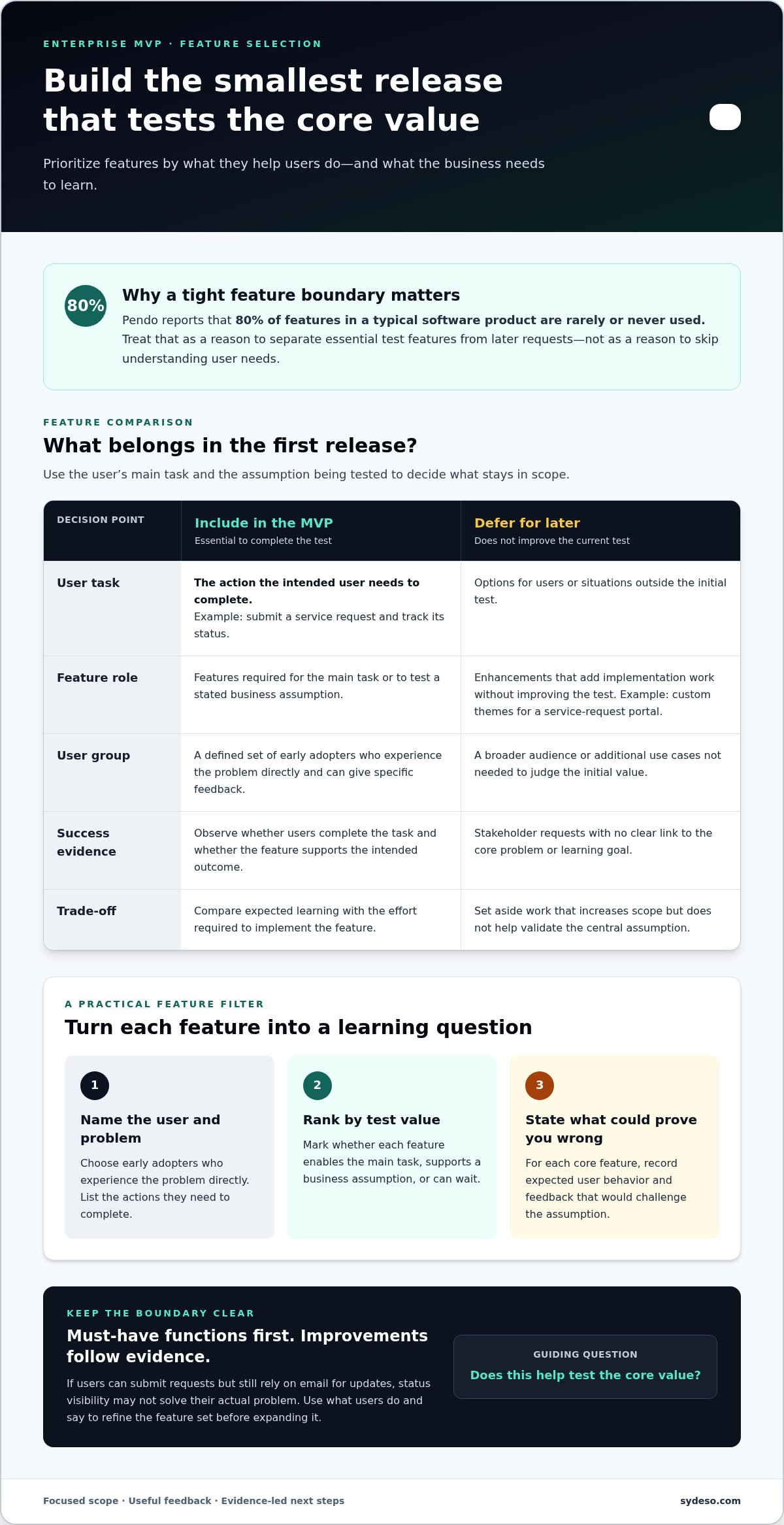
Choose features based on the assumptions they test, not simply on how often stakeholders request them. For a customer portal, start with the task users need to complete, then identify the smallest feature set that can show whether the portal solves it.
-
Identify Core Features for Early Adopters
Step 1: Define the early adopter and their main problem. Select users who experience the problem directly and can give specific feedback. List the actions they need to complete, such as submitting a service request and tracking its status. Include only features that let them complete that journey and judge its value. Avoid adding options for users or situations outside this initial test.
-
Prioritize MVP Features
Step 2: Rank each proposed feature by its role in testing the core value. Mark whether it is required for the user’s main task, supports a business assumption, or can wait. A service-request portal may need request submission and status updates, while custom themes may not help test the central problem. Compare expected learning with implementation effort, then defer features that add work without improving the test.
- Step 3: Record the assumptions behind each feature. For every core feature, state what you expect users to do and what feedback would challenge that expectation. For example, if users can submit requests but still rely on email for updates, status visibility may not solve their actual problem. This turns feature selection into a learning plan rather than a collection of stakeholder preferences.
Step 4: Set a clear boundary for the first release. Separate must-have functions from improvements that depend on user feedback. Keep the first release focused enough to show whether the main task works, but complete enough for early adopters to use it in context. After testing, use observed behavior and reported friction to decide what deserves the next development effort.
Selecting a development partner
Choose a partner who can connect discovery, engineering, and operational decisions. For an established business, assess how the team will work with existing systems, stakeholders, and user feedback, not just how it will build the first version. A practical plan for MVP development for established businesses should account for these constraints from the outset.
- Step 1: Test their approach with your product concept. Ask the team to explain how it would turn a specific business problem into a scoped MVP. A useful response identifies the assumption to test, the intended users, and the evidence that would change the plan. Look for clear reasoning about what to exclude, rather than a feature list that simply repeats your requests. This shows whether the team can make scope decisions with you.
- Step 2: Examine how discovery informs the build. Market research, user interviews, and workflow review should shape the initial scope. Ask how the team records decisions and revisits them when testing challenges an assumption. A lean startup approach should connect each build to a learning goal. For example, a workflow prototype should test a real handoff, not only demonstrate screens. The team should explain how findings affect the next version.
- Step 3: Clarify delivery ownership and constraints. Identify who approves requirements, provides system access, reviews each version, and makes release decisions. The partner should explain dependencies such as API integration, data handling, and internal review cycles in practical terms. Your team supplies business context and timely decisions; the development team translates agreed requirements into working software and communicates delivery risks. This division matters in MVP development for established businesses, where existing operations must remain part of the plan.
- Step 4: Agree on how results shape the next iteration. Before development starts, define how the team will collect user feedback, document defects, and distinguish launch issues from future enhancements. Set a review cadence and name the people responsible for decisions. If testing challenges the product idea, the plan should allow scope to change instead of treating the first specification as fixed.
Bring your product idea and constraints into a discussion about MVP development to define a practical first scope.
Sydeso: Custom software development
Sydeso helps established businesses shape and build software around a defined operational need. Its MVP development service is a fit when you have a product assumption to test, a focused user group, and clear criteria for deciding what to build first.
For an internal process, Sydeso can develop an internal tool suited to the workflow and the people using it. For broader needs that off-the-shelf products do not address, custom software development can be tailored to your requirements. Sydeso also provides launch and support, including deployment, monitoring, post-launch fixes, and new features. Ongoing support is optional and billed through an hourly cap, fixed price per phase, or monthly retainer.
Bring your product goal, intended users, and key constraints into the conversation. Visit sydeso.com to discuss your project with Sydeso.
Set the next release direction
Once a first release has produced evidence, make the next decision explicit: extend the product, revise the workflow, or stop investing in an assumption users did not validate. This keeps future scope tied to observed business value rather than momentum or stakeholder preference. A disciplined approach to MVP development for established businesses treats each release as a decision point, not an automatic step toward a larger build.
Sydeso provides MVP development, custom software development, and internal tools development for businesses turning a defined need into working software. Bring a product goal, its intended users, and the operational constraints into planning. These details give your team a practical starting point for deciding which product direction merits further investment.
Discuss your MVP with Sydeso and decide what the next release should prove. A clear test gives your team a practical basis for moving forward.
Frequently Asked Questions
What Is a Minimum Viable Product?
A minimum viable product is a usable first version with enough capability to test a product’s main value with real users. It can be software, a manual service, or another form of experiment. For example, a team could simulate a proposed approval process before building it into a company system. The useful measure is what the test helps the business learn.
How do I build an enterprise MVP?
Begin with a business owner, a user group, and a defined operational boundary. Map the systems and teams the MVP will touch, then assign people to approve requirements, answer technical questions, and review the work. For example, a sales team’s lead-tracking test may need agreed access to customer records. Record decisions and review the results before expanding its use.
How much does an MVP for enterprises cost?
Project cost depends on scope, and Sydeso provides a written estimate after a free consultation. Key cost drivers include the number of workflows, integrations with existing systems, data requirements, and reviews before launch. A narrow test of one internal process differs from a product connecting several departments. Define the intended users and required capabilities first, so the estimate reflects the work involved.
MVP in Software Development - Why is it essential and how can businesses approach it?
An MVP helps a business test whether a software solution addresses a real need before committing to a broader product. Treat it as a decision tool, not simply a smaller release. For example, a company considering a customer portal could first test whether customers can complete one important task through a limited interface. Use the results to decide whether to expand, revise, or stop.
Need an enterprise-grade MVP?
Sydeso builds MVPs for businesses that need a tailored product or internal tool. Before any code is written, you review and approve the scope and design. You also test the product before it ships. These review points give both teams clarity, from the agreed requirements through the release decision.
What are some examples of MVPs?
Dropbox tested its business hypothesis without releasing the actual software, using an MVP strategy to learn about market needs. Airbnb’s founders tested their idea by offering guests an air mattress in their apartment. Each example tested a central assumption before a larger product took shape.
Questions
- What Is a Minimum Viable Product?
- A minimum viable product is a usable first version with enough capability to test a product’s main value with real users. It can be software, a manual service, or another form of experiment. For example, a team could simulate a proposed approval process before building it into a company system. The useful measure is what the test helps the business learn.
- How do I build an enterprise MVP?
- Begin with a business owner, a user group, and a defined operational boundary. Map the systems and teams the MVP will touch, then assign people to approve requirements, answer technical questions, and review the work. For example, a sales team’s lead-tracking test may need agreed access to customer records. Record decisions and review the results before expanding its use.
- How much does an MVP for enterprises cost?
- Project cost depends on scope, and Sydeso provides a written estimate after a free consultation. Key cost drivers include the number of workflows, integrations with existing systems, data requirements, and reviews before launch. A narrow test of one internal process differs from a product connecting several departments. Define the intended users and required capabilities first, so the estimate reflects the work involved.
- MVP in Software Development – Why is it essential and how can businesses approach it?
- An MVP helps a business test whether a software solution addresses a real need before committing to a broader product. Treat it as a decision tool, not simply a smaller release. For example, a company considering a customer portal could first test whether customers can complete one important task through a limited interface. Use the results to decide whether to expand, revise, or stop.
- Need an enterprise-grade MVP?
- Sydeso builds MVPs for businesses that need a tailored product or internal tool. Before any code is written, you review and approve the scope and design. You also test the product before it ships. These review points give both teams clarity, from the agreed requirements through the release decision.
- What are some examples of MVPs?
- Dropbox tested its business hypothesis without releasing the actual software, using an MVP strategy to learn about market needs. Airbnb’s founders tested their idea by offering guests an air mattress in their apartment. Each example tested a central assumption before a larger product took shape.