How to Get Budget Approval for Your Software Project Plan
Learn how to get budget approval for a software project with a clear scope, credible cost estimates, stakeholder alignment, and a practical plan to manage ri...

A software budget earns approval when it connects a defined business need to a credible delivery plan. To understand how to get budget approval for a software project, set a clear scope, estimate implementation and operating costs, and explain the value the work is expected to deliver. One budgeting recommendation is to secure internal funding for at least 150% of a custom software project’s ballpark estimate.
Approval gives project managers an agreed financial baseline. They can compare actual costs with the plan, manage changes, and flag risks before spending moves off course. A request that omits staffing, support, maintenance, or other operating costs is harder to assess and control.
Build a practical estimate from the project scope, prior costs, and vendor input, then present the case in terms stakeholders can evaluate. A structured budget helps reviewers assess the request and gives project managers a baseline for day-to-day decisions.
Key Takeaways
- Use completed projects and vendor estimates to build a cost model, then separate one-time implementation work from ongoing operating needs.
- Connect the request to a priority the business already recognizes, and show how the proposed work could improve time, workload, or service outcomes.
- Secure a sponsor and align the proposal with stakeholder priorities so reviewers can assess the scope, risks, and expected value.
- Structure the example budget by phase, include contingency based on project risk, and set review points to respond to changing costs.
Table of Contents
- Using historical data and vendor quotes to estimate costs
- Balancing financial reasoning with emotional relevance
- Why is Budget Approval Important for Project Management?
- Software project budget example
- Sydeso: Custom software development
Using historical data and vendor quotes to estimate costs
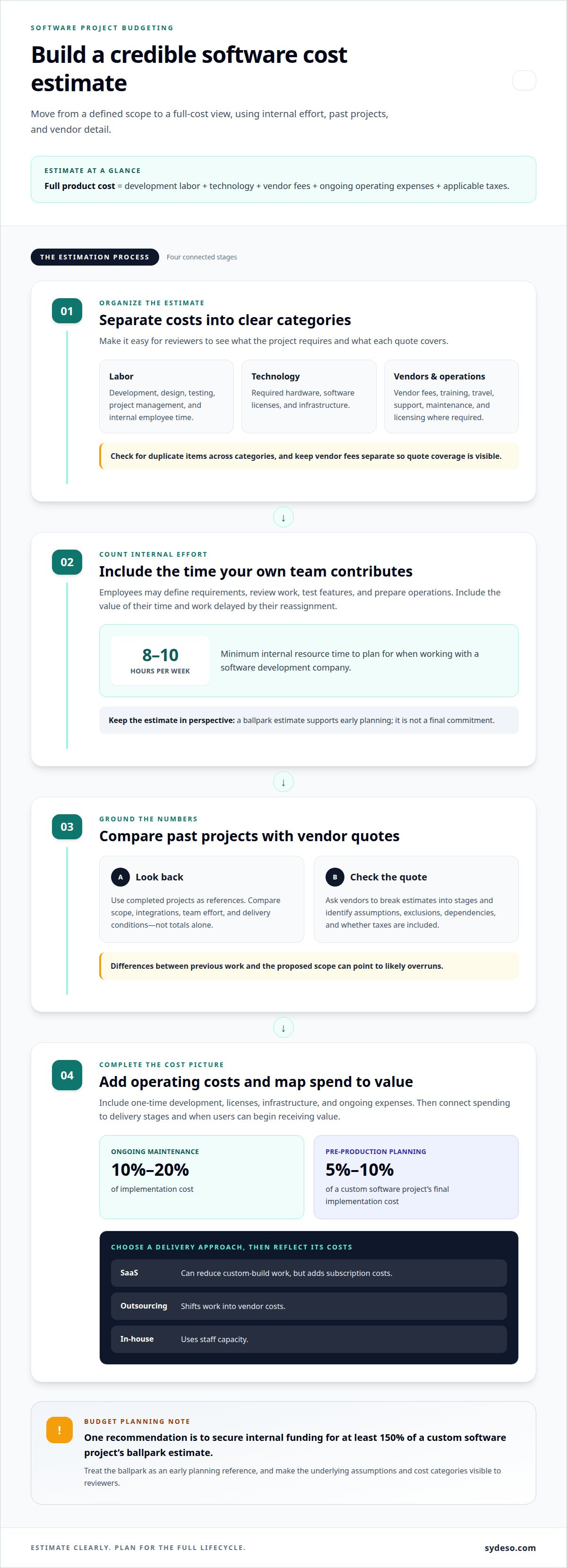
Calculate the total by adding development labor, licenses, infrastructure, maintenance, and required support, then include applicable taxes. SaaS can reduce custom-build work but adds subscription costs. Outsourcing shifts work into vendor costs, while in-house development uses staff capacity.
-
Categorize Labor, Technology, and Vendor Costs
Group the estimate into labor, technology, and vendor costs. Under labor, include development, design, testing, and project management. Under technology, list required hardware and software licenses. Keep vendor fees separate so reviewers can see what each quote covers. Add training, travel, support, and licensing where the project requires them, and check for duplicate items across categories.
-
Assess Internal Costs and Ballpark Estimates
Estimate the internal time needed from employees who will define requirements, review work, test features, and prepare operations. Include the value of their time and any work delayed by their reassignment. A team working with a software development company should plan for a minimum of 8 to 10 hours per week of internal resource time. Use a ballpark estimate to frame early planning, not as a final commitment.
-
Compare Historical Costs and Vendor Quotes
Use completed projects as a reference, comparing scope, integrations, team effort, and delivery conditions rather than totals alone. Ask vendors to break estimates into stages and identify assumptions, exclusions, and dependencies. Check whether quoted prices include taxes. Differences between past work and the proposed scope can point to likely overruns.
-
Calculate Full Costs and Time to Value
Add one-time development, licenses, infrastructure, and ongoing operating expenses to estimate the full product cost. Software maintenance usually costs 10% to 20% of implementation cost. Pre-production planning generally costs 5% to 10% of a custom software project’s final implementation cost. Map spending to delivery stages, then connect each stage to when users can begin receiving value. This shows both funding needs and expected timing.
Balancing financial reasoning with emotional relevance
Present the request as a business case, not just a cost total. Connect measurable savings and delivery risks to the work employees or customers need from the system.
-
Anticipate Financial Gatekeeper Objections
Anticipate finance reviewers’ concerns: uncertain benefits, competing funding needs, operational disruption, or a cheaper alternative. Prepare a direct response to each using project evidence, such as a documented manual handoff that delays customer service. Separate expected savings from assumptions, and explain how the organization will measure results after release.
Set short-term goals for delivery and adoption, then define longer-term goals for workload, service quality, or operating savings. For example, track whether a new workflow reduces duplicate data entry before claiming broader productivity gains. Tie each goal to an owner and review point. This keeps the case specific without presenting projected savings as guaranteed.
-
Present Risks, Assumptions, and Contingencies
State the project’s main risks, the assumptions behind the estimate, and the response if either changes. For example, identify reliance on access to existing customer data and explain how a delay would affect testing and the release sequence. Tie contingency funding to the risks it addresses, rather than presenting it as an unexplained reserve.
Use a SWOT framework or the organization’s approved cost-benefit analysis to connect financial exposure with operational consequences. Explain what happens if the project proceeds, pauses, or excludes a feature. This gives decision-makers a clear basis for comparing options and helps reduce surprises during delivery.
Explain integration in practical terms. If the software must exchange information with a finance system, describe the handoffs, data flows, and user tasks that integration supports. Better fit with existing tools can improve usability and reduce duplicate work. For projects that depend on connected systems, API development and integration can support those connections. Present the expected benefit alongside the integration risk and the plan for testing it.
Why is Budget Approval Important for Project Management?
Approval authorizes planned spending and resources, giving project managers a baseline for delivery decisions. It also helps the organization direct funding toward work that supports its priorities.
- Connect the request to a documented business problem and stakeholder priority. Use current data, such as processing delays, error patterns, workload, or service performance. Explain which measure the project aims to change and who will track it. A practical answer to how to get budget approval for a software project links the proposed work to evidence, not broad claims about improvement.
- Follow the company’s approval process. Secure a sponsor, submit the delivery plan and budget, then allow key stakeholders and managers time to assess spending and resource needs. They may compare the request with past projects and consult other managers. This review establishes who can authorize costs and how decisions are recorded, giving project managers a clear basis for managing approved work.
- Prioritize the request against other projects in the portfolio. Rank proposals by business need, expected value, risk, and resource demand. Focus on a core problem rather than a temporary fix. Define a minimum viable product around the smallest useful release. A release statement that cannot fit under 50 words may signal scope beyond what the first release needs.
- If full approval is unlikely, request phased funding for a bounded pilot. Specify what it will test, the resources it needs, and what evidence will guide the next decision. Set a review gate before expanding scope. This gives decision-makers a defined point to continue, revise, or stop. Teams assessing how to get budget approval for a software project can make later funding conditional on results.
Software project budget example
Use a phased budget to show what the project funds, when expenses occur, and how decisions affect scope. A six-month mobile app example can make the structure clear without treating illustrative figures as a quote.
-
Draft a Software Project Budget Example
Build the estimate around phases: planning, design, development, testing, deployment, and launch. For each phase, document labor, technology, vendor work, and internal time as separate line items. A six-month mobile app plan might assign design first, then development and testing, with a review at each phase boundary. Establish which deliverables each allocation supports, and avoid presenting a single total without its assumptions.
-
Include a Contingency Allowance
Set contingency as a percentage of the total project budget, based on the project’s risk profile. A project with uncertain integrations or changing requirements needs more allowance than work with stable scope and known dependencies. Document the risks the reserve covers and who can authorize its use. Keep contingency separate from planned expenses so reviewers can distinguish expected work from risk response.
- Plan a review point during delivery. In an illustrative mobile app budget, the team might identify higher-than-expected infrastructure costs at a checkpoint. The project manager can then update forecasts, explain the cause, and propose an adjustment before the next phase. If savings emerge, record the decision rather than silently shifting funds between categories.
- Show how budget changes support the product outcome. Present the original allocation, the saving, the proposed change, and its effect on scope together. This makes the decision traceable and helps stakeholders see how the plan responds to evidence.
For a tailored scope and phased estimate, plan your custom software project.
Sydeso: Custom software development
Sydeso helps businesses turn an approved software plan into tailored software, internal tools, or an MVP. Consider Sydeso when existing tools do not support a core workflow or when a defined first release can test a business need.
A clear scope gives the project team a practical basis for planning development, reviewing priorities, and managing delivery. Sydeso also supports launch and can provide ongoing monitoring, fixes, and feature development after the software is built. Your team defines the business requirements and success measures; the development work shapes those needs into a usable product.
Bring the project goals, known constraints, and budget assumptions into the conversation. That gives both sides a shared starting point for discussing scope and delivery needs.
Contact Sydeso to discuss your software project.
Move from approval to accountable delivery
Once a request is approved, turn the decision into a working agreement. Assign an owner to each outcome, record which scope the funding covers, and set a review point for changes. This keeps the approved plan connected to delivery rather than treating approval as the finish line.
The next step in learning how to get budget approval for a software project is to make the handoff clear. Give the delivery team the approved scope, assumptions, decision limits, and success measures. Keep stakeholders involved when evidence calls for a change, and document the reason before adjusting work or reallocating funds. This helps teams act on new information while maintaining visibility over spending.
If you’re ready to turn an approved plan into a defined software project, contact Sydeso about your project. A clear starting point makes the next decisions easier to manage.
Frequently Asked Questions
What does creating a project budget involve?
A project budget translates approved work into planned resource needs and spending. Define the expected deliverables, sequence, ownership, and funding source. Record assumptions that could affect scope, such as access to business data or staff availability. For example, a customer portal may need separate estimates for user access, account management, and reporting. The budget becomes a working control document, not just an approval request.
What happens if the proof of concept shows the idea isn’t worth funding?
Stop before committing to a larger build, then record what the proof of concept established. Note which business assumptions failed, whether the limitation came from technology, data, or user needs, and what work remains. The decision may be to close the effort, revise its scope, or test a narrower use case. A clear stop decision protects future funding from being tied to sunk costs.
What should a software project budget proposal include?
Include the business objective, deliverables, delivery assumptions, and requested authorization. Show who owns decisions, which teams must contribute, and what the project excludes. Add a schedule showing when funding is needed, not just a total amount. For example, a proposal can distinguish discovery spending from later build commitments. This helps finance teams connect payment timing to work and approval gates.
How do you estimate software project ROI, payback period, and total cost of ownership?
Estimate ROI by comparing expected financial benefits with the total investment, using the organization’s standard method. Payback period estimates how long benefits take to recover the initial investment. Total cost of ownership includes costs throughout use, such as implementation, operating resources, renewals, and eventual replacement. Use conservative benefit assumptions and identify the evidence behind each input, such as current labor hours or transaction volumes.
What are typical software development project costs and budget ranges in the United States?
There is no single useful budget range for every US software project. A narrow internal workflow, a customer-facing product, and a system with complex integrations have different scopes and ongoing needs. Estimate costs by defining users, required functions, existing systems, security needs, and delivery stages. Compare proposals only when they cover comparable work and assumptions. This gives decision-makers a meaningful basis for evaluating estimates.
How do you get executive and finance team buy-in for a software project?
Secure an executive sponsor who can connect the proposal to an organizational priority. Give finance a concise view of the decision required, the expected business effect, and the consequences of delaying or declining the work. Tailor supporting detail to each reviewer: operational impact for business leaders, forecast assumptions for finance, and implementation dependencies for technical leads. Resolve scope disagreements before requesting authorization.
Questions
- What does creating a project budget involve?
- A project budget translates approved work into planned resource needs and spending. Define the expected deliverables, sequence, ownership, and funding source. Record assumptions that could affect scope, such as access to business data or staff availability. For example, a customer portal may need separate estimates for user access, account management, and reporting. The budget becomes a working control document, not just an approval request.
- What happens if the proof of concept shows the idea isn’t worth funding?
- Stop before committing to a larger build, then record what the proof of concept established. Note which business assumptions failed, whether the limitation came from technology, data, or user needs, and what work remains. The decision may be to close the effort, revise its scope, or test a narrower use case. A clear stop decision protects future funding from being tied to sunk costs.
- What should a software project budget proposal include?
- Include the business objective, deliverables, delivery assumptions, and requested authorization. Show who owns decisions, which teams must contribute, and what the project excludes. Add a schedule showing when funding is needed, not just a total amount. For example, a proposal can distinguish discovery spending from later build commitments. This helps finance teams connect payment timing to work and approval gates.
- How do you estimate software project ROI, payback period, and total cost of ownership?
- Estimate ROI by comparing expected financial benefits with the total investment, using the organization’s standard method. Payback period estimates how long benefits take to recover the initial investment. Total cost of ownership includes costs throughout use, such as implementation, operating resources, renewals, and eventual replacement. Use conservative benefit assumptions and identify the evidence behind each input, such as current labor hours or transaction volumes.
- What are typical software development project costs and budget ranges in the United States?
- There is no single useful budget range for every US software project. A narrow internal workflow, a customer-facing product, and a system with complex integrations have different scopes and ongoing needs. Estimate costs by defining users, required functions, existing systems, security needs, and delivery stages. Compare proposals only when they cover comparable work and assumptions. This gives decision-makers a meaningful basis for evaluating estimates.
- How do you get executive and finance team buy-in for a software project?
- Secure an executive sponsor who can connect the proposal to an organizational priority. Give finance a concise view of the decision required, the expected business effect, and the consequences of delaying or declining the work. Tailor supporting detail to each reviewer: operational impact for business leaders, forecast assumptions for finance, and implementation dependencies for technical leads. Resolve scope disagreements before requesting authorization.