How to Measure Software Project Success Through User Value
Learn how to measure software project success using delivery metrics, business outcomes, user adoption, feature usage, and feedback to assess real-world value.

A project can meet its schedule and scope yet deliver little value to the people expected to use it. To measure software project success, compare results with clear objectives and assess both business outcomes and user value. Track measurable indicators, then pair them with feedback that explains what the numbers mean.
Delivery metrics show whether work stayed on course, but they don’t reveal whether users adopted the product, rely on its features, or find it useful. Measuring both delivery and outcomes helps teams distinguish a completed project from a successful one and identify where improvement is needed.
This article explains how to define success before development and assess it through objectives, quantitative and qualitative measures, adoption, feature usage, and user satisfaction. It also shows how to interpret those signals together, so project decisions reflect outcomes for the business and the people using the software.
Key Takeaways
- Set success criteria before development begins and connect each measure to a business goal.
- Pair delivery and financial metrics with user feedback to see whether the software creates practical value.
- Track adoption and feature usage over time to spot where users gain value and where they encounter friction.
- Use project objectives and user needs to guide custom software decisions, from an MVP through launch and support.
Table of Contents
- Product adoption, feature usage, and user satisfaction
- What is Project Success?
- Defining project objectives and success criteria
- Quantitative and qualitative measures of project success
- Sydeso: Custom software development
Product adoption, feature usage, and user satisfaction
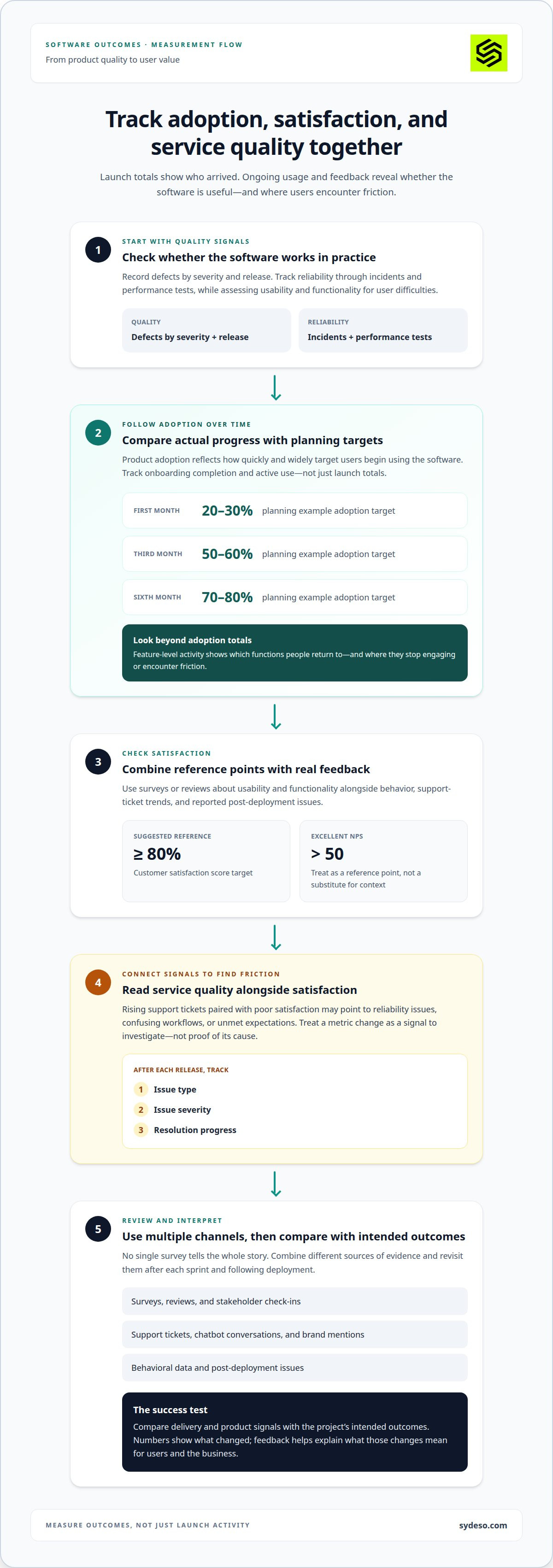
Measure software quality by recording defects by severity and release, then track reliability through incidents and performance tests. Quality assurance analysts assess usability and functionality to identify user difficulties, according to the U.S. Bureau of Labor Statistics.
Product Adoption and Feature Usage
Product adoption measures how quickly and widely target users begin using software; feature usage shows which functions they return to. Track onboarding completion, active use, and feature-level activity to see where people encounter friction or stop engaging. As planning examples, adoption targets may be 20-30% in the first month, 50-60% by the third month, and 70-80% by the sixth month. Compare actual progress with expectations, not just launch totals.
User and Client Satisfaction
User and client satisfaction measures whether software meets people’s needs after deployment. Combine survey scores or reviews about usability and functionality with support-ticket trends, user behavior, and reported post-deployment issues. A customer satisfaction score of at least 80% is one suggested target, while an NPS above 50 is classified as excellent. Treat these as reference points, then interpret responses alongside the project’s intended outcomes.
Review service quality alongside client satisfaction. For example, rising support tickets combined with poor satisfaction may point to reliability issues, confusing workflows, or unmet expectations. After each release, track issue type, severity, and resolution progress, then compare the pattern with feedback from client stakeholders. This gives teams a clearer picture of whether the service works in practice.
Use multiple channels to understand satisfaction rather than relying on a single survey. Brand mentions, chatbot conversations, behavioral data, support tickets, and reviews can each reveal different sources of friction. Regular stakeholder check-ins and post-project surveys add context about collaboration and delivery. Reviewing these signals after each sprint and following deployment helps connect service quality, user experience, and client expectations with measurable outcomes.
What is Project Success?
Project success means delivering useful outcomes that support strategic objectives, not simply marking tasks complete. On-time, on-budget delivery alone can hide poor adoption, weak service quality, or limited business value.
Strategic Alignment and Business Performance
Strategic alignment connects project success metrics to business goals, so teams can see whether software changes the outcomes that matter. If the objective is to grow revenue, track revenue alongside customer acquisition or retention; revenue alone won’t explain what drove a change. A KPI can monitor a defined target, while OKRs connect measurable outcomes to broader priorities. A Balanced Scorecard can also organize measures across financial, customer, internal-process, and learning-and-growth perspectives.
Choose metrics that fit the software’s purpose. For an internal workflow, measure processing efficiency; for a customer-facing product, track customer acquisition and retention. These measures connect delivery work to the reason the project exists.
Metric Reviews and Improvement Opportunities
Set a review rhythm that gives each metric a clear decision point throughout the project lifecycle. Review operational measures daily, sprint measures weekly, product measures monthly, and business measures quarterly. These intervals help teams spot delivery blockers early while giving adoption and financial outcomes time to develop.
Treat a change in a metric as a signal to investigate, not proof of its cause. A missed sprint goal, for example, can prompt a review of blockers, while falling product use can lead to an analysis of onboarding or feature engagement. Agile metrics show where improvement may be needed, but teams still need context to identify the cause. A post-project review can carry lessons into future work.
Risks of Delivery-Only Measures
Delivery-only measures record schedule, budget, and scope, but can miss whether the completed software solves the intended problem. A project may meet its original specification while users avoid a key workflow or business performance stays unchanged. In fixed-price Waterfall work, delivery against time, specification, and budget matters, but it does not prove lasting value.
Pair delivery measures with user, operational, and business outcomes. Review benefits again six months after completion to assess whether they lasted. For projects that need software shaped around specific objectives, align software scope with business goals from the outset.
Defining project objectives and success criteria
Define success criteria before development begins and connect each one to a business goal. This gives the organization a framework for comparing actual results with intended outcomes.
Turning Objectives into Measurable Criteria
Measurable criteria turn a broad objective into an observable result, so the team can assess progress consistently. For example, a service-efficiency project might aim to reduce downtime by half or resolve support tickets within one business day. Set a baseline, name the measure, and specify the desired result before work starts.
Separate delivery outputs from outcomes. Completing a feature confirms that development produced a deliverable; it doesn’t show whether the feature improved the targeted process. Record who owns each measure and how evidence will be collected. Later, the team can compare actual performance with an agreed target.
Tailoring Criteria to Client Goals
Tailored criteria rank measures by their importance to client goals and their impact on customer outcomes. A project focused on service efficiency may prioritize downtime and ticket resolution, while other objectives call for different operational or customer measures. Agree on priorities with stakeholders before development, then document how each criterion relates to the intended use case.
Choose a framework that fits the decision at hand. OKRs can connect measurable outcomes with shared priorities, but need ongoing monitoring and adjustment as requirements change. KPIs track performance against defined targets, while a Balanced Scorecard groups measures across financial, customer, internal-process, and learning-and-growth perspectives. A framework should clarify decisions, not add reporting without purpose.
Keep criteria specific enough to guide action. For each objective, document the baseline, target, data source, review owner, and response if results fall short. For example, a service-efficiency objective can pair a downtime target with a ticket-resolution target. Rank criteria by importance and revisit them when project requirements or customer goals change, keeping success measures relevant throughout delivery.
Quantitative and qualitative measures of project success
Assess project results using both recorded performance and direct feedback from people who use or oversee the software. To decide how to measure software project success, connect each measure to a specific decision the project team or stakeholder needs to make.
Measuring Goals and Requirements
Quantitative measures show whether a defined condition was met; qualitative measures explain how the result works in practice. Together, they assess requirements involving both system behavior and user experience. A test, for example, can confirm that a report exports correctly, while a stakeholder review can reveal whether its layout supports the team’s actual work.
For each requirement, identify evidence that would demonstrate acceptance. This might be a test result, a user walkthrough, or a documented review. A practical approach to measuring software project success pairs a clear pass condition with feedback from the people affected. This makes gaps visible before the team treats delivery as complete.
Budget and Schedule Performance
Budget and schedule measures compare actual spending and milestone dates with the approved plan. They show how delivery progressed, but context is needed to explain why a variance occurred. A change log, for example, can help stakeholders distinguish added requirements from estimation or coordination issues.
Review the variance alongside delivered requirements and quality evidence. If a milestone slips while a key integration remains incomplete, the team can assess whether a dependency or technical issue needs attention. Budget records can also show where effort shifted from planned work to rework. This context makes monitoring useful for future planning, instead of turning a variance into a simple pass-or-fail result.
Quantitative indicators answer what changed; interviews, review notes, and team feedback help explain why. Bring both forms of evidence into the same review, then agree on what to implement next. For example, a test pass combined with repeated user confusion may call for a usability adjustment, not more testing of the same behavior. To connect measurement with software delivery, discuss custom software development.
Sydeso: Custom software development
Sydeso develops custom software for businesses whose goals, workflows, or user needs call for a tailored solution. Consider custom software development when existing tools don’t support the outcomes your project needs to measure. The work can include internal tools, an MVP to test a defined use case, and launch and support after development.
Clear objectives guide scope and provide a basis for evaluating software after release. Sydeso works with businesses to build software around those needs, rather than treating delivery alone as a measure of value.
To discuss a software project shaped around your objectives, contact Sydeso.
Carry project learning into the next decision
Success measures are most useful when they inform what happens after delivery. Treat evaluation as an ongoing management practice, not a final score. As priorities shift, review whether the measures still reflect the decisions your organization needs to make.
A practical way to measure software project success is to connect each result to a next action. Keep what supports the intended outcome, investigate what falls short, and revise the work when evidence points to a better path. This keeps measurement relevant as the product and its users change.
Bring your goals, constraints, and intended outcomes into the conversation before defining the next project. Sydeso can discuss custom software development, internal tools, or an MVP in relation to the work you need done. Contact Sydeso to discuss your project.
Clear measures provide a sounder basis for decisions.
Frequently Asked Questions
Why is it so important to measure success?
Measurement helps teams decide whether to continue, change, or stop work based on evidence. Without it, a completed release can look successful even when it fails to improve a business process. For example, comparing support demand before and after a self-service workflow launches can show whether it reduces staff workload. Regular review also gives stakeholders a shared basis for setting priorities and allocating effort.
Metric Categories: What to Measure at Which Layer?
Choose measures at the level where decisions are made. Team-level measures can track delivery flow and defects; product-level measures can track feature engagement and reliability; business-level measures can track efficiency, customer retention, or revenue. An increase in completed tasks may indicate team output, while a shorter customer response process shows an operational result. Keeping these layers distinct prevents one metric from standing in for every outcome.
What are the key metrics for measuring software project success?
Use a focused set of measures covering delivery, product quality, user behavior, and business results. Delivery measures include milestone progress and schedule variance. Quality measures include defect trends, error rates, and system stability. Product measures show whether users adopt the software and use its core features. Business measures connect results to the project’s purpose, such as reducing manual work. Pair each metric with a decision it informs, so tracking leads to action.
What are common software project success benchmarks and KPIs?
Benchmarks depend on the system and delivery context, so treat them as comparison points rather than universal pass marks. DORA classifies deployment multiple times per day, mean time to recovery under one hour, and change failure rates of 0-15% as elite performance. These measures suit software delivery operations. A business application may need different KPIs, such as fewer processing errors or improved task completion, tied to its intended use.
How can user satisfaction and software adoption be measured?
Track adoption by user group over time, then examine what users do after they start. For example, compare onboarding completion with continued use of a core workflow. Incomplete onboarding, unused features, or a sudden drop in usage can signal friction or churn risk. Gather direct comments through reviews and surveys, then compare them with support tickets and behavioral data. Together, these sources help distinguish a usability problem from low demand.
How do you measure business value and ROI of a software project?
Compare the project’s costs with financial benefits, including added revenue, cost savings, or efficiency gains. A standard ROI calculation is (benefits minus costs) divided by costs, multiplied by 100. For example, a project costing $100,000 with an annual gain of $150,000 has a calculated ROI of 50%. State the measurement period and benefit assumptions clearly, then review operational changes to understand what contributed to the result.
Questions
- Why is it so important to measure success?
- Measurement helps teams decide whether to continue, change, or stop work based on evidence. Without it, a completed release can look successful even when it fails to improve a business process. For example, comparing support demand before and after a self-service workflow launches can show whether it reduces staff workload. Regular review also gives stakeholders a shared basis for setting priorities and allocating effort.
- Metric Categories: What to Measure at Which Layer?
- Choose measures at the level where decisions are made. Team-level measures can track delivery flow and defects; product-level measures can track feature engagement and reliability; business-level measures can track efficiency, customer retention, or revenue. An increase in completed tasks may indicate team output, while a shorter customer response process shows an operational result. Keeping these layers distinct prevents one metric from standing in for every outcome.
- What are the key metrics for measuring software project success?
- Use a focused set of measures covering delivery, product quality, user behavior, and business results. Delivery measures include milestone progress and schedule variance. Quality measures include defect trends, error rates, and system stability. Product measures show whether users adopt the software and use its core features. Business measures connect results to the project’s purpose, such as reducing manual work. Pair each metric with a decision it informs, so tracking leads to action.
- What are common software project success benchmarks and KPIs?
- Benchmarks depend on the system and delivery context, so treat them as comparison points rather than universal pass marks. DORA classifies deployment multiple times per day, mean time to recovery under one hour, and change failure rates of 0–15% as elite performance. These measures suit software delivery operations. A business application may need different KPIs, such as fewer processing errors or improved task completion, tied to its intended use.
- How can user satisfaction and software adoption be measured?
- Track adoption by user group over time, then examine what users do after they start. For example, compare onboarding completion with continued use of a core workflow. Incomplete onboarding, unused features, or a sudden drop in usage can signal friction or churn risk. Gather direct comments through reviews and surveys, then compare them with support tickets and behavioral data. Together, these sources help distinguish a usability problem from low demand.
- How do you measure business value and ROI of a software project?
- Compare the project’s costs with financial benefits, including added revenue, cost savings, or efficiency gains. A standard ROI calculation is (benefits minus costs) divided by costs, multiplied by 100. For example, a project costing $100,000 with an annual gain of $150,000 has a calculated ROI of 50%. State the measurement period and benefit assumptions clearly, then review operational changes to understand what contributed to the result.