How to Scale an MVP After Launch by Validating Product-Market Fit
Learn how to scale an MVP after launch by validating product-market fit, prioritizing user needs, strengthening operations, and tracking growth metrics.

Launch is the start of validation, not a signal to expand. To scale an MVP after launch, first look for evidence of product-market fit: roughly 40% of users should say they’d be very disappointed without the product. Then strengthen what users rely on before adding more features or increasing demand.
It’s tempting to treat early interest as proof that a product is ready to grow. But early adopters may not represent the wider customer base, and growth can expose weak workflows, technical debt, and founder bottlenecks. A measured approach helps distinguish repeatable customer value from isolated feedback.
This guide explains how to assess product-market fit, prioritize improvements using customer behavior and feedback, and prepare your product and team to serve more users. You’ll also learn what to monitor after each release, so scaling becomes a cycle of measurement and refinement rather than a one-time push.
Key Takeaways
- Use retention, willingness to keep using the product, and repeatable customer value to judge whether growth is justified.
- Compare what customers say with what they actually do, then prioritize problems shared by your core users.
- Assign clear owners for product, customer, and operational decisions so routine work doesn’t depend on the founder.
- Track activation, retention, support demand, and usage after each release; use the results to guide the next improvement.
Table of Contents
- Product-market-fit signals as a prerequisite for scaling
- Evaluating customer feedback and target customers
- Team structure and founder bottlenecks
- Post-launch monitoring and continuous improvement
- Sydeso: Custom software development
Product-market-fit signals as a prerequisite for scaling
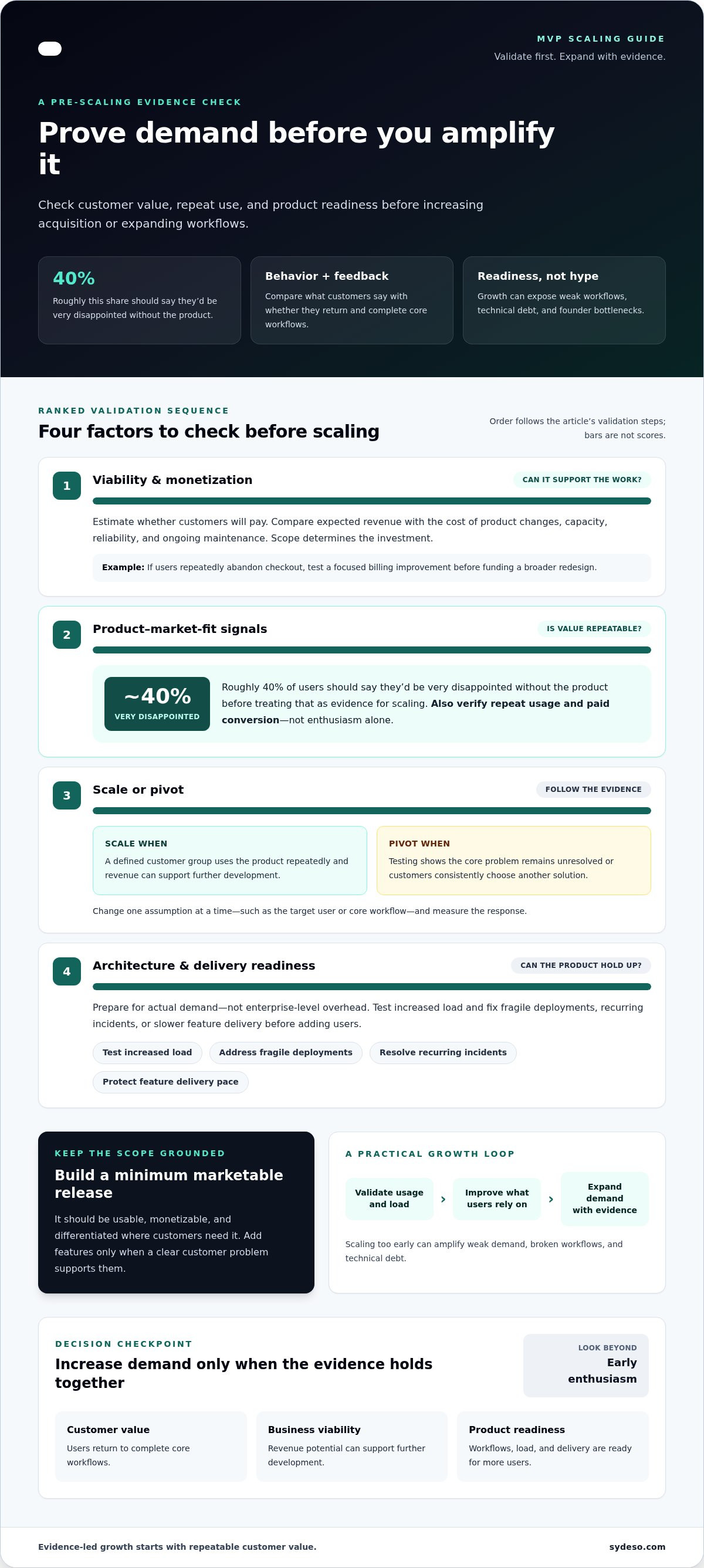
Validate demand and viability before increasing acquisition or expanding workflows. Use evidence from customer behavior, revenue potential, and system performance to decide what to improve next.
-
Assess Product Viability and Monetization
Estimate whether customers will pay, then compare expected revenue with the cost of further development. Build the budget around the work required: product changes, capacity, reliability, and ongoing maintenance. There’s no single scaling cost; scope determines the investment. Avoid adding features until a clear customer problem supports them. For example, if users repeatedly abandon checkout, test a focused billing improvement before funding a broader redesign.
-
Confirm Product-Market-Fit Signals
Measure whether customers would miss the product and whether they return to complete core workflows. Roughly 40% of users should say they’d be very disappointed without it before you treat that signal as evidence for scaling. Compare responses with repeat usage and paid conversion, not enthusiasm alone. Scaling too early can amplify weak demand, broken workflows, and technical debt. Reduce that risk by validating usage and load before expanding acquisition.
-
Choose Between Scaling and Pivoting
Scale when a defined customer group uses the product repeatedly and revenue can support further development. Pivot when testing shows the core problem remains unresolved or customers consistently choose another solution. Change one assumption at a time, such as the target user or core workflow, and measure the response. This keeps a pivot grounded in evidence rather than a founder’s preference or one customer request.
- Prepare the architecture for actual demand, not enterprise-level overhead. Test increased load and address fragile deployments, recurring incidents, or slower feature delivery before adding users. Move toward a minimum marketable product, also called a minimum marketable release: it should be usable, monetizable, and differentiated where customers need it. Add collaborative workflows, such as team invitations, when they help users bring colleagues into the product. That can support acquisition through existing users.
Evaluating customer feedback and target customers
Use customer conversations and post-launch behavior to identify which problems deserve more effort. Then focus go-to-market work on customers who return, gain value, and fit a clear profile.
-
Review Post-Launch Customer Feedback
Group feedback by user goal, workflow, and point of friction. Compare interview comments with product behavior: a user may praise onboarding but repeatedly abandon setup. Track recurring problems, support requests, and actions users complete after signing in. Early adopters may not represent the wider market, so validate patterns with customers beyond your first enthusiastic users. Distinguish a single preference from a problem that blocks a core task.
-
Identify Target Customers and Ideal Profiles
Define an ideal customer profile using users with strong retention and lifetime value. Record shared traits such as role, organization, use case, and the job they need software to perform. Use those traits to shape sales messaging and acquisition channels. For example, if operations teams repeatedly adopt a workflow, focus outreach on similar teams rather than unrelated audiences.
-
Prioritize Work by Customer Value
Rank proposed changes by the customer problem they solve, the effort required, and their effect on engagement. The 80/20 rule offers a useful prompt: identify the small set of features delivering most user value, then protect those workflows. About 64% of software features are rarely or never used, so avoid treating every request as a roadmap commitment. Prototype high-impact changes before expanding the minimum viable product.
-
Iterate on the Product Using Feedback
Choose one validated problem, release a focused improvement, and measure what changes. Check whether users complete the target workflow more often, return, or need less support. If the result misses the intended outcome, refine the change or test another approach rather than adding unrelated features. Teams shaping validated workflows into product changes can explore custom software development.
Team structure and founder bottlenecks
Map recurring work and assign an owner before expanding the team. Hire for sustained demand, automate repeatable workflows, or outsource bounded work that requires specialist capacity.
-
Identify Founder Bottlenecks
List decisions, sales tasks, and approvals that still wait for the founder. Founder-only deal closing can stall go-to-market work as demand grows. Assign repeatable decisions to named owners and document the process. For example, give a team member responsibility for routine customer onboarding while the founder handles exceptions. This keeps learning moving without making every customer interaction depend on one person.
- Define roles before adding headcount. An MVP team typically consists of two to five people; scaling may require a structure that can sustain a growing product. Name an owner for product priorities, engineering quality, customer feedback, and release decisions. Set a clear measure for each responsibility, such as completed onboarding workflows or resolved defects. Clear ownership reduces duplicated effort and makes gaps visible.
-
Expand the Development Team
Hire when recurring workload requires steady ownership and the role supports a viable growth plan. Automate stable, repetitive workflows when manual handoffs consume engineering or customer time. Outsource bounded work when specialist effort is needed without creating a permanent role. Keep decisions, documentation, and acceptance criteria with the startup. This structure limits coordination problems and gives new contributors a defined scope.
- Prepare the team for growth through documented development processes. Record how engineers test, review, deploy, and respond to defects. A new engineer should be able to follow those steps without relying on informal founder explanations. As the team reaches 50 or more people, make culture explicit through written working agreements. Until then, use regular reviews to identify unclear ownership and adjust roles before scaling compounds the problem.
Post-launch monitoring and continuous improvement
Launch begins real-world validation; continuous monitoring shows whether each version improves customer outcomes. To scale an MVP after launch, measure behavior, investigate changes, and refine the product through a repeatable cycle.
- Set a baseline for activation, retention, support volume, conversion, and usage before changing the product. Track each metric by audience and workflow so an overall increase doesn’t hide a decline in a key customer group. The U.S. Census Bureau encourages tracking usage and impact through measures such as downloads and monthly active users. Pair those figures with business outcomes relevant to your product.
- Map where users enter, progress, and stop in the core workflow. For example, if registrations rise but users don’t complete setup, inspect the steps between account creation and first value. Record friction points, support requests, and recurring feedback alongside the relevant workflow. This shows where growth stalls or leaks and gives the team a specific issue to investigate.
- Release one focused improvement at a time, then compare the same measures against your baseline. If a revised onboarding step raises activation but also increases support requests, investigate the added confusion before expanding it. Log the change, intended outcome, observed behavior, and next decision. This cycle of deployment, measurement, learning, and refinement ties each version to customer needs and market fit. Teams scaling an MVP after launch can use these records to connect product decisions with observed results.
- Review performance and reliability alongside customer metrics as the audience grows. Track crashes, latency, and incidents after releases; rising load can expose limits that small tests miss. Connect each issue to an owner and a corrective action, then check the result after deployment. Scaling isn’t a one-time event, so retain this review loop as the platform changes. For structured post-launch follow-through, plan launch and support around monitoring and iteration.
Sydeso: Custom software development
Sydeso develops custom software for teams ready to turn validated product needs into reliable software. If customer behavior supports continued investment but your product needs new workflows, integrations, or technical changes, development support can help move that work forward.
Use internal tools development when the operational work behind your product needs a clearer system. Sydeso’s launch and support service helps teams manage work after release, while AI agent development may suit specific tasks that benefit from an AI-based workflow. Define the scope around validated product priorities and the work your team needs to complete.
Bring your product goals, user feedback, and current delivery constraints to a conversation with Sydeso. Contact Sydeso to discuss the next development step.
Make the Next Product Decision Deliberate
Turn validated learning into a clear delivery decision. Choose the customer problem that matters most, define what a useful release must change, and assign someone to measure the result. This keeps product work tied to evidence instead of a growing backlog.
A disciplined way to scale an MVP after launch is to make every investment address a specific need. Sydeso offers custom software development for product changes, internal tools development for operational needs, and MVP development for building or refining an early product. Start with your priorities, constraints, and the work your team is ready to own.
Bring a concise view of your product goals, user feedback, and delivery challenges. Contact Sydeso to plan your next step. A clear next decision gives your team a practical direction for continued product development.
Frequently Asked Questions
What comes after the MVP?
After the MVP, decide whether to refine the current product, turn it into a minimum marketable product, or change direction. Select one customer use case and define what a complete, dependable experience requires. For example, a team may need clearer account administration before selling to larger organizations. Keep the next release tied to a validated use case, not a feature wishlist.
What is the difference between building an MVP and scaling it?
Building an MVP tests whether a focused product can address a real user problem. Scaling develops the product and its operating practices to serve validated demand consistently. For example, the initial product might support one team’s approval process; scaling may require permissions, reporting, and repeatable onboarding. The difference is the purpose: early development tests assumptions, while scaling strengthens proven product use.
Do you have to rebuild your MVP to scale it?
No. Many products can grow through targeted changes to the parts that limit reliability, maintainability, or user workflows. For example, you might replace a fragile reporting component while leaving stable account management intact. First identify the constraint, map its dependencies, and test a contained change. A broader rebuild makes sense only when the existing system prevents essential product work or creates persistent operational risk.
How long does it take to scale an MVP into a full product?
There’s no fixed timeline because “full product” depends on the intended users, workflows, integrations, and reliability needs. A product for one team has a different scope from one supporting multiple organizations and permission levels. Break the work into usable releases, each with a defined outcome and acceptance criteria. Then estimate delivery based on dependencies, testing needs, and the capacity of the people doing the work.
How much technical debt is acceptable in an MVP?
Accept technical debt when it’s understood, documented, and doesn’t compromise essential workflows or safe operation. Record the shortcut, its effect, and the condition that would make it urgent. For example, a manual data import may be reasonable at first, but repeated errors or growing processing delays can justify replacing it. Debt becomes a scaling concern when it repeatedly blocks product changes or increases operational incidents.
Should you rewrite MVP code before scaling?
Rewrite only when evidence shows smaller repairs can’t address a serious constraint. Compare the cost and risk of incremental changes with the disruption of replacing working software. For example, if one service causes deployment failures, isolate and replace that service before rebuilding unrelated parts. Preserve functioning workflows, create tests around critical behavior, and migrate in stages so teams can detect regressions before they affect more users.
Questions
- What comes after the MVP?
- After the MVP, decide whether to refine the current product, turn it into a minimum marketable product, or change direction. Select one customer use case and define what a complete, dependable experience requires. For example, a team may need clearer account administration before selling to larger organizations. Keep the next release tied to a validated use case, not a feature wishlist.
- What is the difference between building an MVP and scaling it?
- Building an MVP tests whether a focused product can address a real user problem. Scaling develops the product and its operating practices to serve validated demand consistently. For example, the initial product might support one team’s approval process; scaling may require permissions, reporting, and repeatable onboarding. The difference is the purpose: early development tests assumptions, while scaling strengthens proven product use.
- Do you have to rebuild your MVP to scale it?
- No. Many products can grow through targeted changes to the parts that limit reliability, maintainability, or user workflows. For example, you might replace a fragile reporting component while leaving stable account management intact. First identify the constraint, map its dependencies, and test a contained change. A broader rebuild makes sense only when the existing system prevents essential product work or creates persistent operational risk.
- How long does it take to scale an MVP into a full product?
- There’s no fixed timeline because “full product” depends on the intended users, workflows, integrations, and reliability needs. A product for one team has a different scope from one supporting multiple organizations and permission levels. Break the work into usable releases, each with a defined outcome and acceptance criteria. Then estimate delivery based on dependencies, testing needs, and the capacity of the people doing the work.
- How much technical debt is acceptable in an MVP?
- Accept technical debt when it’s understood, documented, and doesn’t compromise essential workflows or safe operation. Record the shortcut, its effect, and the condition that would make it urgent. For example, a manual data import may be reasonable at first, but repeated errors or growing processing delays can justify replacing it. Debt becomes a scaling concern when it repeatedly blocks product changes or increases operational incidents.
- Should you rewrite MVP code before scaling?
- Rewrite only when evidence shows smaller repairs can’t address a serious constraint. Compare the cost and risk of incremental changes with the disruption of replacing working software. For example, if one service causes deployment failures, isolate and replace that service before rebuilding unrelated parts. Preserve functioning workflows, create tests around critical behavior, and migrate in stages so teams can detect regressions before they affect more users.