How to validate an MVP before building the product
Explore MVP product market validation with concepts, prototypes, and focused tests to assess demand, reduce risk, and decide whether to build, revise, or stop.

You can validate an MVP before building the product. MVP product market validation starts by testing whether a real customer problem exists, then checking whether a proposed solution earns interest through concepts, prototypes, or a landing-page A/B test. These tests reduce uncertainty, but they don’t establish product-market fit on their own.
It makes sense to seek evidence before committing time and engineering effort to a full build. Early feedback can reveal whether the problem matters, which parts of a solution users understand, and which assumptions still need testing. Measure behavior and specific decisions, not just positive reactions.
This article explains how to move from problem discovery to solution testing, choose a useful prototype or A/B test, and interpret the results. It also clarifies how market validation relates to product-market fit, so you can decide whether to build, revise the idea, or gather more evidence.
Key Takeaways
- Test one risky assumption at a time with a concept, prototype, or focused experiment before committing to a full build.
- Use concierge or Wizard of Oz tests to observe how people respond to the experience, including where manual work can reveal what needs automation.
- Define a target audience and investigate its current problems and workarounds before judging demand for a proposed solution.
- Separate early interest from evidence of lasting value: product-market fit requires customers to engage with and continue using a solution.
- Set clear decision criteria before testing so the results can guide whether to proceed, revise the concept, or stop.
Table of Contents
- Solution hypothesis testing with concepts, prototypes, and A/B tests
- How to validate MVPs?
- What is market validation?
- Concept, proof-of-concept, and prototype development
- Market validation and product-market fit
- Sydeso: Custom software development
Solution hypothesis testing with concepts, prototypes, and A/B tests
Test a specific solution assumption before choosing features to build. Move from customer evidence to observable behavior, then use the results to refine the product journey.
-
Test Assumptions Before Building
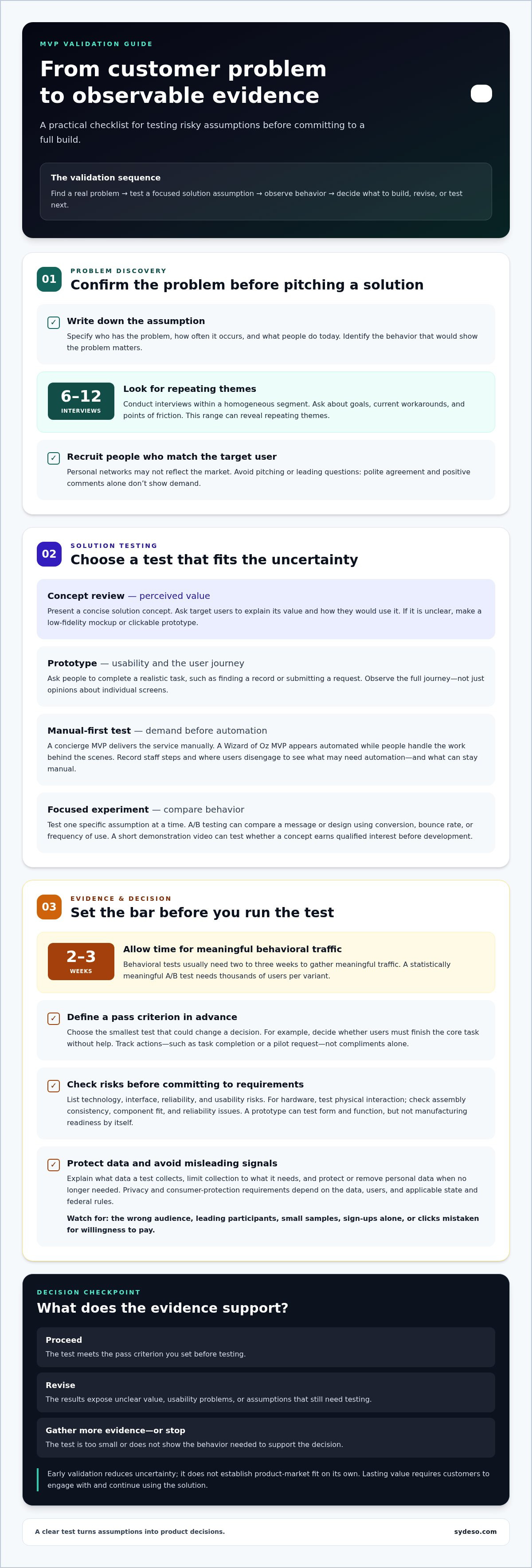
Write down the target user, the problem, and the behavior that would show the problem matters. Then conduct customer discovery interviews about users’ goals, current workarounds, and points of friction. Six to 12 interviews within a homogeneous segment can reveal repeating themes. Avoid pitching the solution or asking leading questions, since polite agreement doesn’t show demand.
For a startup, record each assumption separately: who has the problem, how often it occurs, and what users do today. A common mistake is testing only with friends or relying on positive comments. Personal networks may not reflect the target market, so recruit people who match the intended user group.
-
Test Concepts and Prototypes
Present a concise solution concept, then ask target users to explain its value and how they would use it. If the concept is unclear, create a low-fidelity mockup or clickable prototype. Observe whether users can complete a realistic task, such as finding a record or submitting a request. Test the user journey, not just opinions about individual screens.
Compare one specific assumption at a time. A/B testing can measure whether one message or design earns more engagement, using conversion, bounce rate, or frequency of use. Behavioral tests usually need two to three weeks to gather meaningful traffic, and a statistically meaningful A/B test needs thousands of users per variant. Don’t treat a small sample or sign-ups alone as proof.
-
Reduce Testing Risk
Choose the smallest test that could change a decision. A concept review can test perceived value; a prototype can expose usability problems; a manual workflow can test demand before automation. Before setting MVP requirements, list technology, interface, reliability, and usability risks. Set a pass criterion in advance, such as whether users finish the core task without help.
For hardware, test the physical interaction and document manufacturing questions before committing to production tooling. Check whether the prototype can be assembled consistently, whether components fit, and whether the intended use exposes reliability issues. A prototype can test form and function, but it doesn’t establish manufacturing readiness by itself.
In the US, privacy and consumer-protection requirements depend on the data collected, the users, and applicable state and federal rules. Explain what data a test collects, limit collection to what the test needs, and protect or remove personal data when it’s no longer needed. Common risks include testing with the wrong audience, leading participants, and mistaking clicks for willingness to pay. Define the evidence you need before testing.
How to validate MVPs?
Choose a test that matches the uncertainty: solution usefulness, user behavior, or willingness to pay. A minimum viable product should generate learning that informs the next build decision.
-
Validate Solutions with MVPs and Prototypes
Start with the smallest test that lets users experience the proposed solution. A clickable prototype can test whether people understand a task flow; a concierge MVP can test a service delivered manually. A Wizard of Oz MVP appears automated to users while people handle the work behind the scenes.
Use a piecemeal MVP when one part of the experience can test the central assumption. A short demonstration video can test whether the concept earns qualified interest before development. Track actions, such as completing a task or requesting a pilot, rather than treating compliments as success.
For a manual-first test, record the steps staff perform and where users disengage. That evidence can reveal what needs automation and what should remain outside the first product release.
-
Review Notable MVP Examples
Study Amazon, Uber, and Spotify to identify the core customer job, not to copy their feature sets. A company’s expansion beyond its initial offer can illustrate how a narrow starting point may sit within a broader opportunity.
Ride-sharing services were abundant in 2023, with considerable overlap between apps. Use Uber as a prompt to examine which part of the journey matters to riders and drivers, then test that assumption in your own target market.
For Spotify, map the user’s core task and decide what minimum experience would test it. These examples don’t prove that a similar product will succeed. Their value is in helping a team frame a narrow hypothesis and define observable engagement.
-
Compare Validation Tools and Costs
Match the tool to the question. Interviews reveal user context; prototypes expose usability problems; landing pages measure sign-ups or paid pre-orders; A/B tests compare versions using behavior such as conversion. Choose the method that produces evidence for your decision, not the tool with the longest feature list.
In the US, MVP build and validation costs depend on scope, technical complexity, integrations, and the amount of user testing; a project price is provided after a quote request. Keep the test narrow to limit unnecessary work, and define success criteria before spending on a larger build.
If validation depends on a working internal process, internal tools development can support that test.
What is market validation?
MVP product market validation tests whether a defined audience has a real problem and responds to a proposed solution. It connects customer evidence to product decisions, helping teams distinguish a viable need from an appealing idea.
-
Identify Audiences and Customer Problems
Start by identifying who encounters the problem and what situation triggers it. For example, a scheduling tool might target clinic administrators who coordinate appointments across staff, rather than “anyone who needs a calendar.” Record the task, its frequency, and the workaround people use today. Avoid defining the audience only by broad traits such as age or job title.
Next, describe the problem without proposing a product. “Staff re-enter the same appointment details” is testable; “staff need an AI scheduling app” assumes the answer. This distinction separates customer evidence from feature preferences and gives interviews a clear focus.
-
Segment the Market and Define Personas
Divide the market into groups with meaningfully different needs, processes, or buying roles. For a business scheduling product, clinic administrators, practitioners, and patients may each experience a different part of the process. Choose one segment for initial research rather than blending their feedback into a single average persona.
Build a practical persona from observed behavior: the user’s goal, current tools, constraints, and decision-making role. Use it to select interview participants and test scenarios. A persona shouldn’t replace direct research or turn assumptions about a group into facts.
-
Validate Problems Through Interviews
Ask about recent, specific experiences rather than hypothetical interest. In an interview, invite a clinic administrator to walk through the last appointment change, including the steps, tools, and delays involved. Focus customer discovery interviews on goals, needs, and current behavior, not a pitch for the proposed product.
Within a homogeneous segment, six to 12 interviews can help reveal repeating themes. Track examples that support or challenge the problem hypothesis. A survey can then measure how common and intense the issue is across a wider target audience. Avoid leading questions that invite polite agreement.
-
Assess Feedback, Acceptance, and Usability
Give target users a defined task with a concept or prototype, then observe their actions. For example, ask a clinic administrator to reschedule an appointment using the proposed flow. Note where they hesitate, choose an unexpected path, or need help. This tests usability through behavior rather than asking whether the screen looks appealing.
Separate positive feedback from evidence of acceptance. A user who praises a prototype may still return to an existing workaround. Record task completion, repeated engagement, and requests to use the solution in real work. MVP product market validation is more useful when each feedback round tests a specific assumption about the target user, core task, or product advantage.
Concept, proof-of-concept, and prototype development
Turn the strongest customer problem into a testable concept before committing to a full build. Each stage should answer a different question: does the idea make sense, can it work, and can users complete the core task?
-
Develop Concepts and Proofs of Concept
Write a short concept that names the target user, the problem, and the intended outcome. Buffer’s founder used a two-page website to test demand for a Twitter scheduling tool before development began. That approach tests whether people respond to the offer, not whether the finished product can perform every task.
Use a proof of concept when a technical assumption could block delivery. For example, test whether a required data source can support a basic workflow before designing the full interface. A proof of concept checks feasibility, usually internally; a prototype helps users assess the proposed experience. Record the question each artifact must answer.
Keep the distinctions clear: a concept communicates the idea, a proof of concept tests feasibility, and a prototype makes the interaction tangible. Don’t treat internal technical success as proof of customer demand.
-
Prioritize Core Features and Prototype Rapidly
List the features needed to complete one customer task, then remove anything that doesn’t support it. A single-feature MVP can isolate a key capability and produce focused feedback. For a task-management tool, test creating and assigning a task before adding dashboards, integrations, or reporting.
Build a low-fidelity prototype or mockup to test navigation and comprehension before engineering the working version. No-code and low-code tools can support rapid prototyping with minimal coding. Measure task completion, points of confusion, and requests for help. These observations show how well the core feature fits the user journey.
Use Build-Measure-Learn to connect each prototype round to a decision. Roughly 80 percent of features built never achieve meaningful adoption, so prioritize features tied to a validated need. Define what evidence supports keeping, changing, or removing each feature before the next iteration.
-
Use AI in Prototyping and User Research
Use AI tools to draft interface copy, outline interview themes, or generate alternative screen flows. Review every output against the product concept and real customer language. For example, compare an AI-generated onboarding flow with interview notes before adding it to a prototype.
Keep a human review step for research summaries and generated designs. Check whether the output preserves user meaning, handles unusual cases, and supports the intended task. AI-generated screens can help teams explore ideas, but teams should test prototypes and assess their usability and feasibility before relying on them.
Before launch, collect feedback on the actual prototype, not only AI-generated descriptions. About 30 percent of generative AI proof-of-concept projects were estimated to be abandoned after that stage by the end of 2025. Treat that figure as a reason to define a clear test and decision before expanding the work.
Market validation and product-market fit
Market validation tests whether a defined group has a problem and responds to a proposed solution. Product-market fit requires stronger evidence: customers receive lasting value and continue choosing the product.
- Separate early interest from commercial evidence. A landing page with several hundred visitors can show whether an offer earns sign-ups, but sign-ups alone don’t establish demand. Track what visitors do next, such as completing onboarding, returning to use a core feature, or committing to a paid pilot. Each action provides a different level of evidence.
For example, a project-planning tool may attract sign-ups from team leads. If those users never invite colleagues or return to manage work, interest hasn’t translated into regular use. Define the next behavior that would support your assumption before interpreting the results.
- Test one or two commercial assumptions in a focused validation round. A typical round takes two to six weeks, giving a team time to observe how people respond and decide what to change. Possible assumptions include whether a specific customer segment will pay, whether an existing buyer can approve the purchase, or whether a core workflow fits daily work.
Use paid pilots with defined success criteria to test willingness to pay and delivery fit. A pilot might assess whether a team can complete an agreed workflow and continue using it. A repeatable sales process across multiple paying customers in similar segments provides stronger commercial evidence than a single enthusiastic buyer.
- Measure continued use after launch, not just first-use activity. A flattening eight-week retention curve can indicate that a product delivers lasting value. Pair retention with behavior data: identify which features users return to, where they stop, and whether the product supports the task that brought them in.
For a document-review product, repeat use by the same teams matters more than a one-time download. Compare observed behavior with the original value claim. If customers return but avoid the feature meant to solve their problem, revise the product assumption rather than treating activity as proof of fit.
- Set a decision gate before collecting more data. Qualitative validation typically needs 5 to 15 people per segment before patterns repeat; a focused quantitative test needs enough relevant traffic to distinguish meaningful behavior. If evidence contradicts the assumption, identify what failed, revise the target or solution, then test again. Stop or pivot when the core need isn’t supported.
Market validation informs product development; it doesn’t certify permanent product-market fit. Use repeated customer engagement, retention, and a repeatable path to paying customers to judge whether a viable product is serving an actual market. Plan your next product development step when the evidence supports moving from testing into a build.
Sydeso: Custom software development
Sydeso helps businesses turn validated product assumptions into a working MVP through custom software development. Translate test results into a defined feature scope, user journey, and build plan before development begins.
Choose MVP development when customer evidence supports building a usable version but the scope still needs disciplined prioritization. Sydeso can also help with launch and support once the product is ready, managing the transition from development into real use.
Bring your validation findings and product requirements to the next planning conversation. Contact Sydeso to discuss your MVP.
Turn evidence into a deliberate next step
A useful validation result changes a decision. It may narrow the audience, remove a feature, or set a clear boundary for the first release. Treat MVP product market validation as an ongoing decision process, not one-time approval to build. Keep assumptions visible as customer behavior reveals what the product needs to do.
When evidence supports moving forward, translate it into a defined scope, technical priorities, and a plan for learning after launch. Sydeso’s MVP development and custom software development services help turn that scope into a working product. Internal tools development can support the business workflows behind the user experience.
Contact Sydeso to discuss your MVP. Take the next step with a clear view of what you’ve learned and what the product must prove next.
Frequently Asked Questions
Can you validate an MVP without building a product?
Yes. Test the central assumption with a service mockup, sample workflow, or landing page before building software. For example, a team testing a meal-planning idea could manually create sample plans and observe whether participants follow them. Measure actions that matter to the decision, such as completing the workflow or making a payment commitment. This tests demand or usability, but not the reliability of a finished product.
What is a minimum viable product (MVP)?
A minimum viable product is a basic working version that lets a team learn from real users while addressing a specific need. It should include enough of the core journey for users to complete a meaningful task. For example, a booking MVP might let customers select a service and submit a request, while staff handle confirmation manually. The goal is focused learning, not a complete feature set.
What is the difference between MVP validation and idea validation?
Idea validation tests whether a problem exists and matters to a target group. MVP validation tests whether a particular solution helps users address that problem. A team might first learn that small businesses struggle to track invoices, then test whether a simple tracking workflow fits their daily process. Evidence for the problem supports further exploration, but doesn’t prove that a specific product will be used or purchased.
How long should MVP testing take before raising a seed round?
Customer research and validation for seed-stage companies can take months before founders feel confident about raising a seed round. Use that time to test defined commercial and product assumptions, rather than treating the calendar as the measure of success. Evidence can include repeated use, customer commitments, and a consistent sales process. The key question is whether the results support the next funding and product decisions.
How many users do you need to validate an MVP?
The number depends on the test. Qualitative research typically needs 5 to 15 people per segment before patterns repeat. A landing page test typically needs several hundred visitors, while a statistically meaningful A/B test needs thousands of users per variant. These figures serve different methods, so don’t combine them into one sample-size target. Select the method first, then recruit people who match the intended customer group.
What are some examples of MVPs?
A concierge MVP delivers a proposed service manually, letting a team observe the work before automating it. A video MVP demonstrates a product concept and measures whether viewers take a defined next step. A single-feature MVP exposes one core capability for focused user feedback. Pebble’s E-Paper Watch Kickstarter campaign is another MVP example from 2012. Each approach tests a different assumption, so choose the format that fits the decision.
What happens if your MVP fails validation?
Identify which assumption the evidence disproved, then decide whether to revise, pivot, or stop. For example, if users need expense tracking but ignore automated categorization, keep the validated need and reconsider the feature. Write down the result and the next test before changing direction. A failed test can prevent further work on an unsupported idea, provided it reached the intended users and measured relevant behavior.
What is the primary goal of an MVP?
The primary goal is to learn whether a focused solution creates value for its intended users. Choose one customer task and define observable evidence, such as successful completion, repeat use, or a request to adopt the workflow. A restaurant reservation MVP, for instance, should help a diner place a booking and staff process it. Those results guide what to improve, build next, or leave out.
Questions
- Can you validate an MVP without building a product?
- Yes. Test the central assumption with a service mockup, sample workflow, or landing page before building software. For example, a team testing a meal-planning idea could manually create sample plans and observe whether participants follow them. Measure actions that matter to the decision, such as completing the workflow or making a payment commitment. This tests demand or usability, but not the reliability of a finished product.
- What is a minimum viable product (MVP)?
- A minimum viable product is a basic working version that lets a team learn from real users while addressing a specific need. It should include enough of the core journey for users to complete a meaningful task. For example, a booking MVP might let customers select a service and submit a request, while staff handle confirmation manually. The goal is focused learning, not a complete feature set.
- What is the difference between MVP validation and idea validation?
- Idea validation tests whether a problem exists and matters to a target group. MVP validation tests whether a particular solution helps users address that problem. A team might first learn that small businesses struggle to track invoices, then test whether a simple tracking workflow fits their daily process. Evidence for the problem supports further exploration, but doesn’t prove that a specific product will be used or purchased.
- How long should MVP testing take before raising a seed round?
- Customer research and validation for seed-stage companies can take months before founders feel confident about raising a seed round. Use that time to test defined commercial and product assumptions, rather than treating the calendar as the measure of success. Evidence can include repeated use, customer commitments, and a consistent sales process. The key question is whether the results support the next funding and product decisions.
- How many users do you need to validate an MVP?
- The number depends on the test. Qualitative research typically needs 5 to 15 people per segment before patterns repeat. A landing page test typically needs several hundred visitors, while a statistically meaningful A/B test needs thousands of users per variant. These figures serve different methods, so don’t combine them into one sample-size target. Select the method first, then recruit people who match the intended customer group.
- What are some examples of MVPs?
- A concierge MVP delivers a proposed service manually, letting a team observe the work before automating it. A video MVP demonstrates a product concept and measures whether viewers take a defined next step. A single-feature MVP exposes one core capability for focused user feedback. Pebble’s E-Paper Watch Kickstarter campaign is another MVP example from 2012. Each approach tests a different assumption, so choose the format that fits the decision.
- What happens if your MVP fails validation?
- Identify which assumption the evidence disproved, then decide whether to revise, pivot, or stop. For example, if users need expense tracking but ignore automated categorization, keep the validated need and reconsider the feature. Write down the result and the next test before changing direction. A failed test can prevent further work on an unsupported idea, provided it reached the intended users and measured relevant behavior.
- What is the primary goal of an MVP?
- The primary goal is to learn whether a focused solution creates value for its intended users. Choose one customer task and define observable evidence, such as successful completion, repeat use, or a request to adopt the workflow. A restaurant reservation MVP, for instance, should help a diner place a booking and staff process it. Those results guide what to improve, build next, or leave out.