Legacy System Modernization: Understand the Scope, Risks, and Steps
Explore legacy system modernization services: compare refactoring, migration, and rebuilding, assess risks, prioritize work, and protect business continuity.

Modernization doesn’t always mean replacing an old system. A legacy system is defined more by limits in its architecture or design than by its age. Legacy system modernization services can include refactoring code, migrating an application, changing its architecture, or rebuilding selected parts, depending on the system’s condition and business needs.
A full replacement can disrupt operations, while leaving a system untouched can preserve the constraints that prompted a review. Start by understanding the application, its dependencies, and the processes it supports. This article explains what modernization can involve, how to assess and prioritize the work, and how to manage migration and continuity risks. It also compares approaches so you can identify a practical path without treating every aging application as a rebuild project.
Key Takeaways
- Assess each application’s architecture, dependencies, risks, and business role before choosing a modernization path.
- Prioritize work by weighing operational impact, business objectives, technical debt, and available resources.
- Plan data validation, phased releases, and continuity measures to reduce disruption during migration.
- Choose between refactoring, migration, rearchitecture, or rebuilding based on what the system needs to support next.
Table of Contents
- What is Legacy System Modernization?
- Modernization risks, including data migration and business continuity
- Assessment, prioritization, and implementation steps
- Definition and scope of legacy modernization
- Sydeso: Legacy modernization
What is Legacy System Modernization?
Legacy system modernization updates applications, infrastructure, or workflows whose design limits operational needs. It can preserve useful functions while changing how a system runs.
Characteristics of Legacy Applications
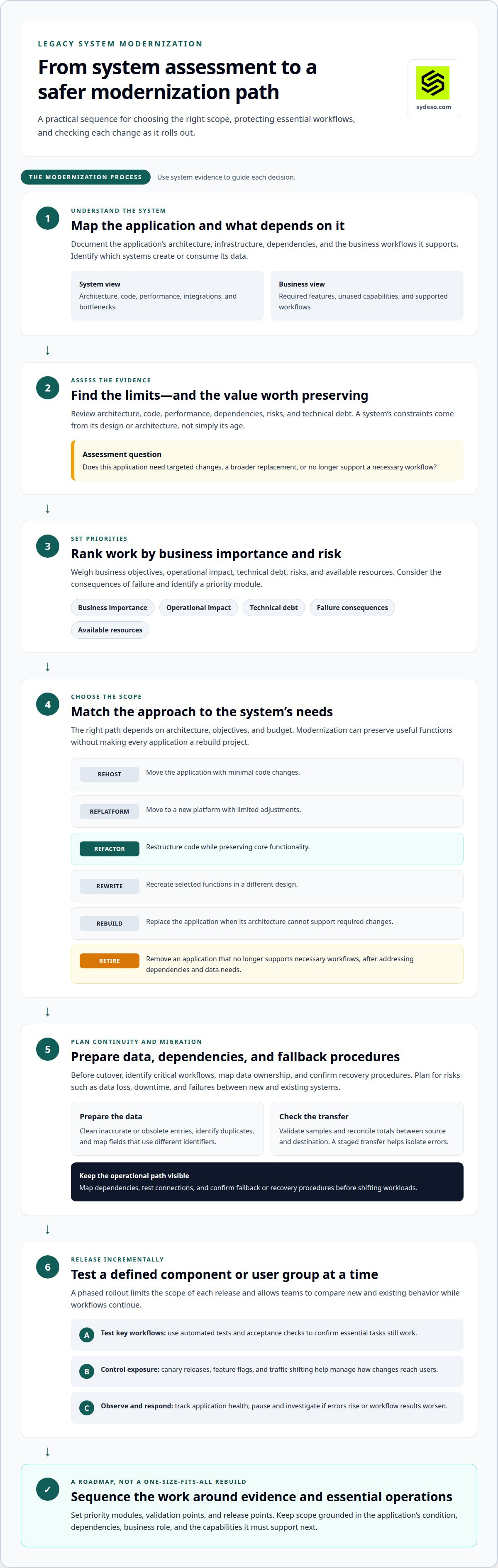
A legacy application is identified by constraints in its architecture or design, not simply its age. It may be difficult to maintain, integrate with newer systems, or adapt to changing workflows. A portfolio assessment maps applications, dependencies, infrastructure, and business roles. This helps establish whether a system needs targeted changes or broader replacement, based on its operational value and technical limits.
Modernization Approaches
Rehosting moves an application with minimal code changes; replatforming moves it to a new platform with limited adjustments. Refactoring restructures code while preserving core functionality, while rebuilding replaces the application. The right scope depends on architecture, objectives, and budget. A sound provider plan should document these options, dependencies, testing, and continuity measures. Cost depends on scope, system complexity, data, and integrations; pricing is determined for the case after a quote request.
Portfolio Assessment and Roadmaps
An assessment reviews architecture, code, performance, dependencies, risks, and the workflows each application supports. Teams can then rank systems by business importance, technical debt, and the consequences of failure. A roadmap sequences the work, identifies a priority module, and sets validation and release points. Healthcare and banking and financial services are sectors where legacy modernization is relevant. Assessment findings and delivery scope shape project effort and timing.
Rebuilding, Rewriting, and Retiring Applications
Rebuilding replaces an application when its architecture cannot support required changes; rewriting recreates selected functions in a different design. Retirement removes an application that no longer supports necessary workflows, after addressing its dependencies and data needs. For example, a team might replace a tightly coupled application, rewrite a critical module, and retire a duplicate tool. These choices avoid unnecessary migration while keeping essential operations in view.
Modernization risks, including data migration and business continuity
Modernization can expose data, integration, and availability problems during development and deployment. An incremental plan gives teams checkpoints to test changes while operational workflows continue.
Migration and Business Continuity Risks
Migration risks include data loss, downtime, and failures between a new application and existing infrastructure. These can interrupt work or leave teams relying on incomplete information. Before cutover, a continuity plan should identify critical workflows, dependencies, and fallback procedures. Teams should also map data ownership and confirm which systems create or consume each record.
Data cleansing removes inaccurate or obsolete entries before transfer; deduplication identifies repeated records. Teams can validate samples and reconcile totals between the source and destination. For example, customer records may use different identifiers across two applications. Mapping those fields before migration helps prevent split or duplicated records. A staged transfer also makes errors easier to isolate before they affect more users.
Incremental Migration and Rollout
Incremental migration moves a defined application component or user group at a time. This limits the scope of each release and lets teams compare new and existing behavior. Automated tests can cover key workflows, while acceptance checks confirm users can complete essential tasks. Observability tracks application health over time and helps teams identify errors and performance changes.
Canary releases, feature flags, and traffic shifting let teams control how a change reaches users. Teams can monitor a small release before broader deployment. If error rates rise or workflow results worsen, they can pause the rollout and investigate. Continuous integration and continuous delivery help make updates repeatable, but still depend on useful tests and clear release ownership.
Infrastructure and AI-Assisted Migration
Infrastructure modernization changes the environment that supports an application, such as its hosting platform or deployment process. Moving outdated infrastructure can introduce configuration differences, network dependencies, and integration failures. Before shifting operational workloads, teams should map dependencies, test connections, and confirm recovery procedures. Containerization can package application code with its libraries and dependencies in a portable unit.
AI-assisted code analysis can surface patterns in a large codebase, such as repeated logic or possible dependencies. This can guide migration planning, but it does not replace engineering review. Teams must validate findings against application behavior, data flows, and business rules. Automation can support repeatable checks; developers remain responsible for assessing whether migrated code preserves required workflows.
Assessment, prioritization, and implementation steps
A modernization assessment turns system evidence into a strategy and an ordered delivery plan. It connects technical findings to business priorities, security needs, and the work required to keep applications running.
Modernization Assessment and Strategy
An assessment examines architecture, code, performance, dependencies, bottlenecks, and technical debt. Technology analysis, architecture audits, code reviews, and performance testing reveal how the existing system behaves. The review also identifies which features remain necessary, which are unused, and which capabilities the organization needs next. This evidence matters because strategy should reflect the system’s current state, budget constraints, and business objectives, not a preferred technology alone.
Prioritizing Implementation Steps
Prioritization ranks candidate changes by business value, operational impact, delivery effort, and implementation risk. A team might first address a fragile interface that blocks essential workflows, then schedule lower-impact reporting changes. The roadmap assigns owners, dependencies, validation criteria, and release points to each stage. Teams can start with a high-priority module, confirm its performance, and use the findings to refine later work. This makes trade-offs visible before development starts.
Risk, Security, and Compliance
Risk assessment identifies threats to data, access, integrations, and service availability before changes reach production. Security review should inform architecture and design, not arrive only before deployment. Teams document sensitive data flows, access controls, failure points, and recovery needs. They also map applicable compliance obligations to system functions and data handling. After release, continuous monitoring tracks application health and security signals, helping teams investigate changes and adjust controls as the system evolves.
A practical implementation plan links each release to a business outcome, a test, and an accountable owner. For example, a customer-facing module can have acceptance checks for its core workflow, data accuracy, and integration behavior. The organization can review results before expanding the change. Clear decision points help teams pause, revise, or proceed based on observed performance rather than assumptions about the existing system.
Definition and scope of legacy modernization
Legacy modernization changes software, infrastructure, or both to support current business needs. “Legacy” describes constraints in design or architecture, not a system’s age. Scope can range from moving an application to cloud infrastructure with minimal code changes to restructuring its components or replacing it. The distinction matters: cloud migration changes where software runs, while application modernization may also change how it works.
An organization can modernize one application, a connected group of systems, or the infrastructure beneath them. For example, a warehouse application might keep its existing workflows while moving platforms, then add API integration to connect inventory data with newer tools. A broader transformation could also address technical debt, outdated code, and deployment processes. Defining boundaries first helps separate essential changes from unrelated upgrades.
The chosen scope should match the problem. If an application’s core functions remain useful, refactoring or replatforming may preserve them while addressing specific constraints. If its architecture blocks required changes, a rebuild may be more suitable. Standardized workflows with no competitive advantage may fit commercial software instead. Each path affects integration work, data handling, testing, and the responsibilities of the teams maintaining the system.
Modernization also changes how engineering capacity is used. Strategic work can shift up to 40% of engineering capacity from legacy troubleshooting toward product innovation. That is a potential direction, not a project result to assume. A roadmap should connect each proposed change to a documented business need, such as reducing duplicate entry between systems or making a critical workflow easier to maintain.
Set the scope in practical terms: name the applications and infrastructure involved, the workflows that must continue, the integrations that must remain, and the desired operational changes. This gives leaders a basis for comparing targeted updates with wider transformation. To discuss a defined modernization scope, plan a legacy modernization assessment.
Sydeso: Legacy modernization
Sydeso supports organizations modernizing applications while keeping the workflows they serve in view. Turn to Sydeso when an assessment points to code changes, replacement components, or integration work that needs a defined delivery plan.
Legacy modernization can address an application and its dependencies in stages. When existing tools no longer support operations, custom software development or internal tools development can provide a tailored path. For a new capability that needs validation before broader rollout, MVP development can help define and test its core functions.
The next step is to outline the system’s constraints, required workflows, integrations, and continuity needs. That gives the work a clear scope and establishes what the modernization effort must preserve or change. To discuss your project, contact Sydeso.
Set the Next Modernization Decision
Make the next move a decision with a clear owner, scope, and operational purpose. Identify the application or workflow that needs attention first, then define what must remain stable during the change. This gives technical and business teams a shared starting point for delivery planning.
The right legacy system modernization services should fit the work ahead, not force every system into the same approach. Sydeso supports this work through legacy modernization, custom software development, internal tools development, and MVP development. Discuss which capabilities need to change and which existing workflows must keep working to define a practical next step.
Discuss modernization with Sydeso and outline the system, its constraints, and the outcome your team needs. A defined starting point makes the next decision easier to own and act on.
Frequently Asked Questions
How do I know if my software needs modernization?
Modernization may be worth assessing if routine changes take longer, integrations require manual work, or failures disrupt important tasks. For example, if staff export data from one application and re-enter it elsewhere, the software may be creating avoidable operational friction. Compare recurring problems with the business cost of maintaining the current process, then identify the system or workflow causing the greatest impact.
What are legacy applications?
Legacy applications are business programs that remain in use but no longer fit current technical or operational needs well. A payroll tool may still handle essential calculations, yet require a specialist to maintain it or lack a practical connection to newer finance software. The term describes an application’s constraints and role in the business, not a specific programming language or age.
What does application re-engineering involve?
Application re-engineering examines how an existing program works, then changes its structure or selected components to meet current needs. The work can include documenting business rules, removing unused functions, reorganizing code, and rebuilding a module while preserving required behavior. For example, a team might retain an established approval process while replacing the part that makes reporting difficult to change.
What are legacy system modernization services?
Legacy system modernization services help organizations change or replace software and supporting technology that no longer serves their needs effectively. The scope may include reviewing an application, updating its architecture, improving integrations, or moving it to a different platform. Sydeso provides legacy modernization for businesses updating existing systems while keeping required workflows in view.
What types of legacy modernization services are available?
Common approaches include rehosting, replatforming, refactoring, rearchitecting, rebuilding, and retiring applications that no longer serve a needed function. They differ in how much of the existing system changes. A team might rehost an application to change its operating environment, refactor code to improve maintainability, or replace a component that blocks a required business capability.
What are the steps in a legacy system modernization project?
A project typically moves from discovery to a defined scope, implementation, testing, and operational handover. This sequence keeps business needs connected to technical decisions.
- Document system purpose, users, dependencies, and pain points.
- Set priorities, scope, ownership, and success criteria.
- Choose an approach and plan data and integration work.
- Implement changes, test critical workflows, then release and monitor.
Questions
- How do I know if my software needs modernization?
- Modernization may be worth assessing if routine changes take longer, integrations require manual work, or failures disrupt important tasks. For example, if staff export data from one application and re-enter it elsewhere, the software may be creating avoidable operational friction. Compare recurring problems with the business cost of maintaining the current process, then identify the system or workflow causing the greatest impact.
- What are legacy applications?
- Legacy applications are business programs that remain in use but no longer fit current technical or operational needs well. A payroll tool may still handle essential calculations, yet require a specialist to maintain it or lack a practical connection to newer finance software. The term describes an application’s constraints and role in the business, not a specific programming language or age.
- What does application re-engineering involve?
- Application re-engineering examines how an existing program works, then changes its structure or selected components to meet current needs. The work can include documenting business rules, removing unused functions, reorganizing code, and rebuilding a module while preserving required behavior. For example, a team might retain an established approval process while replacing the part that makes reporting difficult to change.
- What are legacy system modernization services?
- Legacy system modernization services help organizations change or replace software and supporting technology that no longer serves their needs effectively. The scope may include reviewing an application, updating its architecture, improving integrations, or moving it to a different platform. Sydeso provides legacy modernization for businesses updating existing systems while keeping required workflows in view.
- What types of legacy modernization services are available?
- Common approaches include rehosting, replatforming, refactoring, rearchitecting, rebuilding, and retiring applications that no longer serve a needed function. They differ in how much of the existing system changes. A team might rehost an application to change its operating environment, refactor code to improve maintainability, or replace a component that blocks a required business capability.
- What are the steps in a legacy system modernization project?
- A project typically moves from discovery to a defined scope, implementation, testing, and operational handover. This sequence keeps business needs connected to technical decisions.