Minimum Viable Product Development: Balancing Value, Usability and Fit
Master minimum viable product development by balancing value, usability, and technical fit. Learn how to launch focused MVPs that validate real user demand.

A useful MVP is not a half-built interface. It’s a working product with only the core features needed to solve a real customer problem and gather feedback. Minimum viable product development balances customer value, usability, and technical feasibility, helping a team test an idea before expanding it.
Keeping the first release focused helps a team learn without building every feature on its wish list. But even a small product needs to work well enough for people to complete a real task and give meaningful feedback.
This article explains what an MVP is and how to balance value, usability, feasibility, and feedback, with examples to guide product decisions. It also covers how AI tools can support customer and market research, and where they may help during development. The aim is to clarify what belongs in an MVP, what can wait, and what evidence should guide the next iteration.
Key Takeaways
- Keep an MVP focused on the core customer problem, with enough functionality for users to complete a real task.
- Use examples such as Airbnb’s early test to see how a small experiment can validate demand before broader development.
- Weigh customer value, usability, technical feasibility, and implementation effort when deciding what belongs in the first release.
- Use AI to support customer and market research, then test its findings against real user feedback.
- Let evidence from early users guide what to improve, add, or leave out next.
Table of Contents
- What is a minimum viable product (MVP)?
- What are some examples of MVPs?
- MVP value, usability, feasibility, and feedback
- Airbnb MVP example
- AI tools for MVP research and development
- Sydeso: Custom software development
What is a minimum viable product (MVP)?
A minimum viable product is a working version with the essential features customers need. It tests a product idea with real users before a team expands its scope.
MVP Definition and Purpose
An MVP is a functional product that solves a core customer problem and helps a team learn from early users. Customer responses can guide decisions before a company invests in a broader product. For example, a booking MVP might let customers find an available appointment and reserve it, while postponing reminders and loyalty features.
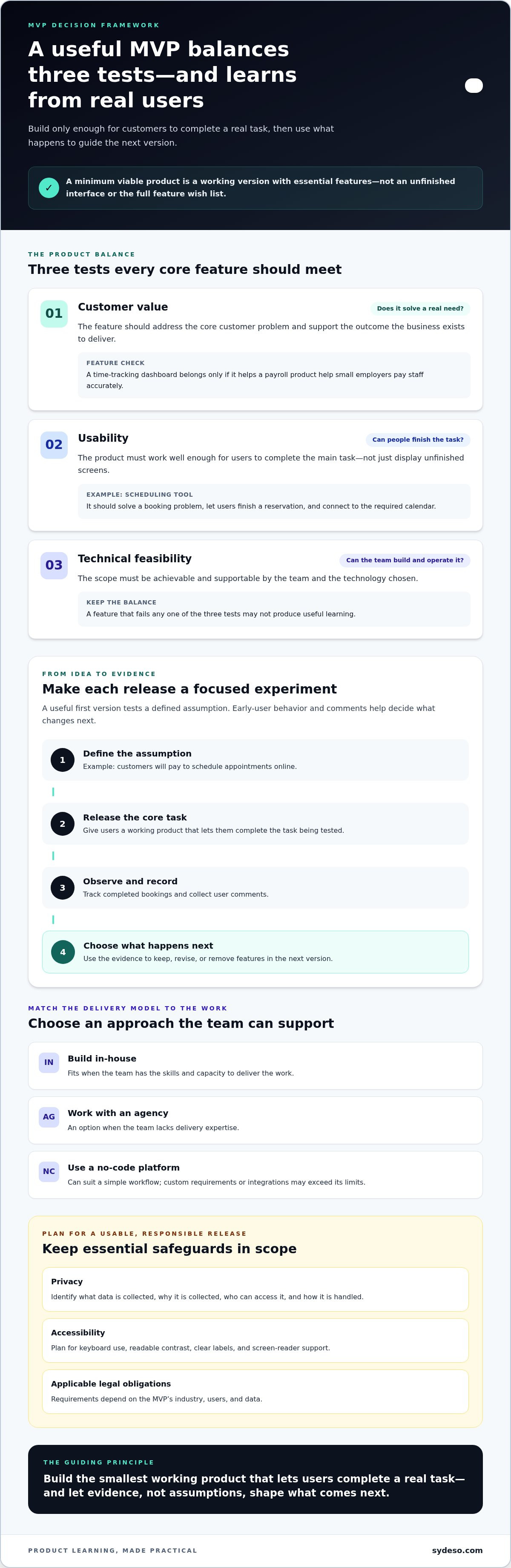
Start by defining the company’s mission in practical terms: who the business serves, which problem it addresses, and what outcome it supports. A payroll product, for example, might help small employers pay staff accurately. Use that mission to assess feature ideas: a time-tracking dashboard belongs only if it helps deliver that outcome.
Frank Robinson coined and defined the term minimum viable product in 2001. The concept gained popularity in 2009, after Eric Ries described it in The Lean Startup. In the lean startup approach, a first version acts as an experiment. A team releases it to early adopters, observes their behavior, and uses the results to decide what to change.
Core Features and Product Backlog
An MVP backlog is an ordered record of product work, with essential customer tasks ahead of optional improvements. Define the customer need each feature serves, then prioritize work against the company’s strategic goal. A U.S. MVP must account for applicable legal obligations, which depend on its industry, users, and data. Privacy planning should identify what data is collected, why, who can access it, and how it is handled. Accessibility planning should address keyboard use, readable contrast, labels, and screen-reader support.
For feature decisions, map the customer’s main task from start to finish. A meal-ordering MVP needs a menu, order placement, and confirmation; restaurant ratings can wait if they don’t help complete the transaction. Record postponed ideas in the backlog instead of adding them to the first release. This keeps the experiment focused and connects feedback to product choices.
Minimum viable product development works best when each release tests a defined assumption. If the assumption is that customers will pay to schedule appointments online, track completed bookings and user comments. A working product should let customers complete that task, not just display unfinished screens. The evidence helps the team keep, revise, or remove features in the next version.
What are some examples of MVPs?
MVP examples show how a business can test demand with focused functionality. A first version might support one customer task, one user group, or one sales channel. This narrow launch helps a growing business identify what is necessary before expanding the product. The goal is learning, not presenting every planned feature at once.
A focused first release can help a business test demand before expanding its product range. For its beta website, Jeff Bezos asked 300 friends and colleagues to test the site, which sold only books. That limited offer gave the team a practical way to test online book buying. The business could learn from a real storefront before adding other product categories.
That example illustrates a benefit for growing businesses: an MVP can test a specific assumption before a larger commitment. A team might test whether customers will place orders online, complete a booking, or use a new internal workflow. If users struggle to complete the main task, the team can revise the process before extending the product.
The potential benefit is more than a smaller first release. It is clearer evidence about customer needs and product functionality. A focused experiment can also reveal an assumption that needs changing before it shapes months of further work.
Consider a growing food supplier moving orders from email to a digital platform. Its first release could let existing customers view available products and submit an order. The team could observe where customers pause, what information they need, and whether staff can process the orders. Delivery tracking and account analytics could stay in the backlog until the core order flow works.
For a growing company, a useful MVP also provides a basis for deciding what comes next. Feedback can reveal features that remove genuine obstacles, while usage patterns can show which parts customers ignore. The team can then prioritize improvements around observed needs, making expansion a response to evidence rather than assumptions.
In the United States, the price depends on the case and is given after a quote request. Scope, required functionality, integrations, and testing affect the work involved.
When an idea needs a working first release, MVP development support can help define its scope and build the initial product.
MVP value, usability, feasibility, and feedback
A useful MVP balances customer benefit with a usable experience and a product the team can support. Testing with early users then turns the concept into evidence for improvement.
Value, Usability, and Feasibility
Value means the product addresses a customer need; usability means people can complete the task; feasibility means the team can build and operate it. Each matters: a product that fails one test may not produce useful learning. For example, a scheduling tool should solve a real booking problem, let users finish a reservation, and connect to the required calendar.
Choose a delivery model that fits the work. Build in-house when the team has the skills and capacity; work with an agency when it lacks delivery expertise. A no-code platform can suit a simple workflow, but custom requirements or integrations may exceed its limits.
Agile Discovery and Feedback Loops
Agile discovery is a repeated cycle of examining assumptions, testing a small change, and using the results to set the next improvement. This helps teams adjust direction before untested features accumulate. For example, a support portal team can observe a user searching for an answer, simplify its categories, and test whether the revised flow helps.
There is no single build duration for every MVP. Scope, integrations, technical feasibility, and time for decisions and testing shape the schedule. A narrow product with one complete user task requires different work from a product with several user roles and connected systems.
Early Adopters and Customer Feedback
Early adopters are users who try an MVP and share feedback about its function, usability, and value. A limited release helps a team collect feedback in a manageable setting. For a booking product, user testing can reveal confusing steps, while analytics show where people leave before confirming an appointment.
Use more than one signal. Surveys capture what users say concerns them; task testing shows what they actually do. Engagement and satisfaction measures can help distinguish a one-off complaint from a recurring obstacle.
Building from User Feedback
Building from feedback means converting observed user needs into specific backlog changes, then checking whether those changes improve the experience. This matters because individual requests may conflict with the product’s main purpose. If several users struggle to find an order, improve search before adding a feature requested by one person.
After each release, compare user behavior and comments with the original assumption. Keep changes that help customers complete the core task, revise those that create friction, and defer unrelated additions. This loop supports validated learning, one of the five principles of the Lean Startup method. Teams repeat it until they reach product-market fit or decide the concept is not viable.
Airbnb MVP example
Airbnb’s early test focused on one problem: finding short-term lodging during a busy event. Its founders tested demand by renting out air mattresses in their San Francisco apartment during a conference. The experiment let them observe whether visitors would accept the arrangement and pay for a place to stay. The broader lesson is to test the customer need directly before building a platform.
For a startup, this example shows how an MVP can make an assumption observable. The aim was not to prove every part of a future rental service, but to learn whether guests needed an alternative and hosts could provide one. Teams can use the same approach by testing their riskiest assumption through a simple, real interaction.
Amazon offers a different example of focused beginnings. Jeff Bezos founded the company in 1994, and it grew from a small online bookstore to the third-largest enterprise in 20 years. The practical takeaway is that an initial product category can give a business a clear starting point. Expansion follows a distinct purpose, rather than requiring every future category at launch.
Uber’s founders began developing their ride-hailing idea in 2008 after noticing how difficult it was to hail a cab in a big city. Steve Blank described an Uber ride in late 2011 as reaching its “aha moment” in about two minutes. These details illustrate how a direct service experience can reveal whether a concept solves a problem. Teams can look for the point when users understand the core benefit.
Dropbox offers a useful hypothetical example of narrowing a product test. A first version could focus on uploading a file and accessing it from another device. That would test the central value of file access without requiring a full suite of sharing and administration features. One possible signal is whether users return to retrieve files after uploading them.
A Spotify-style MVP could test whether listeners value a simple way to find and play music. A Foursquare-style test could focus on checking in at a venue and discovering nearby places. These are illustrative product scopes, not claims about each company’s historical first release. Each isolates a central user action for testing.
Across Airbnb, Amazon, Uber, Dropbox, Spotify, and Foursquare, the examples point to the same discipline: connect one customer problem to a testable product action. Define the learning goal first, then choose the smallest release that can produce useful evidence. If early results challenge the concept, revise the product before expanding its functionality.
AI tools for MVP research and development
AI can support MVP research by organizing market signals, customer preferences, and competitor activity across large datasets. Teams can use those patterns to form a focused concept, then test it with target users. For example, if research points to missed appointment reminders, a team can validate the problem through customer interviews before defining the product work.
Start with a specific research task. An AI tool can group interview notes by recurring pain point, summarize support conversations, or identify questions customers ask repeatedly. These outputs can help teams gather evidence with less manual effort, but they don’t establish demand on their own. Patterns in existing data still need validation with the people the product aims to serve.
AI can also inform early interface decisions. Analysis of customer interactions may reveal where users hesitate or which information they seek first. A team designing a returns portal, for instance, could use those findings to make return status easier to locate. Prototype testing with actual users can then show whether the change works.
During development, AI can assist with routine tasks such as data entry, customer service, and some marketing activities. For an MVP, a team might use an AI agent to sort incoming feedback into themes. A person should review the categories and decide what deserves action, keeping the focus on product decisions rather than simply producing more output.
Use AI outputs as inputs to a decision process, not as product requirements. A practical review can ask:
- Which customer problem does this finding describe?
- What evidence supports the pattern, and which users does it represent?
- What small test could confirm or challenge the assumption?
- Would acting on the result improve the core task?
For example, an AI summary might suggest users want more account settings. User testing could instead reveal that people can’t complete the main task because a required field is unclear. Fixing that field may deliver more value than adding settings. Compare AI-generated suggestions with observed behavior, direct feedback, and the MVP’s purpose.
Data quality and context shape the usefulness of AI analysis. Incomplete records can hide a customer segment, while a broad prompt can produce findings too general to guide a release. Define the question, use relevant input, and review the result before it affects scope. Track whether any resulting change improves task completion or user satisfaction.
AI can help teams research and build an MVP, but customer evidence must guide product decisions. For teams applying AI to product workflows, explore AI agent development as part of a focused product plan.
Sydeso: Custom software development
Sydeso develops custom software and MVPs for businesses that need to test a product idea or address a specific operational need. If customer feedback has clarified the core workflow, but your team lacks the capacity or technical skills to build it, MVP development can turn that scope into a working product.
For internal processes, Sydeso builds internal tools for workflows that don’t fit a standard product. Its launch and support services help teams take the work beyond development, with ongoing monitoring, fixes, and new features billed separately. To get started, define the customer problem, essential user task, and evidence the first release should collect. A free, non-binding video consultation is the next step toward a written estimate.
To discuss your product or software needs, contact Sydeso.
Set the Next Release Around What You Learn
The first release should support a decision, not just deliver a product. Use what the team learns to choose the next move: improve the core workflow, extend the product, or pause work that no longer supports the business goal. This keeps future investment tied to evidence and customer ownership.
Minimum viable product development provides a structured way to move from a tested concept to a product roadmap. Keep the next scope connected to customer needs, operational constraints, and the outcomes the business intends to support.
Sydeso offers MVP development, custom software development, and internal tools development. These services help teams shape a first product release or address a defined workflow need.
Contact Sydeso about MVP development to discuss the next step for your product. A focused decision today gives your team a practical basis for what comes next.
Frequently Asked Questions
What is the purpose of the MVP?
An MVP helps a team make a product decision using evidence from real use. For example, a clinic considering online intake could test whether patients complete a digital form before adding appointment reminders. The team can review completion, support requests, and user comments to decide whether to revise the form, expand the service, or reconsider the concept. This makes the release a learning tool, not just a smaller product.
MVP development: what, why, and how?
MVP development involves defining, building, and testing a focused product release. It gives a team a way to assess whether a proposed solution fits a customer need. For a home-maintenance service, the first release might let customers submit a repair request and receive confirmation. The team can then assess the request flow, identify missing information, and decide which changes support the next release.
What is an MVP not?
An MVP isn’t a mockup users can’t use, a collection of unfinished screens, or a full product with every planned feature. It is not a shortcut around basic reliability or a substitute for understanding the customer. A delivery service’s first release, for instance, still needs to accept an order and provide usable confirmation. Features unrelated to that complete task can wait.
What is the difference between an MVP and a PoC?
A proof of concept tests whether an idea or technology is feasible; an MVP is a functional product used to test customer response and market demand. For example, a team might use a PoC to test whether a payment connection works. An MVP would let a customer complete a purchase through a usable flow. The distinction matters because technical feasibility alone doesn’t show that customers want the product.
What is the primary goal of an MVP?
The primary goal is to gather evidence that helps the team decide what to do next. That evidence may support continuing, changing direction, or stopping work on an assumption. For example, a team building a service-request portal could examine whether users submit requests without staff assistance. If customers repeatedly need help at the same step, that points to a specific design or process change.
What is a minimum viable product in product development?
In product development, an MVP is a usable release built around a complete customer task and a learning objective. Before choosing implementation work, define the intended user, the task, and the evidence needed. For a returns process, that might mean submitting a return and receiving clear next steps. The product team can assess both the customer journey and the work required to process each request.
What are the key steps to develop an MVP?
Begin by defining the target user and the problem. Then set the learning objective, map the main user journey, and choose the smallest scope that supports it. Build and test the release before showing it to intended users. After launch, compare behavior and direct feedback with the original objective. For a service portal, measure whether users submit complete requests and where they need staff assistance.
What tools and technologies are commonly used for MVP development?
Teams commonly use design and prototyping tools, programming frameworks, databases, cloud hosting, testing systems, and analytics. The right stack depends on the product’s user tasks, data needs, integrations, and operating conditions. A simple information portal may need a different foundation from a marketplace that processes orders. Choose tools that support the required release and make testing, maintenance, and later changes manageable.
Questions
- What is the purpose of the MVP?
- An MVP helps a team make a product decision using evidence from real use. For example, a clinic considering online intake could test whether patients complete a digital form before adding appointment reminders. The team can review completion, support requests, and user comments to decide whether to revise the form, expand the service, or reconsider the concept. This makes the release a learning tool, not just a smaller product.
- MVP development: what, why, and how?
- MVP development involves defining, building, and testing a focused product release. It gives a team a way to assess whether a proposed solution fits a customer need. For a home-maintenance service, the first release might let customers submit a repair request and receive confirmation. The team can then assess the request flow, identify missing information, and decide which changes support the next release.
- What is an MVP not?
- An MVP isn’t a mockup users can’t use, a collection of unfinished screens, or a full product with every planned feature. It is not a shortcut around basic reliability or a substitute for understanding the customer. A delivery service’s first release, for instance, still needs to accept an order and provide usable confirmation. Features unrelated to that complete task can wait.
- What is the difference between an MVP and a PoC?
- A proof of concept tests whether an idea or technology is feasible; an MVP is a functional product used to test customer response and market demand. For example, a team might use a PoC to test whether a payment connection works. An MVP would let a customer complete a purchase through a usable flow. The distinction matters because technical feasibility alone doesn’t show that customers want the product.
- What is the primary goal of an MVP?
- The primary goal is to gather evidence that helps the team decide what to do next. That evidence may support continuing, changing direction, or stopping work on an assumption. For example, a team building a service-request portal could examine whether users submit requests without staff assistance. If customers repeatedly need help at the same step, that points to a specific design or process change.
- What is a minimum viable product in product development?
- In product development, an MVP is a usable release built around a complete customer task and a learning objective. Before choosing implementation work, define the intended user, the task, and the evidence needed. For a returns process, that might mean submitting a return and receiving clear next steps. The product team can assess both the customer journey and the work required to process each request.
- What are the key steps to develop an MVP?
- Begin by defining the target user and the problem. Then set the learning objective, map the main user journey, and choose the smallest scope that supports it. Build and test the release before showing it to intended users. After launch, compare behavior and direct feedback with the original objective. For a service portal, measure whether users submit complete requests and where they need staff assistance.
- What tools and technologies are commonly used for MVP development?
- Teams commonly use design and prototyping tools, programming frameworks, databases, cloud hosting, testing systems, and analytics. The right stack depends on the product’s user tasks, data needs, integrations, and operating conditions. A simple information portal may need a different foundation from a marketplace that processes orders. Choose tools that support the required release and make testing, maintenance, and later changes manageable.