Red Flags When Hiring a Software Agency That Can Cost You
Spot red flags when hiring a software agency, from vague quotes to unclear code ownership. Learn how to verify references, AI review, and delivery quality.

A polished proposal isn’t proof of a sound delivery process. The clearest red flags when hiring a software agency include vague estimates, unclear code ownership, weak references, and no explanation of how AI-generated code is reviewed. A strong agency can explain its approach, show how progress is reviewed, and clarify who is responsible for defects.
A low quote can look efficient, but the scope behind it matters more than the headline figure. Expect clear acceptance criteria, a defensible estimate, and written terms for ownership and scope changes. The same standard applies to AI: understand how its output is reviewed before it enters your codebase.
This guide explains how to assess quotes, AI use, source-code access, client references, and signs of a disciplined partner. Use these practical checks to distinguish a clear delivery plan from promises that leave important decisions unresolved.
Key Takeaways
- Assess a quote by reviewing its assumptions, timeline, and acceptance criteria, not just its total.
- Set clear ownership of the code and project accounts so access remains under your control.
- Use recent client references and completed work to understand how an agency delivers and communicates.
- Look for a team that explains AI review, shows working progress, and takes responsibility for quality.
Table of Contents
- 1. Why is a very low quote a warning sign?
- 2. Intellectual property ownership and source-code access
- 3. Client references and portfolio verification
- 4. Green flags in a software agency
- Sydeso: Custom software development
1. Why is a very low quote a warning sign?
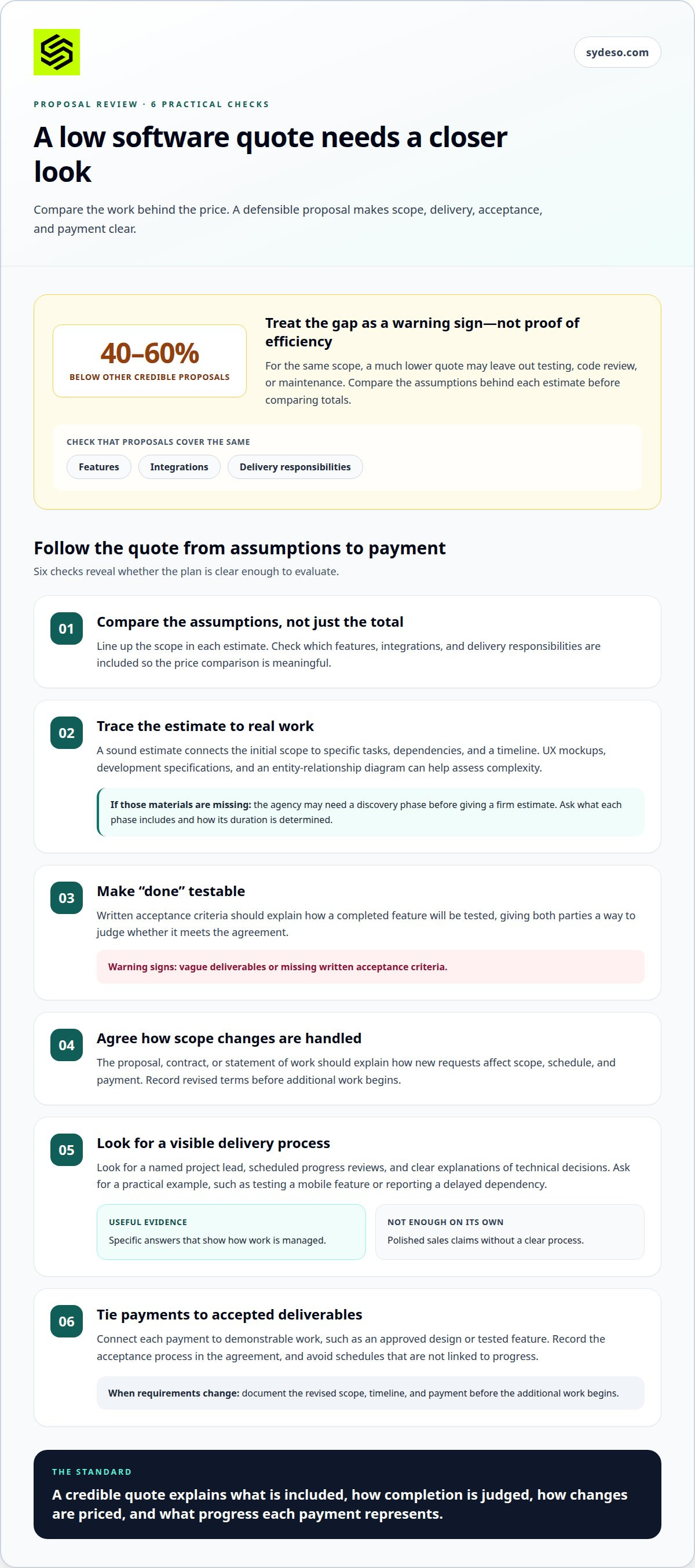
A quote 40-60% below other credible proposals for the same scope is a warning sign. The difference may reflect omitted work, such as testing, code review, or maintenance, rather than a more efficient development process. Compare the assumptions behind each estimate, including features, integrations, and delivery responsibilities.
A sound estimate connects the initial scope to specific tasks, dependencies, and a timeline. UX mockups, development specifications, and an entity-relationship diagram can help an agency assess complexity. If these materials are missing, the agency may need a discovery phase before providing a firm estimate. Ask what each phase includes and how its duration is determined.
Watch for vague deliverables, missing written acceptance criteria, and no process for scope changes in a proposal, contract, or statement of work. Acceptance criteria should explain how a completed feature will be tested, so both parties can judge whether it meets the agreement. A change procedure should clarify how new requests affect scope, schedule, and payment before work proceeds.
A visible delivery process matters more than sales promises. Look for a named project lead, scheduled progress reviews, and clear explanations of technical decisions. Ask the team to walk through a practical example, such as testing a mobile feature or reporting a delayed dependency. Specific answers show how the agency manages work; polished claims alone do not.
Payment terms work best when tied to defined milestones and accepted deliverables. Connect each payment to demonstrable work, such as an approved design or tested feature, and record the acceptance process in the agreement. Avoid payment schedules that aren’t linked to progress. If requirements change, document the revised scope, timeline, and payment before the additional work begins.
2. Intellectual property ownership and source-code access
Establish control before development starts, not after a disagreement. Set up the code repository under your organization and invite the agency to contribute. This gives you ongoing access to working files, commit history, and build instructions. If access begins only at handover, a change in the relationship can disrupt the project.
Put ownership terms in the agreement before signing. Specify who owns the custom code after delivery, and distinguish it from third-party libraries, tools, or other components with separate license terms. The agreement should also address project documentation, design files, and deployment instructions. A clause that refers only to “the software” may leave important materials undefined.
Keep operating accounts in your organization’s name, including hosting, domain, and app store accounts. For a mobile app, hold the Apple Developer and Google Play accounts under your organization, then grant the agency the access it needs. If the agency owns those accounts, transferring access later can become a separate project.
Set clear boundaries for data, too. Specify who controls project data, who can access it during development, and how access ends when the work concludes. A handover plan, for example, can document how to export business data and remove agency credentials. These steps help preserve control over both the application and the information it uses.
A practical ownership check covers the repository, accounts, contract, and handover documents. Confirm that repository access works, credentials are stored securely, and the documentation explains how to build and deploy the application. For a native mobile app, include the release process and the organization accounts used to publish it. If an agency resists these arrangements, treat that as a red flag. For custom software development, make access and ownership part of the project setup, not a final delivery task.
3. Client references and portfolio verification
Request two or three references from completed projects, including at least two clients from the last year. Recent customers can describe how the agency handled delivery, communication, and changes after signing. Ask each reference to discuss one concrete feature, such as a payment workflow or reporting tool, and whether it worked as agreed. A reference limited to praise offers little insight into the agency’s actual process.
Use the same short set of questions for each call. Ask what the agency delivered, how it handled missed expectations, and whether the final work matched the contract. Clarify who managed the project and whether the reference would hire the same team again. Differences between answers may reveal warning signs, such as unclear accountability or repeated handoffs that weren’t apparent during sales discussions.
A portfolio should show products you can examine, not just screenshots and logos. Ask for a live product or walkthrough, then inspect the parts relevant to your project. For a customer portal, review its main user flow; for an internal tool, see how a routine task moves through the system. Ask the agency to identify exactly what it built and what work came from others.
Relevance matters more than visual similarity. Experience with a comparable workflow may help an agency understand the data, integrations, and user roles your project needs. Ask how the example’s requirements differed from yours and which technical decisions changed as a result. If the agency can’t explain its own work, treat that as a warning sign.
Before signing, compare portfolio claims with the proposed team and contract. Confirm that the people who built a cited product will work on your project, and clarify any third-party components or license terms that affect reuse. A money-back guarantee doesn’t replace a clear development process or a track record you can discuss with clients. References and verifiable work provide stronger evidence than a sales presentation alone.
4. Green flags in a software agency
A credible software development agency uses the opening stage to understand the business before choosing tools. Business analysis may take one to two weeks before technology decisions are made. During that conversation, the team should map user needs, existing workflows, and constraints. An honest assessment also identifies unresolved decisions that could change the design.
Meet the project lead and at least one developer who will build the product. Their answers should connect business needs to practical choices, such as how an automated task will be reviewed or how a user action changes stored data. The U.S. Bureau of Labor Statistics notes that developers and testers need to communicate clearly and explain problems during development. Clear explanations are part of delivery, not an optional courtesy.
Good teams make progress visible through working software and a defined feedback loop. A live, testable application within the first two weeks of development gives both sides something concrete to assess. Regular demonstrations, such as working software every two weeks, let the team show completed behavior and record feedback. If a feature needs revision, the next steps and owner should be clear.
Before work begins, ask how the team handles security, privacy, and compliance for your project. A sound process identifies what data the team can access, how that access is controlled, and how sensitive data is handled in development and testing. The agency should explain which compliance requirements apply to your business, document responsibilities, and describe how it reports security problems.
AI use should come with a review process: the agency explains how generated code is tested and who owns defects before that code enters your repository. If subcontractors contribute, the agency should disclose their role and remain accountable for quality and delivery. Project documentation and a written or rehearsed handover should support continued operation if the engagement ends. Discuss your software development project with a team that makes its process and accountability clear.
Sydeso: Custom software development
Sydeso builds custom software for businesses whose workflows need a tailored solution rather than an off-the-shelf fit. Turn to Sydeso for a new business application, an internal tool, or an MVP that puts a defined product idea into use. Projects can also include deployment, monitoring, and post-launch feature development.
A clear project starts with shared expectations. Define the users, essential features, and decisions the software must support. Sydeso uses that scope to shape development around your business needs, with delivery responsibilities and ownership addressed as part of the project.
If you’re planning a custom software project, contact Sydeso to discuss what you need to build.
Make your next software decision with clear priorities
Use these red flags when hiring a software agency to set clear boundaries for your own project. Write down the business problem, who needs the software, and which decisions the system must support. This gives planning conversations a practical starting point and helps separate essential work from ideas that can wait.
The right development path depends on what you need to put into use. Sydeso develops custom software for tailored business needs, internal tools for team workflows, and MVPs for defined product ideas. Start with the outcome you need, then shape the scope around it. A focused brief makes the first project discussion more useful.
If you’re ready to discuss your requirements and next steps, contact Sydeso about your project. A clear starting point can help you move forward with confidence.
Frequently Asked Questions
What should I ask an agency about how it uses AI?
Ask which tasks use AI, what information enters the tools, and who reviews the output before it affects users. If an AI agent drafts customer responses, for example, clarify whether a person reviews them before they reach a customer and how errors are reported. Also ask how AI-generated code is tested and who is responsible for defects. The answers should describe the actual workflow, not just name the tools.
Are small agencies riskier than large ones?
Agency size alone doesn’t determine project risk. Focus on whether the team has the roles your project needs and whether responsibilities remain clear if someone becomes unavailable. Identify who handles technical decisions, delivery coordination, and product testing. A small team may communicate directly, while a larger one may divide work among specialists. The practical test is whether accountability and continuity are clear.
How do I check an agency instead of trusting the pitch?
Ask the agency to explain a technical decision using a project example, then compare that explanation with what its references describe. You can also request samples of the project materials it will maintain, such as a requirements document or release notes. Check whether those materials connect business goals to completed work. Strong evidence shows how decisions were made, not only what the final product looks like.
Is a very detailed contract enough protection?
No. A contract defines responsibilities, but it can’t replace active oversight during delivery. Assign someone on your side to review demonstrations, record decisions, and raise mismatches while changes are manageable. If a workflow behaves differently from the approved design, for example, document the discrepancy and agree on how to resolve it. The contract provides a framework; regular reviews help keep the work aligned.
Should I always choose the cheapest option?
No. Choose based on the work included and how the agency will deliver it, not the lowest total alone. Compare whether proposals cover deployment, testing, documentation, and ongoing maintenance, then identify any work treated as an extra. A lower initial quote may reflect a narrower scope. If core responsibilities are undefined, the headline price won’t show the full effort required.
What are the red flags when hiring a software development agency?
Common red flags when hiring a software agency include unclear responsibility, evasive answers about AI review, inaccessible project materials, and proposals that omit important delivery work. Treat repeated gaps as more serious than a single awkward answer. If the agency can’t explain who approves a release or how it handles a new request, the project may lack the controls needed for predictable decisions.
Questions
- What should I ask an agency about how it uses AI?
- Ask which tasks use AI, what information enters the tools, and who reviews the output before it affects users. If an AI agent drafts customer responses, for example, clarify whether a person reviews them before they reach a customer and how errors are reported. Also ask how AI-generated code is tested and who is responsible for defects. The answers should describe the actual workflow, not just name the tools.
- Are small agencies riskier than large ones?
- Agency size alone doesn’t determine project risk. Focus on whether the team has the roles your project needs and whether responsibilities remain clear if someone becomes unavailable. Identify who handles technical decisions, delivery coordination, and product testing. A small team may communicate directly, while a larger one may divide work among specialists. The practical test is whether accountability and continuity are clear.
- How do I check an agency instead of trusting the pitch?
- Ask the agency to explain a technical decision using a project example, then compare that explanation with what its references describe. You can also request samples of the project materials it will maintain, such as a requirements document or release notes. Check whether those materials connect business goals to completed work. Strong evidence shows how decisions were made, not only what the final product looks like.
- Is a very detailed contract enough protection?
- No. A contract defines responsibilities, but it can’t replace active oversight during delivery. Assign someone on your side to review demonstrations, record decisions, and raise mismatches while changes are manageable. If a workflow behaves differently from the approved design, for example, document the discrepancy and agree on how to resolve it. The contract provides a framework; regular reviews help keep the work aligned.
- Should I always choose the cheapest option?
- No. Choose based on the work included and how the agency will deliver it, not the lowest total alone. Compare whether proposals cover deployment, testing, documentation, and ongoing maintenance, then identify any work treated as an extra. A lower initial quote may reflect a narrower scope. If core responsibilities are undefined, the headline price won’t show the full effort required.
- What are the red flags when hiring a software development agency?
- Common red flags when hiring a software agency include unclear responsibility, evasive answers about AI review, inaccessible project materials, and proposals that omit important delivery work. Treat repeated gaps as more serious than a single awkward answer. If the agency can’t explain who approves a release or how it handles a new request, the project may lack the controls needed for predictable decisions.